Blog

All In the Community Know the Law Legal News and Product Recalls Legal Options
Bordas and Bordas Attorneys law blog banner featuring the firm logo on a blue background with the text "Law Blog

Out-Of-State Car Accidents: What To Do If You Are Injured

Out-Of-State Car Accidents: What To Do If You Are Injured Road trips and traveling across the states is fun for everyone involved, but unexpected accidents may cause confusion and stress—particularly if someone gets injured. By ensuring you know what to do after an accident, even one that occurs out of state, you can protect yourself and potentially make the legal process easier should you decide to pursue a claim. Call First Responders & Gather Evidence Regardless of where your accident occurs, ensuring everyone at the scene is safe takes precedence. Take a moment to check everyone for injuries and call for emergency help if needed. Some injuries may seem minor at first glance, so it is wise to follow up with a medical professional, as concussions and other soft tissue injuries may not show up immediately. If you can, spend some time collecting evidence of the scene, as this may help you with a future claim. Pictures of the damage to the vehicles, nearby road signs, road conditions, weather, and injuries may be useful later. Take a moment to exchange contact and insurance information with any other drivers involved in the crash, and identify any eyewitnesses and get their contact information. Requesting a physical copy of the police report of the accident—or at least knowing where to get it—may also help your case in the future. Insurance Coverage & Jurisdiction When you are in an accident outside your home state, the laws of the state where the crash happened take precedence. This could potentially impact how fault is determined, the potential compensation for damages, and the statute of limitations on when you can file a case. Some examples of what could differ depending on the state include: Comparative fault laws may reduce damages based on your share of fault No-fault insurance systems may restrict you from suing unless your injuries meet certain requirements Minimum insurance coverage requirements may alter the amount of compensation you can obtain Statutes of limitations for filing may vary Many auto-insurance policies give national coverage to policyholders. Different state laws may impact your policy in unexpected ways, so it could be beneficial to consult with an attorney to familiarize yourself with any difficulties you may encounter. Medical & Travel Expenses If you are injured out of state, certain expenses could pile up, such as follow-up care, transportation, hospital stays, or more. Depending on the nature of your injury, going back to work or even handling daily tasks may be more difficult. If this is the case, you could file a personal injury claim if you have the right documentation. Keeping medical records, bills, travel receipts, and any copies of conversations with your insurer may help provide further details for your case. Speak With a Bordas & Bordas Attorney About Your Out-of-State Accident If you find yourself injured due to a car accident outside of your home state, it is not unusual to feel far from home. Knowing what to do after the crash, and being aware of how a state’s laws could impact your situation, could increase your chances of a successful claim. At Bordas & Bordas, our seasoned team of attorneys has experience dealing with out-of-state accident claims and can help you through the process. Call our office today to discuss your legal rights and options during a free consultation.

Bordas & Bordas Presents 16 High School Seniors with Anti-Bullying Award

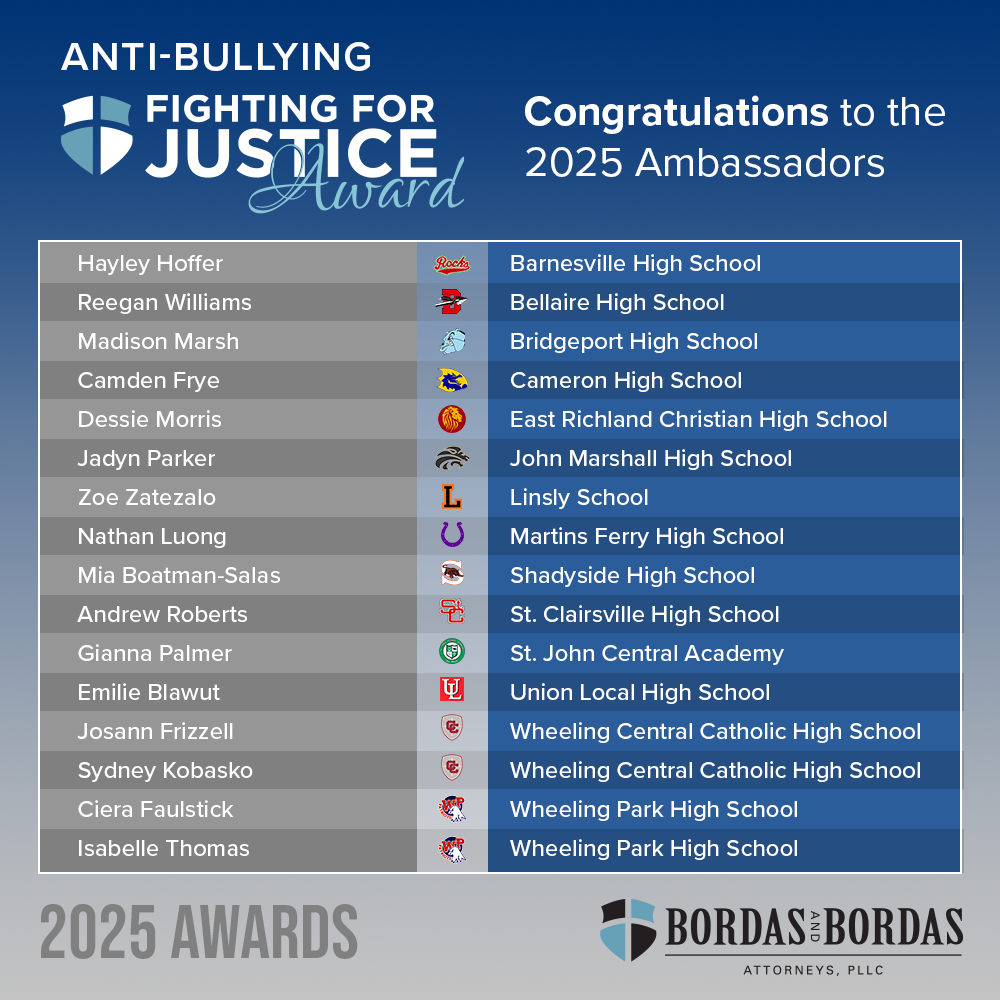
Bordas & Bordas is proud to announce the names of the 16 students from schools in Ohio, Marshall and Belmont counties who are recipients of the Bordas & Bordas Anti-Bullying Fighting for Justice Award. The 2025 award recipients: Hayley Hoffer, Barnesville High School Reegan Williams, Bellaire High School Madison Marsh, Bridgeport High School Camden Frye, Cameron High School Dessie Morris, East Richland Christian High School Jadyn Parker, John Marshall High School Zoe Zatezalo, The Linsly School Nathan Luong, Martins Ferry High School Mia Boatman-Salas, Shadyside High School Andrew Roberts, St. Clairsville High School Gianna Parker, St. John Central Academy Emilie Blawut, Union Local High School Josann Frizzell, Wheeling Central Catholic High School Sydney Kobasko, Wheeling Central Catholic High School Ciera Faulstick, Wheeling Park High School Isabelle Thomas, Wheeling Park High School “Congratulations to the senior students who have been named 2025 Bordas & Bordas Anti-Bullying Ambassadors,” said Managing Partner Jamie Bordas. “Nominations from educators and community members highlighted the significant contributions these young adults have made through their actions and attitudes in both their schools and communities.” The award was created in 2014 by Bordas & Bordas founder Jim Bordas and honors each Anti-Bullying Ambassador with a $500 cash prize. The criteria for students nominated includes treating everyone equally, respecting differences in others, and standing up for those who are targeted by others or are discriminated against. “We are proud to recognize these individuals who serve as positive examples for their peers. We wish the Anti-Bullying Ambassadors and the class of 2025 the best of luck in their future endeavors,” said Bordas. Bordas & Bordas is a plaintiff’s litigation law firm with offices in Pittsburgh, Wheeling, W.Va., St. Clairsville, Ohio, and Moundsville, W.Va. The firm’s attorneys practice throughout the region in diverse areas of law and are licensed in Pennsylvania, West Virginia, Ohio, and Texas.

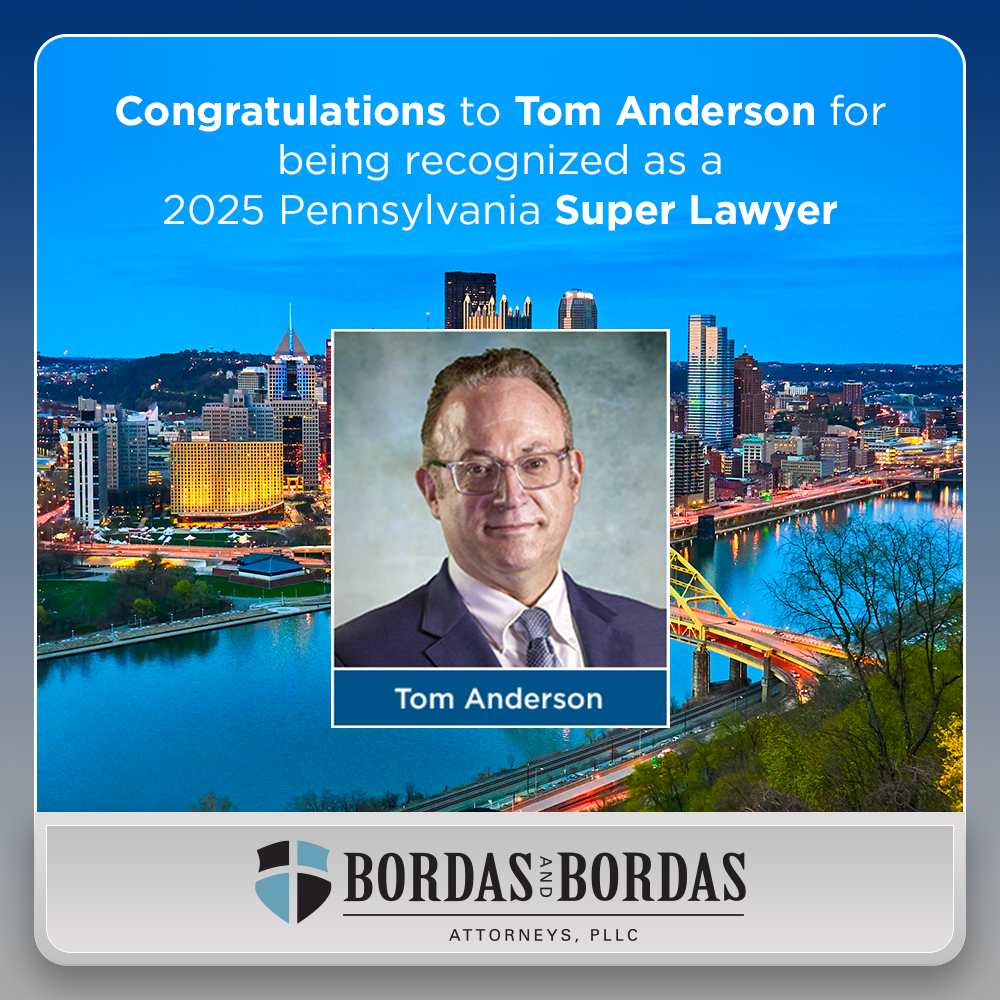
Promotional graphic congratulating Tom Anderson on being recognized as a 2025 Pennsylvania Super Lawyer, featuring his portrait, the Pittsburgh skyline, and the Bordas and Bordas Attorneys logo.

Bordas & Bordas Attorney Tom Anderson named 2025 Pennsylvania Super Lawyer

PITTSBURGH, PA. – Bordas & Bordas is proud to announce that attorney Tom Anderson has been selected to the 2025 Pennsylvania Super Lawyers list. Multi-year Pennsylvania Super Lawyer, Tom Anderson, focuses his practice on helping individuals who have been injured or discriminated against in violation of state and federal laws. Anderson focuses his practice on employment law, personal injury, medical malpractice, premises liability, and commercial law. Anderson has tried many jury trials involving very serious personal injury claims, catastrophic damages, and high exposure employment actions in both state and federal courts. He has obtained seven-figure verdicts and numerous significant settlements. In 2024, a jury in the United States District Court for the Middle District of Pennsylvania returned a verdict of $20,500,000 against American Home Patient/Lincare in a racial discrimination case arising out of its State College, Pennsylvania location. Anderson served as trial counsel for the plaintiff, Patricia Holmes. The 8-person jury awarded Holmes $500,000 in compensatory damages and $20 Million in punitive damages. It found that American Home Patient/Lincare, by and through its employees, including a manager, intentionally discriminated against Ms. Holmes by creating a hostile or abusive work environment because of her race in violation of federal law (Title 42, United States Code, Section 1981.) Super Lawyers, part of Thomson Reuters, is a rating service of outstanding lawyers from more than 70 practice areas who have attained a high degree of peer recognition and professional achievement. The annual selections are made using a patented multiphase process that includes a statewide survey of lawyers, an independent research evaluation of candidates and peer reviews by practice area. The result is a credible, comprehensive and diverse listing of exceptional attorneys. Bordas & Bordas is a plaintiff’s litigation law firm with offices in Pittsburgh, Wheeling, W.Va., St. Clairsville, Ohio, and Moundsville, W.Va. The firm’s attorneys practice throughout the region in diverse areas of law and are licensed in Pennsylvania, West Virginia, Ohio, and Texas.

Bordas and Bordas Attorneys law blog banner featuring the firm logo on a blue background with the text "Law Blog

Nursing Home Abuse: Hold Responsible Parties Accountable for Injured Residents

Nursing Home Abuse: Hold Responsible Parties Accountable for Injured Residents When you place someone in a nursing home, you expect them to receive adequate care and respect. Unfortunately, nursing home abuse is a serious issue across the United States, and injured residents often suffer in silence. If you suspect that your loved one has suffered abuse, you can hold the responsible parties legally accountable. Our nursing home abuse attorneys at Bordas & Bordas could help you understand your legal rights and fight for justice on your behalf. Signs of Abuse Nursing home abuse of vulnerable residents can take many forms, such as emotional, physical, financial, and neglect.  Abuse can result in bruises, weight loss, and other unexplained injuries. Emotional changes, such as fearfulness or withdrawal, may also be indications of abuse and mistreatment. Signs of neglect may include malnutrition, poor hygiene, or missed medications. Possible reasons for the abuse are staff shortages, lack of proper training, or negligence, all of which can create a dangerous environment for the residents. It is not always easy to recognize nursing home abuse, but you know your loved ones better than anyone else. If you notice changes in your loved one’s health or behavior, it is your right to demand answers. When you take action, you can hold the responsible parties accountable and stop the abuse before it gets worse. Legal Protection You and your loved ones have legal protections against nursing home abuse and neglect. Nursing home residents are protected by both federal and state laws and are legally entitled to live in a safe environment. When someone violates those rights, they must be held legally accountable. Whether this includes health care staff or administrators, residents have the legal right to seek justice for their injuries. Documenting injuries, medical records, and staff interactions provides crucial evidence that can be used to support your nursing home abuse claim. We can use this evidence to assess your situation and pursue compensation accordingly. Taking Action Against Negligent Facilities An apology from the responsible party or a promise to change is not enough. If abuse has occurred, you have the legal right to pursue a claim. Filing a lawsuit sends a clear message of your intention to hold abusive parties accountable for their actions and can also help prevent future harm to other vulnerable nursing home residents. The situation can be emotional and overwhelming, which is why you should have guidance from legal professionals who are experienced in dealing with negligent facilities and not afraid to fight for your rights. Call a Nursing Home Abuse Lawyer To Hold Perpetrators Accountable Your loved ones deserve to live in a safe environment. If they have suffered harm due to nursing home abuse, do not stay silent. We can help you hold responsible parties accountable for injuring residents. We will stand by your side and gather crucial evidence to support your claim. Schedule a free consultation today and let us start to fight for the compensation and justice that you deserve.

Bordas and Bordas Attorneys law blog banner featuring the firm logo on a blue background with the text "Law Blog

The Complexities of Multi-Car Accidents

The Complexities of Multi-Car Accidents The complexities of multi-car accidents, also known as chain-reaction crashes or pileups, leave many drivers confused, injured, and uncertain about who is at fault. In contrast to two-vehicle collisions, these accidents involve numerous factors that must be carefully evaluated to determine what exactly occurred. Common Causes of Multi-Car Accidents Multi-car accidents typically occur on congested highways, in construction zones with limited stopping distances, and during inclement weather. In these scenarios, the need to suddenly stop may result in a collision that causes a chain reaction. Various factors could complicate the crash, such as: Speeding Distracted driving Not maintaining a safe following distance The driver who made the initial impact may not be the only individual who is liable. Other drivers may be partially liable if they reacted improperly to the crash, drove aggressively, or broke traffic laws. The complexity of these factors requires an investigation to assess who is responsible for a multi-car collision. Who Is at Fault in Multi-Car Accidents? Police reports, witness statements, closed-circuit television footage, and physical evidence taken from the scene of the accident may help assign fault. In addition to a police investigation, insurance companies may conduct their own evaluations, and in certain cases, accident reconstruction experts could investigate the scene. More than one driver could be responsible for a pileup. Many states follow comparative negligence laws, allowing fault to be divided among multiple drivers. However, some states follow contributory negligence laws, where being slightly at fault may prevent a driver from receiving any compensation. Due to the difference in such laws, it is advisable that legal counsel handle each case. The Challenges of Multi-Car Accident Cases Claims for multi-car accidents are often delayed or denied outright due to disagreements between insurance companies. Drivers frequently attempt to shift blame to others, especially if severe injuries or costly property damage are involved. Furthermore, some drivers may be underinsured or uninsured, making recovery more difficult. Another common challenge is that the harm suffered in a multi-car accident may not be immediately apparent. The effects of an injury may be delayed, and having an incomplete medical history could make connecting an injury to an accident more difficult. As such, it is essential to have significant documentation, including medical records, images of the scene, and witness statements. Information that could support your account of the chain-reaction crash may help resolve any disputes over fault. Legal Advice Could Help Victims of Multi-Car Accidents If you are injured due to a multi-car accident and are wondering about liability, speaking to an experienced attorney may help provide clarity. In the aftermath of an accident, it may be daunting to establish liability, communicate with different insurance companies, and secure fair compensation. Bordas & Bordas Could Help You Navigate the Legal Complexities of a Multi-Car Accident Our team could help you navigate the complexities arising from a multi-car accident and help determine who is at fault to obtain the compensation you may deserve. Start the process today with a free initial consultation.

Law blog banner featuring Bordas and Bordas Attorneys logo alongside attorney Zak Zatezalo's professional headshot.

Igloo Expands Cooler Recall In the Wake of New Injuries

Igloo Expands Cooler Recall In the Wake of New Injuries If you own an Igloo cooler, you may want to give some attention to the Igloo Products Corp. ongoing recall of its 90 Qt Flip & Tow Rolling Coolers. Igloo just expanded that recall to include an additional 130,000 units after receiving additional reports of injuries, including those as serious as fingertip amputations. With this latest expansion. Igloo has now recalled nearly 1.2 million units across the United States, Canada, and Mexico. The issue, according to the recall notice, is that the coolers’ tow handles can pinch users’ fingers against the cooler body, creating fingertip amputation and crushing hazards. Igloo has said that consumers of the recalled 90 Qt Flip & Tow Rolling Coolers should immediately stop using them and contact the company for a free replacement handle. To date, Igloo has fielded some 78 injury reports over these coolers, including 26 cases involving fingertip amputations, bone fractures, and/or serious lacerations. All of the defective coolers were manufactured in the United States by Igloo Products Corp., before January 2024 and all were sold between January 2019 and January 2025 at major retailers including Dick’s, Costco, Target, and Academy and at Amazon.com and Igloocoolers.com. These coolers retailed for between $80 and $140. The latest expansion includes the following additional model numbers: 34692 – Latitude 90 Qt Roller (07/2020–09/2021) 34785 – Latitude 90 Qt Roller (10/2021–12/2022) 34790 – MaxCold Latitude 90 Qt Roller (10/2021–02/2023) If you own an Igloo cooler and want to see if your cooler is included in the recall, check the bottom label for the model number of your cooler on and check the circular stamp near the cooler base for the manufacturing date. All impacted units have tow handles and “IGLOO” printed on the side. To request a replacement handle Igloo cooler owners can contact Igloo toll-free at 888-943-5182 from 8 a.m. to 5 p.m. ET Monday through Friday, email Igloo at: igloo90qt@sedgwick.com, or visit www.igloo90qtrecall.expertinquiry.com. And if you’ve been injured by a defective Igloo cooler, you should contact an experienced law firm right away to explore you claim potential.

Ohio Spoliation of Evidence Law

Ohio Spoliation of Evidence Law In many cases and incidents, evidence gets lost, some innocently, some not. For example, the recording of a black box can be recorded over, as can security camera video that records an incident. The first example is more likely to be intentional; the second could be, but may not as well. The security camera recording of a fall on the property’s premises may be intentionally neglected. However, the security camera recording an event on the owner’s property may be recorded over innocently, if the tape is not timely recovered. This article will identify the standard of proof for the various types of lost evidence and the rights attainable under the same. In Ohio, there are two applicable concepts that are tied to spoliation of evidence. First, there is the intentional spoliation of evidence. Ohio is one of the few jurisdictions that allows for an independent tort claim for intentional spoliation of evidence. Elliott-Thomas v. Smith, 110 N.E.3d 1231, 1233 (Ohio 2018). Ohio law permits claims for intentional spoliation but precludes claims for negligent spoliation. Smith v. Howard Johnson Co., 615 N.E.2d 1037, 1038 (1993). In order to bring an intentional spoliation claim, a party must establish “(1) pending or probable litigation involving the plaintiff, (2) knowledge on the part of defendant that litigation exists or is probable, (3) willful destruction of evidence by defendant designed to disrupt the plaintiff’s case, (4) disruption of plaintiff’s case, and (5) damages proximately caused by the defendant’s acts.” Smith, 615 N.E.2d at 1038. Furthermore, “a plaintiff is under a duty to preserve evidence that it knows or reasonably should know is relevant to the action.” C4 Polymers, Inc. v. Huntington Natl. Bank, 41 N.E.3d 788, 803 (Ohio 2015). A defendant claiming evidence was spoiled by plaintiff must establish: “(1) that the evidence is relevant, (2) that the plaintiff’s expert had an opportunity to examine the unaltered evidence; and (3) that, even though the plaintiff was contemplating litigation against the defendant, the evidence was intentionally or negligently destroyed or altered without providing an opportunity for inspection by the defense.” C4 Polymers, Inc., 41 N.E.3d at 803. In order to prove the client engaged in spoliation of evidence, the defendant would have to establish the three elements outlined in C4 Polymers, Inc. Based on the facts and circumstances surrounding the incident, it would be difficult for the defendant to establish elements two and three. Additionally, Ohio also follows the missing evidence doctrine. “Under Ohio law, ‘the concept of negative, or adverse, inference arises where a party who has control of the evidence in question fails, without satisfactory explanation, to provide the evidence.’ (citation omitted). ‘Ohio courts normally would require a strong showing of malfeasance -- or at least gross neglect -- before approving such a charge.’” O’Brien v. Ed Donnelly Enterprises, Inc., No. 2:04-CV-85, 2006 WL 2583327, at *4 (S.D. Ohio Sept. 5, 2006), objections overruled, No. 2:04 CV 85, 2007 WL 81843 (S.D. Ohio Jan. 8, 2007) (Quoting, Brokamp v. Mercy Hosp. Anderson, 726 N.E.2d 594, 608-09 (1999) (citing Veranardakis v. Thriftway Inc., 1997 Ohio App. LEXIS 1818 (May 7, 1997). Under this theory, Ohio courts will allow an adverse inference to arise when a party in control of evidence fails to provide the particular evidence without a sufficient explanation as to why the evidence is missing. Again, the defendant will have a difficult time proving the client’s actions rose to a level of malfeasance. Given the injuries sustained, it is reasonable that the client did not immediately go to the hospital and attempted to alleviate the pain through a different outlet. Although defendants may argue the client was negligent in not immediately going to the hospital, it will be difficult to establish the client was malicious or grossly negligent. CONCLUSION In sum, Ohio law provides an independent tort claim for intentional spoliation of evidence as well as a missing evidence doctrine that controls the absence of evidence.

Bordas and Bordas Attorneys law blog banner featuring the firm logo on a blue background with the text "Law Blog

Why is it called “the Bar”?

Why is it called “the Bar”? The legal profession is often referred to as “the bar.” While this can be the source of many jokes, many do not know the actual origin of this name for the profession. The term dates back to medieval times, when courtrooms were built with a physical barrier that separated the judge, lawyers, and criminals or parties to the case from the public or others in the courtroom. Modern courtrooms in Europe and the United States generally continue with this tradition, placing a partition or railing between the seating area where the public and press can observe the legal proceedings and the area where the lawyers present the case to the judge and jury. The phrase “passing the bar” is used to describe a future lawyer’s successful completion of all of the requirements to practice law, and specifically, the exam that lawyers must take to establish their qualification to practice. But it quite literally means that the lawyer has earned the right to occupy that space in the courtroom, and is able to move past the physical barrier that sets lawyers apart from spectators in the courtroom. In a similar vein, you may hear the judicial profession referred to as “the bench.” The origin of that phrase is also literal and describes the location of the judge in the courtroom while cases are being heard. The next time you are in a courtroom, take a look around and you will be able to see and know the origin of these descriptions of the legal profession!

Law blog banner featuring Bordas and Bordas Attorneys logo alongside attorney Zak Zatezalo's professional headshot.

Bread Sold in Ohio and Pennsylvania Recalled for Containing Glass

Bread Sold in Ohio and Pennsylvania Recalled for Containing Glass If you’ve recently bought Upper Crust bread in Ohio or Pennsylvania, you may want to be very careful about eating it. The Food and Drug Administration has announced that bread sold by the Maryland-based company Upper Crust Crest Hill Bakery in six different states has been voluntarily recalled following the discovery of glass fragments on top of the bread. The bread was recalled on April 12 The bakery, also known as the Crest Hill Bakery, sells partially baked bread and frozen pizza dough it then sells to major food retailers and wholesalers. The recall involves three (3) different types of breads: the Ancient Grains Hoagie Roll, Multigrain Sourdough, and Whole Grain Multigrain loaves. While no specific stores were included in the FDA’s announcement, the questionable bread was sold in California, Connecticut, Delaware, Maryland, Ohio, and Pennsylvania If you have any of these recalled breads on hand, you should probably dispose of them to be safe. And if you or a loved one have been injured from consuming this recalled bread, you should contact an experienced law firm right away to explore your rights.

Costs of Litigation- What Is a Legitimate Cost?

According to 26 U.S.C.A. § 7430(c)(1) and I.R.C. § 7430(c)(1), the term “reasonable litigation costs” are defined as follows: (A) reasonable court costs, and (B) based upon prevailing market rates for the kind or quality of services furnished— (i) the reasonable expenses of expert witnesses in connection with a court proceeding, except that no expert witness shall be compensated at a rate in excess of the highest rate of compensation for expert witnesses paid by the United States, (ii) the reasonable cost of any study, analysis, engineering report, test, or project which is found by the court to be necessary for the preparation of the party's case, and (iii) reasonable fees paid or incurred for the services of attorneys in connection with the court proceeding, except that such fees shall not be in excess of $125 per hour unless the court determines that a special factor, such as the limited availability of qualified attorneys for such proceeding, the difficulty of the issues presented in the case, or the local availability of tax expertise, justifies a higher rate. In the case of any calendar year beginning after 1996, the dollar amount referred to in clause (iii) shall be increased by an amount equal to such dollar amount multiplied by the cost-of-living adjustment determined under section 1(f)(3) for such calendar year, by substituting “calendar year 1995” for “calendar year 2016” in subparagraph (A)(ii) thereof. If any dollar amount after being increased under the preceding sentence is not a multiple of $10, such dollar amount shall be rounded to the nearest multiple of $10. Corson v. C.I.R., 123 T.C. 202 (2004) addressed what is a reasonable litigation cost and specifically discusses section 7430. The opinion states that section 7430 defines reasonable litigation costs as reasonable court costs and reasonable fees paid or incurred for the services of attorneys in connection with the proceeding. Corson, 123 T.C. at *212 (citing Sec. 7430(c)(1)). Corson involved the review of determining what the fair litigation costs of the prevailing party are in a tax claim. Furthermore, attorney’s fees, which may be considered litigation costs in a claim, are limited by statute and are adjusted for living costs. Id. (citing Sec. 7430(c)(1)(B)(iii)). According to the National Center for State Courts’ Civil Litigation Cost Model, the median costs of litigation broken down by case type are as follows: Automobile $43k, Premises Liability $54k, Real Property $66k, Employment $88k, Contract $91k, and Malpractice $122k. More on this can be found here. As you can see, the cost of litigating a legal claim can be very expensive. A contingency lawyer will generally agree to forgo all attorney fees and litigation costs if there is no verdict or settlement in the client’s favor. It is this factor that will likely benefit a client in various ways. Examples of the same are that the attorney bears all the economic risks associated with the litigation, and the contingency fee substantially ensures the attorney will be diligent and assertive in the handling of the claim, because the attorney will not get paid, if at all, until a successful resolution of the case. A person may want to keep all of this in mind when assessing the legitimacy of the lawyer’s share of the recovery in a successful claim.

courtroom

Why I Want To Be a Judge

As I meet more and more people in the course of my campaign, I am frequently asked about why I am doing this. Folks see the time and effort my supporters and I are putting into this race, and they naturally wonder what it is about being a Circuit Judge that would make me so determined to reach that position.  I spent a good deal of time thinking about that question when people first started asking me to run clear back in 2011, and I continue thinking about it now.  The answers are always the same. The simplest answer has to do with the way I was raised.  My parents always emphasized the need to do my absolute best at any task I started.  In last week’s column, I mentioned that one of Dad’s favorite sayings was “any job worth doing is worth doing right”.  Dad’s grammar may not have been the best, but the message he drilled into me was born of the tremendous work ethic he was taught by his father.  He taught me to strive for the highest level in anything I did, and that is what I have done throughout my 35 years as a lawyer.  It takes many, many years in the practice of law to gain the experience necessary to be a fair and effective judge.  After three decades during which I served as chief counsel in more than 50 jury trials, I have finally gained the necessary experience.  It’s only natural that I now seek to move into the highest level of my profession. I have to confess that the other answer to the “why am I doing this” question is a bit more selfish.  OK, maybe it’s a lot more selfish.  If there is one thing I have learned in my 35 years of practice, it is that nothing is as personally and professionally satisfying as helping to change someone’s life for the better.  I’m not talking here about the cases most lawyers see every day; I’m referring to the cases where our work has actually, significantly changed someone’s life.  Let me give two examples. Several years ago, I was prosecuting a case of alleged child abuse and neglect.  The neglected child was a little blonde-haired, blue-eyed boy of around 6 years old.  All you had to do was look into that little fella’s eyes, and you could see the potential in him.  He was a bright little boy, but Mom rarely took him to school.  He was full of life, but years of experience told me that he had no chance where he was.  With a lot of time, effort, and commitment from everyone involved, and with a judge who truly understood the importance of these cases, we were able to get that little boy placed in a good home where he was eventually adopted.  I will never forget the status hearing we had after the little guy was placed in a loving home shortly before Christmas.  The hearing was over, and as he was leaving the Courtroom, the youngster turned, and with a beaming smile, shouted, “Merry Christmas, everybody!”  There wasn’t a dry eye in the courtroom. The other case involved a sexual predator who preyed on young girls who were near his family, generally step-children or nieces.  He would begin abusing them when they were 4 or 5 years old, and would continue until they were 12 or 13 and old enough to understand the perversion they were being subjected to.  The case began when one victim came forward, who led law enforcement to another, and then another.  The victims were adults by then, in their late 20s and early 30s, each of whom had continued to live in fear of the day when they would again come face to face with their abuser.  I prosecuted and convicted the pedophile, and I will never forget the looks on their faces as they sat in the courtroom, holding hands, as their abuser finally faced justice.  After the judge handed down what amounted to a life sentence, we all hugged and we all cried. So, what is consistent about those cases?  It’s making a difference.  It’s changing a person’s life.  The young boy is now a happy child, making straight A’s in a home where he is loved.  The women who were victimized as children are married, some with children of their own, able to live without looking over their shoulders.  You see, nothing is as satisfying as making a real difference in someone’s life.  Lawyers see such cases a few times in a career.  A judge gets to work with them every week.  More than anything else, that is why I want to be a judge.  I want to make a difference.

A Plaintiff's Perspective in Filing an Amended Complaint

A civil lawsuit generally has a time limitation in which the injured party must file a lawsuit by or they will forever waive their rights to file a claim. So, what can you do if you file a claim in time but realize after the statute of limitations that you failed to include all the claims you wanted in front of the court? Have you waived your right to make these claims, or is there a possibility to include these claims after the statute of limitations? If the claims are evolving from the same occurrence and/or are simply amplifying the existing claims, you will likely be able to amend your Complaint to include the omitted allegations. This article identifies the law that will support an amended of the Complaint under these circumstances in a Federal Court. Standard of Law The Plaintiff’s Amended Complaint: Amendments Before Trial. Amending as a Matter of Course. A party may amend its pleading once as a     matter of course within: 21 days after serving it, or if the pleading is one to which a responsive pleading is required, 21 days after service of a responsive pleading or 21 days after service of a motion under Rule 12(b), (e), or (f), whichever is earlier. Other Amendments. In all other cases, a party may amend its pleading only with the opposing party's written consent or the court's leave. The court should freely give leave when justice so requires. (emphasis added). The Rule further reads: Relation Back of Amendments. When an Amendment Relates Back. An amendment to a pleading relates back to the date of the original pleading when: the law that provides the applicable statute of limitations allows relation back; the amendment asserts a claim or defense that arose out of the conduct, transaction, or occurrence set out—or attempted to be set out—in the original pleading; or (emphasis added) Pursuant to Fed. Civ. R. 15(a)(2), “The court should freely give leave when justice so requires.” See, e.g., Coe v. Bell, 161 F.3d 320, 341 (6 th Cir. 1988).  The rule is part of a “liberal policy of permitting amendments to ensure the determination of claims on the merits.” Marks v. Shell Oil Co., 830 F.2d 68, 69 (6 th Cir.1987). The Court in Marks held: Under the Federal Rules, a party amending a pleading after a responsive pleading has been served “may amend his pleading only by leave of court ... and leave shall be freely given when justice so requires.” See Fed.R.Civ.P. 15(a). A court's refusal to grant leave to amend is reviewable under the “abuse of discretion” standard. Zenith Radio Corp. v. Hazeltine Research, Inc., 401 U.S. 321, 330-332, 91 S.Ct. 795, 802-803, 28 L.Ed.2d 77 (1971); Tefft v. Seward, 689 F. 2d 637 ( 6th Cir.1982). Estes v. Kentucky Utilities Co., 636 F. 2d 1131 ( 6th Cir.1980). 2 Though the decision to grant leave to amend is committed to the trial court's discretion, that discretion is limited by Fed.R.Civ.P. 15(a) 's liberal policy of permitting amendments to ensure the determination of claims on their merits. See Espey v. Wainwright, 734 F. 2d 748 (11th Cir.1984).Id at 69 Amendment of a Complaint after the Statute of Limitations The Courts and the applicable law has long held that if the allegations of the amended claim relates back to the occurrence stated in the initial complaint, as it does here, the allegations will not be barred by the statute of limitations.  Watkins & Son Pet Supplies v. Iams Co., 107 F.Supp.2d 883, 897 (S.D. Ohio 1999); Boerkoel v. Hayes Mfg. Corp. 76 F.Supp. 771, 776 (S.D. Mich. 1948); Hall v. Spencer County, Ky., 583 F.3d 930, 933-934 (6th Cir.2009); and Fed R Civ. P 15(a) (2) and (c). Further, when the Plaintiffs do not seek to state a new cause of action or add a new party; rather, they seek to amend their Complaint to “merely explain, expand or amplify” the existing claims for the occurrence, the motor vehicle incident, it is a permissible amendment. Watkins & Son Pet Supplies v. Iams Co., 107 F.Supp.2d 883,897 (S.D. Ohio 1999); Boerkoel v. Hayes Mfg. Corp. 76 F.Supp. 771, 776 (S.D. Mich. 1948); Hall v. Spencer County, Ky., 583 F.3d 930, 933-934 (6th Cir.2009); and Fed R Civ. P 15(a) (2) and (c). If the Plaintiff seeks to include a claim for punitive damages or other damages, it is not a considered a new cause of action. Regardless, when it and the other allegations in the amended complaint “relate back” to the same occurrence, they are permissible amendments. Payne v. A.O. Smith Corp., 578 F.Supp. 733 (S.D. Ohio 1983); Cohen v. Bucey, 158 Ohio St. 159, 168 (1952); Watkins & Son Pet Supplies v. Iams Co., 107 F.Supp.2d 883, 897 (S.D. Ohio 1999); Hall v. Spencer County, Ky., 583 F.3d 930, 933-934 (6th Cir.2009); and Fed R Civ. P 15(a) (2) and (c). Even a new legal theory after the statute of limitations in an amended complaint that is “substantially more sophisticated than the original complaint” is proper if it evolves from the same occurrence. Hall v. Spencer County, Ky., 583 F.3d 930, 934 (6th Cir.2009). In considering whether to allow an amendment, the Court may consider any undue delay, lack of notice, bad faith by the moving party, repeated failure to cure deficiencies by previous amendments, undue prejudice to the opposing party, and futility of amendments. Coe, 161 F. 3d at 341.  If these factors are not present, leave to amend should be “freely given.” Foman v. Davis, 371 U.S. 178, 182, 83 S. Ct. 227, 9. L. Ed. 2d 222 (1962). Arguments that the lack of bad faith, undue prejudice, and undue delay do not exist could include the following reasons: The deadline for filing motions to amending the pleadings has NOT passed; The Complaint was filed only short period before; The new counsel for Plaintiff has only been involved in the matter since last month; Defendants have complete access and knowledge of their conduct in this matter, but Plaintiffs have very limited personal knowledge of the respective Defendants conduct in the matter; Little if any discovery was performed to date; The case deadlines for Discovery Deadlines and Expert Disclosures has not passed. The amendment will “merely explain, expand or amplify” the existing claims for the occurrence, the motor vehicle incident; and The amendment will include a claim for punitive damages or other damages; CONCLUSION: Accordingly, under the above law and with the identified factors, a Court is likely to grant a Motion to Amend A Complaint, even after the passing of the statute of limitations

Contact Us

Fill out this form below and we'll contact you shortly
*Required Fields