Blog

All In the Community Know the Law Legal News and Product Recalls Legal Options

Interesting West Virginia Facts

I was on the West Virginia Secretary of State’s website recently. While on the website, I noticed some interesting tabs.  For instance, if you hit the Secretary’s Desk tab, you can read about the history of the Secretaries of States from 1863 to present.  I found some interesting facts regarding West Virginia. - The first brick street in the world was laid in Charleston on October 23, 1870 on Summers Street. - The nation’s largest and oldest burial ground is located in Moundsville. -  Weirton is the only city in the U.S. that extends from one state border to another. - The 1500 Block of Virginia Street in Charleston is considered the longest city block in the world. - Coal House, the only residence in the world built entirely of coal, is located in White Sulphur Springs. According to onlyinyourstate.com, some strange old West Virginia laws include: - Whistling underwater is prohibited. - Roadkill may be taken home for supper. - For each act of public swearing, a person shall be fined one dollar. - When a railroad passes within 1 mile of a community of 100 or more people in it, they must build a station and stop there regularly to pick up and drop off passengers. - It is illegal to snooze on a train. - A tax of 1 cent is levied for every 16 and 9 ounce containers of coke sold in a store. - A person may not hold public office if he or she has ever participated in a duel. - You cannot walk a lion, tiger or leopard, even on a leash.

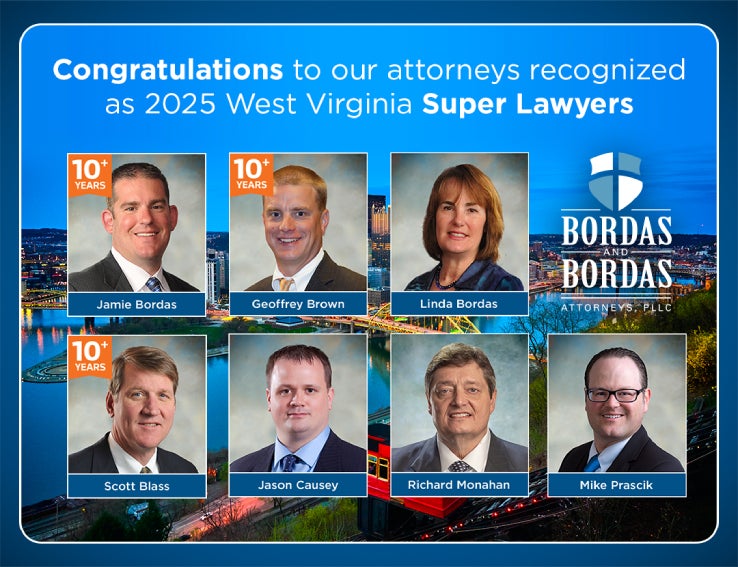
Seven Attorneys at Bordas & Bordas named 2025 West Virginia Super Lawyers

Bordas & Bordas is proud to announce that seven attorneys have been selected to the 2025 West Virginia Super Lawyers list. Bordas & Bordas attorneys Jamie Bordas, Linda Bordas, Geoffrey Brown, Scott Blass, Jason Causey, Richard Monahan and Mike Prascik were selected as 2025 West Virginia Super Lawyers. Jamie Bordas, managing partner of Bordas & Bordas for 20 years, has been a West Virginia Super Lawyer for over a decade. Bordas spearheads Bordas & Bordas’ operations across multiple states and jurisdictions. An extremely accomplished litigator, Bordas has concentrated on the negotiation and resolution of the firm’s most complex and significant cases, including mass tort settlements of $36,500,000 and $18,500,000 and a single plaintiff settlement of over $18,000,000. In 2019, he served as lead counsel for a plaintiff at trial and presented the Oral Argument before the West Virginia Supreme Court in a case that resulted in a $16,922,000 verdict against Walmart. The verdict is believed to be one of the largest, if not the largest, verdicts in the history of Wood County, West Virginia, on behalf of a single plaintiff. He has also obtained a $10 million verdict in an insurance bad faith case in Belmont County, Ohio. In 2023, Bordas argued a case, Harris v. Hilderbrand, Slip Opinion No. 2023-Ohio-3005, before the Ohio Supreme Court where the Court unanimously ruled that police officers do not have immunity from negligent acts with K9 officers outside of duty. He also served as appellate counsel in Brown v. City of Oil City in which the Supreme Court of Pennsylvania decided in May 2023 that a contractor who has created a dangerous condition through work performed for a possessor of land may be liable to all persons suffering injuries caused by the dangerous condition. Bordas works on cases involving diverse areas of law, including insurance bad faith, toxic torts, personal injury, medical malpractice, business litigation and more. He has frequently been invited to speak to groups of attorneys on techniques applicable to trial skills, negotiation, mediation and resolution of cases as a result of his reputation for getting the best possible results for his clients. He has led the firm’s expansion into Pittsburgh and the rest of Western Pennsylvania and the opening of the firm’s Gateway Center offices in Pittsburgh. Linda Bordas, also a partner, founded Bordas & Bordas with her husband Jim Bordas when she joined his practice upon graduating from law school in 1985. She had previously worked as a hospital pharmacist and immediately applied her background to become one of West Virginia’s most successful medical malpractice attorneys. Linda has obtained numerous major verdicts and settlements in almost every area of medicine and handled appeals that have expanded the rights of patients and especially the families of children who were injured or killed as a result of negligence. She obtained a verdict of $2 Million in Davis vs. Wang, which involved the death of an infant due to medical negligence. That case also significantly affected the law in West Virginia for jury selection and juror bias in medical negligence cases and cases in general. She also obtained a $2,500,000 verdict in Klamut vs. Youssef in a case involving the death of woman as a result of medical negligence involving radiation oncology. In Andrews vs. Reynolds, she obtained a $2,760,000 verdict following the death of an infant, and helped establish law regarding loss of future wages for the survivors in a wrongful death action. In Mackey vs. Irisari, Linda obtained a $1.8 Million verdict following the failure of physicians to recognize signs of septic shock following a surgery. In Nickerson vs. Andreini, she obtained a $1 Million verdict on behalf of a young boy who required a hip replacement as a result of negligence by an orthopedic surgeon. She has also obtained multiple multi-million dollar settlements on behalf of other clients in medical malpractice cases involving various areas of medicine. Geoffrey Brown, a partner at Bordas & Bordas, has been a West Virginia Super Lawyer for 13 years. He concentrates his work on the firm’s complex litigation and medical malpractice cases. He has obtained major jury verdicts not only in medical malpractice, but also in cases of stockbroker negligence, workplace injury, and wrongful death. Brown has earned a reputation for comprehensive preparation and attention to detail in theses demanding areas of law. He has obtained multi-million-dollar verdicts in West Virginia and Ohio. Brown has also been involved in Bordas & Bordas’ business litigation department and has handled multi-jurisdictional contract disputes involving Fortune 500 companies and representation of individuals before the Financial Industry Regulatory Authority (FINRA) arbitration panel. Scott Blass has been a West Virginia Super Lawyer for 15 years. Blass has been litigating complex civil cases for over 30 years. He has obtained seven-figure verdicts on behalf of his clients in diverse areas of the law, including verdicts of over $4 million in a product liability case, $8 million in an auto accident case, $1.4 million in an insurance bad faith case, and $5.7 million in a medical malpractice case. Blass has also represented the families of oil and gas workers killed in fires/explosions and obtained settlements of $19 million and $19.5 million. He has been recognized as one of the foremost insurance bad faith and insurance coverage lawyers in West Virginia. Jason Causey has been a West Virginia Super Lawyer for the past eight years. Causey is a leader in consumer law in the State of West Virginia. Through aggressive litigation, he has saved dozens of homes from foreclosure. In 2011, Causey and one of the firm’s founding partners, Jim Bordas, were forced to trial against Quicken Loans in an effort to save the home of two Wheeling, West Virginia, women from foreclosure. In addition to saving the home, they obtained a verdict of nearly $3,000,000 in this predatory lending action. In 2016, Jim Bordas and Causey teamed up again for a $1,700,000 result against a municipality after a broke water-main flooded a local business. Richard Monahan has been a West Virginia Super Lawyer since 2020. Monahan has been representing West Virginia citizens and consumers for more than 29 years. Among his successful trials, he has obtained verdicts and judgments of $3.9 million in a wrongful death action arising from a motor vehicle collision and $2.5 million in a retaliatory discharge case.  He has also worked in complex litigation, including substantially contributing to class actions involving natural gas rights, product liability claims involving defective drugs, and other consumer claims resulting in verdicts or settlements in the hundreds of millions of dollars. Monahan is also known for his extensive appellate work.  In addition to his involvement in numerous appeals before the West Virginia Supreme Court of Appeals, he also fully briefed and argued a case before the United States Supreme Court, resulting in a unanimous decision in favor of West Virginia class action plaintiffs in Smith v. Bayer Corp., 564 U.S.299 (2011). He was selected as Appellate Lawyer of the Week for his argument in that case by The National Law Journal. Mike Prascik has been named a West Virginia Super Lawyer for the first time. With over 20 years of experience, Prascik has a history of representing individuals injured by defective products and unsafe workplace conditions, while also handling various other types of civil litigation. He is a 2002 graduate of West Virginia University College of Law, where he served as a Legal Research and Writing teaching assistant. Prascik currently provides crucial litigation support, research, and writing on cases throughout the region for Bordas & Bordas. Super Lawyers, part of Thomson Reuters, is a rating service of outstanding lawyers from more than 70 practice areas who have attained a high degree of peer recognition and professional achievement. The annual selections are made using a patented multiphase process that includes a statewide survey of lawyers, an independent research evaluation of candidates and peer reviews by practice area. The result is a credible, comprehensive and diverse listing of exceptional attorneys. Bordas & Bordas is a plaintiff’s litigation law firm with offices in Pittsburgh, Wheeling, W.Va., St. Clairsville, Ohio, and Moundsville, W.Va. The firm’s attorneys practice throughout the region in diverse areas of law and are licensed in Pennsylvania, West Virginia, Ohio, and Texas.

BB_BeyondTheShild_Header.

Behind the Shield Newsletter – March 2025

Happy St. Patrick’s Day! May your day be filled with good fortune, laughter, and maybe even a little bit of that Irish luck! We recently had a leprechaun, who was convinced his pot of gold was under threat, visit Bordas & Bordas for some legal advice on the best way to protect his pot of gold. Want to see how our attorneys handled this tricky situation? Click here to watch the video. Have a lucky day! Fighting for Justice for 40 Years In 2025, Bordas & Bordas is proudly celebrating 40 years, a testament to our unwavering commitment to serving our community and fighting for justice. Since our founding in 1985 by Jim and Linda Bordas, we’ve grown from a small practice into one of the region’s premier personal injury law firms with offices in Pittsburgh, Pennsylvania, Wheeling and Moundsville, West Virginia, and St. Clairsville, Ohio. The story of Bordas & Bordas Attorneys PLLC began with a unique partnership. Linda, a former hospital pharmacist turned lawyer, and Jim, who has been described by many as a giant in the legal profession, combined their expertise and passion for justice to open the doors of Bordas & Bordas upon Linda’s graduation from law school in 1985. Their remarkable record, including never losing a trial together, fueled the firm’s early success. Linda’s medical background proved invaluable, particularly in medical malpractice cases, where she became a leading force, securing landmark verdicts and expanding patient rights. Jim spent his career fighting battles for his clients that others couldn’t or wouldn’t fight. For over four decades, he built a reputation of success through landmark jury verdicts and settlements. In 2000, the Bordas legacy continued with the addition of Jim and Linda’s oldest son, Jamie, who became the firm’s managing partner in 2005. Jim cherished working alongside Jamie, creating a strong bond, and ensuring the firm’s values would endure. Linda remains a partner at Bordas & Bordas and continues to provide guidance and advice as we continue to fight for justice. Our C ore Values: The Shield of Bordas & Bordas Our logo, a shield with four quadrants and a central cross, symbolizes what we hold dear: Experience: Four decades of dedicated legal service. Family: A firm built on strong family values and lasting relationships. Community: A commitment to serving and giving back to our community. Results: A proven track record of securing substantial recoveries for our clients. Christian Values: The Cross in the center represents the moral compass that guides our work. Our Commitment to You A lot has changed in 40 years, but one thing remains the same: Our reputation for taking on any opponent in the courtroom. This is backed by years of success and record-breaking results, including numerous multi-million-dollar verdicts and settlements across a wide range of personal injury practice areas. We understand the challenges clients face, which is why our cases are handled on a contingency fee basis. This means clients pay no fee unless we secure a recovery for them. We offer: Free initial consultations. No retainer required. We advance all case expenses. Our work has garnered national attention, with features on programs like 60 Minutes, Inside Edition, and CNN, showcasing our dedication to seeking justice for our clients. Learn more about our results by clicking here. As we celebrate 40 years, we reaffirm our commitment to providing exceptional legal representation and upholding the values that have guided us since 1985. We are grateful for the trust our clients have placed in us and look forward to serving our community for many years to come. Building Strong Co-Counsel Partnerships at Bordas & Bordas At Bordas & Bordas, we deeply value collaborative relationships with fellow members of the trial bar. Our firm’s history is marked by significant successes achieved through strategic co-counsel partnerships. We recognize the strength that comes from combining our resources and expertise with that of other firms. Our firm’s size and diverse team of attorneys, specializing in various practice areas, enable us to effectively handle complex cases. We are particularly well-equipped to collaborate on matters involving: Personal Injury Wrongful Death Insurance Bad Faith Trucking and Auto Accidents Product Liability Medical Malpractice / Nursing Home Injuries Premises Liability We understand the importance of a strong co-counsel relationship and are committed to open communication, shared strategy, and a unified approach to achieving the best possible outcome for our clients. Our law firm’s proven track record against major corporations, including Walmart, Quicken Loans, AEP, American Home Patient/Lincare, and ManorCare, demonstrates our ability to handle high-stakes litigation. We believe that a collaborative approach allows us to maximize recoveries and provide exceptional legal representation. You can learn more about our firm’s capabilities and results at bordaslaw.com. Whether we’ve partnered in the past or are exploring a new co-counsel opportunity, we are eager to discuss how we can work together. Please feel free to reach out to managing partner Jamie Bordas directly at 304-242-8410. We consider it a privilege to collaborate with fellow trial lawyers. What Our Clients Say About Us Hear directly from Tom and Michele McFadden about their experience working with Bordas & Bordas and how we helped them achieve a successful outcome. Click To Watch Video It’s common for people to be shaken up after a car accident, and that can lead to mistakes. Learn the Dos and Don’ts after a car accident: Colin, a West Virginia University College of Law graduate, focuses his practice on personal injury litigation and works out of the firm’s Pittsburgh office. During his time at WVU College of Law, he served as an environmental law research assistant, where he helped draft and edit two published law review articles on coal mining and the opioid epidemic.  As a clinical student at the United States Supreme Court Clinic, his clinic successfully appealed two cases in the Fourth Circuit Court of Appeals. Prior to joining the firm, Colin gained valuable experience through internships at World Green Growth Organization, The Mills McDermott Criminal Law Center, and Bordas & Bordas itself. With a strong foundation in law and a passion for justice, he is committed to advocating for the rights of injured individuals. A Pittsburgh native, Colin is passionate about environmental conservation and environmental law. Outside of the office he enjoys skiing, hiking and camping. Quotes to Live By:

The History of the 3 Musketeers Candy Bar

Did you know that the original 3 Musketeers candy bars came in packs of three? Neither did I! My youngest son told me that little piece of trivia the other day. Since it was fascinating to me, I decided to do a little research and find out what the history of the 3 Musketeers candy bar was and share that history with you.nnMars, Incorporated introduced 3 Musketeers in 1932. It came in a box and had three mini candy bars in it. One was strawberry, one was chocolate, and one was vanilla. Their marketing department advertised it as a candy bar so big it could be shared with two friends. I guess that’s true if you can find two friends who like vanilla and strawberry candy bars. No one is going to share the chocolate one!nnAn interesting fact is that they stopped producing the strawberry and vanilla versions in 1945. Rationing of sugar began during the war in 1942, and it became too expensive to continue producing all three flavors. Since chocolate was the favorite by popular demand, Mars only continued to produce the chocolate flavor.nnThere have been other flavors of 3 Musketeers over the years in limited editions, such as mint, French vanilla, mocha cappuccino, cherry, raspberry, and orange, but the chocolate version is the only one you see today.nnSince everything is shrinking, I’m pretty sure the size of today’s 3 Musketeers is barely larger than the original mini size. Back then, you paid a whopping 5 cents for all three candy bars. Today’s prices are closer to a dollar for just one. But, as a bonus, there is less fat in 3 Musketeers than in other candy bars – only 7 grams! I say that’s a win-win because if you count fat grams and want a treat, you can never go wrong with chocolate-covered nougat!

What Is a Dispositive Motion?

Lawyers and judges often refer to “dispositive” motions. Scheduling orders, which are issued in every civil case, almost always set a deadline for any dispositive motions to be filed. But what exactly is a dispositive motion?nnIt’s not really as mysterious as it sounds. A dispositive motion is meant to dispose of the case. In other words, it asks the court for a ruling that addresses the legal issues and terminates the case in advance of the trial.nnGenerally speaking, there are two kinds of dispositive motions:n Motion to Dismiss nThe first kind of dispositive motion is known as a motion to dismiss. These motions are usually filed early in the case and are a way of testing the sufficiently of the pleadings. They are not meant to look into the facts of the case—just the allegations. Basically, a motion to dismiss asks a question: If you accept as true everything the other party says, has he alleged enough to state a valid claim under our state’s law? If the answer is yes, the judge will deny the motion and the case will proceed. If the answer is no, the judge will enter an order explaining his reasoning and dismissing the case.n Summary Judgment Motion nThe second kind of dispositive motion is known as a summary judgment motion. Unlike a motion to dismiss, a summary judgment motion is specifically designed to look into the facts. Importantly, however, the summary judgment process is not a substitute for jury trials. Juries are a vital part of our system of justice, and the right to a jury trial is actually protected by the Seventh Amendment. The point of a summary judgment motion is to see if there are disputed issues of fact that require a jury in the first place. If A says the light was green, and B says the light was red, the judge will deny summary judgment and let the jury decide the issue. Even if A has given contradictory statements, or is a friend of one of the parties, or has a prior conviction for false swearing, these are all issues of credibility that a judge cannot decide. Instead, the judge will deny summary judgment and let the case go to the jury—which will then hear all of the evidence for itself, weigh it, and reach its own verdict.

Bordas_Social_AntiBullying_2025

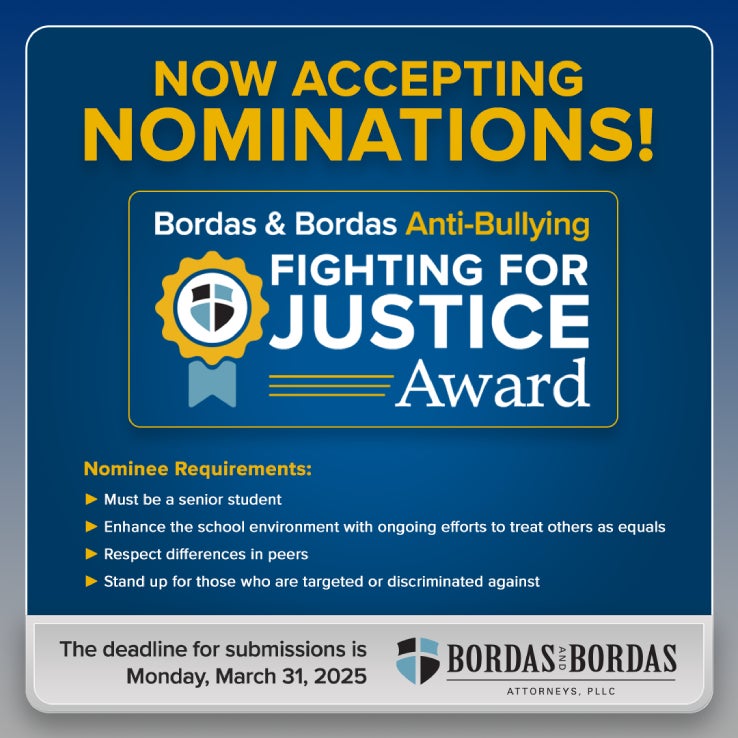
Bordas & Bordas Welcomes Nominations for 2025 Anti-Bullying Fighting for Justice Award

WHEELING, W.Va. – Bordas & Bordas is pleased to welcome nominations for the 2025 Anti-Bullying Fighting for Justice Award. The award was created in 2014 by Bordas & Bordas founder Jim Bordas and honors senior students in each high school in Ohio, Marshall and Belmont counties. The criteria for students nominated includes treating everyone equally, respecting differences in others, and standing up for those who are targeted by others or are discriminated against. The winners of the award are deemed Anti-Bullying Ambassadors and receive a $500 cash award. “We are thrilled to continue recognizing these outstanding young leaders who are making a positive impact on their schools and communities,” said managing partner Jamie Bordas. “The Anti-Bullying Fighting for Justice Award celebrates kindness, empathy, and the courage to stand up for what is right.” Senior students may be nominated by peers, teachers, coaches or community members. To nominate a senior student from your community, visit bordaslaw.com/antibullyingaward. The award will be presented at the end-of-year award ceremony at each of the recipients’ schools. The deadline for nominations is Monday, March 31.

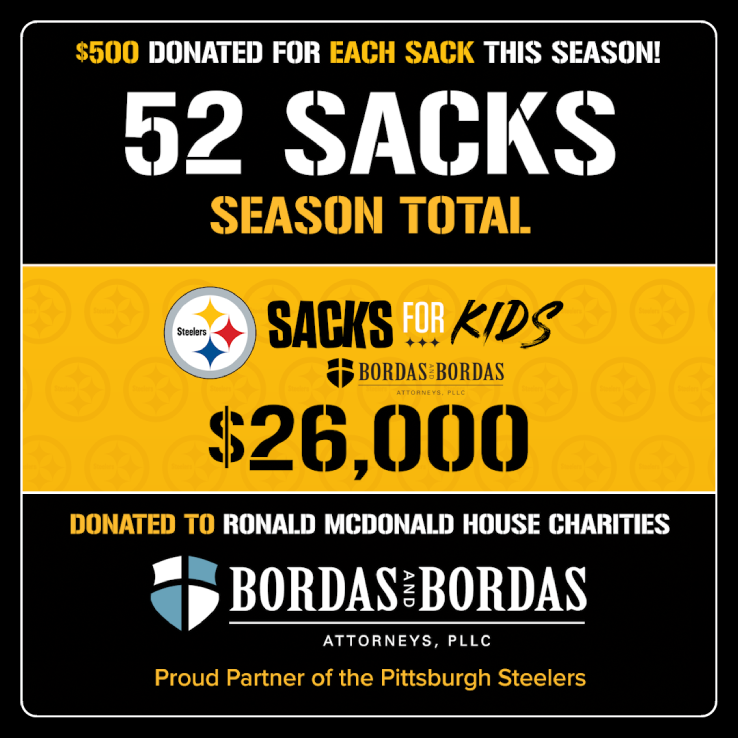
Bordas_SacksForKids-2024

Bordas & Bordas Donates $26,000 to Ronald McDonald House through Pittsburgh Steelers Partnership

PITTSBURGH, PA. – The law firm of Bordas & Bordas has donated a total of $26,000 to the Ronald McDonald House Charities of Pittsburgh in conjunction with their Pittsburgh Steelers partnership for the 2024-25 season. The firm started the Sacks for Kids campaign in 2015 and a donation of $500 goes to the Ronald McDonald House Charities of Pittsburgh and Morgantown for every sack made by the Steelers defense, including the pre-season, regular season and postseason. The Steelers ended the 2024-25 season with a total of 52 sacks. Over the history of this partnership, Bordas & Bordas has now contributed over $300,000 to Ronald McDonald House Charities of Pittsburgh and Morgantown. “The Sacks for Kids program is more than just a fun way to watch the Steelers. It’s about being able to help make a difference in the lives of families in need during a difficult time. This year, we’re celebrating ten years of giving back, and we’re proud to have donated over $300,000 to the Ronald McDonald House throughout our time with the program,” said managing partner Jamie Bordas. The Ronald McDonald House Charities of Pittsburgh and Morgantown is a charity designed to help families with children being treated in a medical center. The Ronald McDonald House organization has local chapters in 62 countries and regions. It provides housing and meals at no cost so families can focus on care and togetherness rather than worry about the rising costs of hotels and travel. “Although we were disappointed in the season coming to an end like many Steelers fans, writing this check is a good way for us to end the season because we know that it will help a lot of families,” said Bordas. On January 4, marketing representative Olivia Silverio presented Eleanor Reigel, CEO of Ronald McDonald House Charities of Pittsburgh and Morgantown, with a check as part of the Sacks for Kids partnership with the Pittsburgh Steelers. Two families staying at the House joined them. Photo: (Pittsburgh Steelers)

Bordas_BestLawyers-Ranked_2025-1

Bordas & Bordas Attorneys Recognized in 2025 Edition of Best Law Firms®

Bordas & Bordas is proud to announce that the law firm has been recognized for excellence in the 2025 edition of Best Law Firms® rankings in the United States. The recognition identifies the top-performing law firms across 127 practice areas and 188 local jurisdictions. The Best Law Firms® rankings are based on a rigorous evaluation process that includes collecting client and professional reference evaluations, peer reviews from leading attorneys, industry leader interviews, and reviewing additional firm information provided by law firms during the formal research submission process. Firms that have attorneys recognized in the most recent edition of the Best Lawyers in America® in specific practice areas are eligible to receive a law firm ranking in the same practice areas and metro jurisdictions. Bordas & Bordas attorneys Jamie Bordas, Geoff Brown, Scott Blass and Tom Anderson were recognized in the Best Lawyers in America® 2025 edition. The practice areas in which the firm was recognized for in the 2025 edition of Best Law Firms® rankings include: Metropolitan Tier 1 Morgantown Employment Law- Individuals Medical Malpractice Law- Plaintiffs Personal Injury Litigation- Plaintiffs Product Liability Litigation- Plaintiffs Metropolitan Tier 3 Morgantown Litigation- Labor and Employment “We are immensely proud to receive recognition in the 2025 edition of Best Law Firms® rankings,” said Jamie Bordas, Managing Partner at Bordas & Bordas. “This achievement reflects our firm’s commitment to fighting for justice and our dedication to providing exceptional legal representation to our clients.” The law firm of Bordas & Bordas has a long history of serving communities in West Virginia, Pennsylvania, and Ohio. The firm’s team of experienced attorneys offers a wide range of legal services.

What Is a Settlement Video?

As your case progresses, it will likely reach a point where your attorneys will discuss the possibility of entering settlement negotiations or participating in a mediation to try and settle the case before it goes to trial. Most courts require some type of mediation to occur in the case at some point before trial, but settlement negotiations can occur at any point in time in your case, including before the case is filed. Your attorney may take different approaches to the settlement negotiations depending on the stage of the case when those negotiations occur, but an element of settlement negotiations that is becoming more frequently used is the creation of a “settlement video.”nnA settlement video serves a purpose similar to a written demand or mediation statement. It educates the other side and the mediator if one is involved in the negotiations, about the case. Whereas written demand letters or mediation statements set forth the evidence in your case, including the evidence establishing the defendant’s liability and misconduct, evidence about your injuries and damages, and an introduction to you and how the situation gave rise to your injuries and a lawsuit have affected your life, a settlement video can help bring those things to life and give the other side in your case a better idea of the case and how you would present it to a jury at trial.nnSettlement videos typically include interviews with the plaintiff and his or her family members and friends. This allows the defendant to get to know the plaintiff better and to learn about who the plaintiff is as a person and how his injuries have affected him, both physically and emotionally. The defendant will be able to see video footage of the plaintiff’s day-to-day life as a result of the injuries, including things like how the plaintiff now walks with a limp, cannot lift his arms to get a cup out of the cupboard, or cannot dress anymore without assistance. The videos will show the emotions that the plaintiff and his family members experience in talking about what happened and how this has affected their lives. If the case involves someone who has died, family members can share photographs and memories about their loved one and really express the toll that the loss has taken on the family and how much their loved one is missed.nnSettlement videos can also help illustrate the injuries that a plaintiff sustained. Animations can show the force of a vehicle collision, and how it caused the plaintiff’s head and neck to move forward and backward, and can highlight the specific part of the neck and spine that were injured as a result of those movements. Illustrations can zoom in on the body parts that were injured, and pictures of broken bones, scars, burns, or other physical injuries can all be included to show the extent of the injuries and physical damages.nnExcerpts of depositions taken in the case, particularly of the defendant or defendant’s witnesses, can be included to highlight the ways in which the defendant was acting unsafely or was unaware of applicable rules and regulations and how they failed to follow those rules. It can be compelling for the defendant to view actual testimony that is harmful to them, the same way that a jury would hear that testimony, and to see the demeanor of the person giving that testimony. Expert witness interviews or depositions also help illustrate how persuasive testimony would be given at trial that establishes the defendant’s liability or the plaintiff’s damages and can be more effective than simply reading about that expert’s opinion.nnAll in all, a settlement video can be an effective way of presenting the strengths of your case and can be a persuasive tool in making clear to defendants just how valuable the case is, and can give some insight into how jurors would hear and view the case if it were presented at trial. While there are several considerations that go into whether a case is a good fit for a settlement video, including the available evidence, the timeframe to create the video, and the cost involved in creating the video, settlement videos can be a useful negotiation tool in many different types of cases.

Two men on a golf course holding a $10,000 donation check from Bordas & Bordas to The Oglebay Foundation.

Bordas & Bordas Amateur Golf Classic Proceeds Benefit Oglebay Foundation’s Access to the Parks Program for Seventh Year

Bordas & Bordas’ Scott Blass presented Oglebay Foundation President and CEO Eriks Janelsins with a $10,000 check representing proceeds from the 2024 Bordas & Bordas Amateur Golf Classic. Thank you again to all Bordas & Bordas Amateur Golf Classic sponsors and participants! The $10,000 donation will go towards supporting Access to the Parks scholarships, an Oglebay Foundation program providing low-income Ohio County children and an accompanying adult with free year-round admission to all the activities at Oglebay and Wheeling Park!

Minor’s Brain Injury Claim Dismissed for Lack of Personal Jurisdiction and Forum Non Conveniens

J.F., a minor, was left in a persistent vegetative state due to a defective and unsafe Aisys CS2 anesthesia system (“Anesthesia System”) used during surgery at Shands Jacksonville Medical Center (“Shands”) in Jacksonville, Florida. Datex, a subsidiary of General Electric Company (collectively referred to as “GE Defendants”), manufactured the Anesthesia System, and Crothall Healthcare, Inc. (“Crothall”), an independent entity, serviced the Anesthesia System. Plaintiff sued the Defendants in the Court of Common Pleas of Philadelphia County, Pennsylvania. The GE Defendants filed preliminary objections, asserting that the trial court lacked general and specific personal jurisdiction over them.nnGE was incorporated in New York and headquartered in Massachusetts. Datex was a Delaware corporation with a principal place of business in Wisconsin. The Anesthesia System was designed and manufactured in Wisconsin and sold to Shands by Datex in Florida. However, the invoice that was sent by Datex to Shands indicated that payment for the Anesthesia System was to be sent to the GE Defendants’ bank, located in Pittsburgh, Pennsylvania. The trial court entered an order sustaining the GE Defendants’ preliminary objections and dismissing them from the case.nnCrothall, which was headquartered in Pennsylvania, filed a motion to dismiss for forum non conveniens. The trial court entered an order granting the motion and dismissing the complaint without prejudice to Plaintiff refiling in Florida or another appropriate jurisdiction.nn“A corporate defendant’s activities within the Commonwealth ‘may give rise to either specific or general jurisdiction.’” Merino v. Repak, B.V., 286 A.3d 1249, 1256 (Pa. Super. 2022). General jurisdiction exists in “situations where a corporation’s connections are ‘so continuous and systematic as to render them essentially at home in the forum State,’ allowing for jurisdiction over causes of action unrelated to in-state activities.” Hammons v. Ethicon, Inc., 240 A.3d 537, 555 (Pa. 2020). Specific jurisdiction applies where there are “more limited connections with a state which restrict jurisdiction to causes of action ‘where there is an affiliation between the forum and the underlying controversy.’” Id. nnIn Mallory v. Norfolk Southern Railway Co., 600 U.S. 122 (2023), the Supreme Court of the United States addressed 42 Pa.C.S. § 5301(a)(2)(i), and held by registering in Pennsylvania, the foreign corporation voluntarily consents to suit in the Commonwealth in order to avail itself of the opportunity to do business in Pennsylvania. However, in this case the Superior Court determined that Plaintiff waived any argument on general jurisdiction as it was not raised in the trial court. Trigg v. Children’s Hospital of Pittsburgh of UPMC, 229 A.3d 260, 269 (Pa. 2020).nnPennsylvania courts have relied on the following three-part test to determine whether specific jurisdiction exists in a particular case:n Did the plaintiff’s cause of action arise out of or relate to the out-of-state defendant’s forum-related contacts? Did the defendant purposely direct its activities, particularly as they relate to the plaintiff’s cause of action, toward the forum state or did the defendant purposely avail itself of the privilege of conducting activities therein? Would the exercise of personal jurisdiction over the nonresident defendant in the forum state satisfy the requirement that it be reasonable and fair? Hammons, 240 A.3d at 556.nnHere, the only Pennsylvania related activity or occurrence averred was the existence of a bank lockbox located in Pittsburgh, PA. The Superior Court found no evidence showing that the GE Defendants purposefully sought Pennsylvania as the locale where it would receive payment on the Anesthesia System, and the payments directed to Pennsylvania had no relation to the allegations in Plaintiff’s complaint; therefore, the Court concluded that the trial court did not err or abuse its discretion in granting the GE Defendants’ preliminary objections as to personal jurisdiction.nnFinally, when assessing whether to disturb the plaintiff’s choice of forum, the trial court must consider private factors, including,n the relative ease of access to sources of proof; availability of compulsory process for attendance for unwilling, and the cost of obtaining attendance of willing, witnesses; possibility of view of the premises, if view would be appropriate to the action; and all other practical problems that make trial of a case easy, expeditious and inexpensive. McConnell v. B. Braun Medical Inc., 221 A.3d 221, 227 (Pa. Super. 2019).nnThe court must also consider factors affecting the public interest, including thatn administrative difficulties follow for courts when litigation is piled up in congested centers instead of being handled at its origin. Jury duty is a burden that ought not to be imposed upon the people of a community which has no relation to the litigation. There is an appropriateness, too, in having the trial . . . in a forum that is at home with the state law that must govern the case, rather than having a court in some other forum untangle problems in conflict of laws, and in law foreign to itself. Id. at 227-28.nnUpon review, the Superior Court agreed with the trial court’s decision to dismiss Croththall from the suit on the basis of forum non conveniens because J.F.’s injuries were sustained in Florida, all identified potential witnesses reside outside Pennsylvania, the Anesthesia System remains in Florida along with potentially other relevant evidence, and Florida law likely applies to this dispute. Moreover, the Court determined that Crothall had provided evidence to support the trial court’s conclusion that the key witnesses it would present at trial were based in Florida and would testify, consistent with the company’s defense asserted in its answer that Crothall had insufficient involvement with the Anesthesia System to be found liable for J.F.’s injuries.nnThe Court’s opinion in Kennedy v. Crothall Healthcare, Inc., 2024 PA Super 177 (August 9, 2024) can be accessed here.

Minor’s Brain Injury Claim Dismissed for Lack of Personal Jurisdiction and Forum Non Conveniens

J.F., a minor, was left in a persistent vegetative state due to a defective and unsafe Aisys CS2 anesthesia system (“Anesthesia System”) used during surgery at Shands Jacksonville Medical Center (“Shands”) in Jacksonville, Florida. Datex, a subsidiary of General Electric Company (collectively referred to as “GE Defendants”), manufactured the Anesthesia System, and Crothall Healthcare, Inc. (“Crothall”), an independent entity, serviced the Anesthesia System. Plaintiff sued the Defendants in the Court of Common Pleas of Philadelphia County, Pennsylvania. The GE Defendants filed preliminary objections, asserting that the trial court lacked general and specific personal jurisdiction over them.nnGE was incorporated in New York and headquartered in Massachusetts. Datex was a Delaware corporation with a principal place of business in Wisconsin. The Anesthesia System was designed and manufactured in Wisconsin and sold to Shands by Datex in Florida. However, the invoice that was sent by Datex to Shands indicated that payment for the Anesthesia System was to be sent to the GE Defendants’ bank, located in Pittsburgh, Pennsylvania. The trial court entered an order sustaining the GE Defendants’ preliminary objections and dismissing them from the case.nnCrothall, which was headquartered in Pennsylvania, filed a motion to dismiss for forum non conveniens. The trial court entered an order granting the motion and dismissing the complaint without prejudice to Plaintiff refiling in Florida or another appropriate jurisdiction.nn“A corporate defendant’s activities within the Commonwealth ‘may give rise to either specific or general jurisdiction.’” Merino v. Repak, B.V., 286 A.3d 1249, 1256 (Pa. Super. 2022). General jurisdiction exists in “situations where a corporation’s connections are ‘so continuous and systematic as to render them essentially at home in the forum State,’ allowing for jurisdiction over causes of action unrelated to in-state activities.” Hammons v. Ethicon, Inc., 240 A.3d 537, 555 (Pa. 2020). Specific jurisdiction applies where there are “more limited connections with a state which restrict jurisdiction to causes of action ‘where there is an affiliation between the forum and the underlying controversy.’” Id. nnIn Mallory v. Norfolk Southern Railway Co., 600 U.S. 122 (2023), the Supreme Court of the United States addressed 42 Pa.C.S. § 5301(a)(2)(i), and held by registering in Pennsylvania, the foreign corporation voluntarily consents to suit in the Commonwealth in order to avail itself of the opportunity to do business in Pennsylvania. However, in this case the Superior Court determined that Plaintiff waived any argument on general jurisdiction as it was not raised in the trial court. Trigg v. Children’s Hospital of Pittsburgh of UPMC, 229 A.3d 260, 269 (Pa. 2020).nnPennsylvania courts have relied on the following three-part test to determine whether specific jurisdiction exists in a particular case:n n n Did the plaintiff’s cause of action arise out of or relate to the out-of-state defendant’s forum-related contacts? n n n Did the defendant purposely direct its activities, particularly as they relate to the plaintiff’s cause of action, toward the forum state or did the defendant purposely avail itself of the privilege of conducting activities therein? n n n Would the exercise of personal jurisdiction over the nonresident defendant in the forum state satisfy the requirement that it be reasonable and fair? n n n Hammons, 240 A.3d at 556.nnHere, the only Pennsylvania related activity or occurrence averred was the existence of a bank lockbox located in Pittsburgh, PA. The Superior Court found no evidence showing that the GE Defendants purposefully sought Pennsylvania as the locale where it would receive payment on the Anesthesia System, and the payments directed to Pennsylvania had no relation to the allegations in Plaintiff’s complaint; therefore, the Court concluded that the trial court did not err or abuse its discretion in granting the GE Defendants’ preliminary objections as to personal jurisdiction.nnFinally, when assessing whether to disturb the plaintiff’s choice of forum, the trial court must consider private factors, including,n the relative ease of access to sources of proof; availability of compulsory process for attendance for unwilling, and the cost of obtaining attendance of willing, witnesses; possibility of view of the premises, if view would be appropriate to the action; and all other practical problems that make trial of a case easy, expeditious and inexpensive. n McConnell v. B. Braun Medical Inc., 221 A.3d 221, 227 (Pa. Super. 2019).nnThe court must also consider factors affecting the public interest, including thatn administrative difficulties follow for courts when litigation is piled up in congested centers instead of being handled at its origin. Jury duty is a burden that ought not to be imposed upon the people of a community which has no relation to the litigation. There is an appropriateness, too, in having the trial . . . in a forum that is at home with the state law that must govern the case, rather than having a court in some other forum untangle problems in conflict of laws, and in law foreign to itself. n Id. at 227-28.nnUpon review, the Superior Court agreed with the trial court’s decision to dismiss Croththall from the suit on the basis of forum non conveniens because J.F.’s injuries were sustained in Florida, all identified potential witnesses reside outside Pennsylvania, the Anesthesia System remains in Florida along with potentially other relevant evidence, and Florida law likely applies to this dispute. Moreover, the Court determined that Crothall had provided evidence to support the trial court’s conclusion that the key witnesses it would present at trial were based in Florida and would testify, consistent with the company’s defense asserted in its answer that Crothall had insufficient involvement with the Anesthesia System to be found liable for J.F.’s injuries.nnThe Court’s opinion in Kennedy v. Crothall Healthcare, Inc., 2024 PA Super 177 (August 9, 2024) can be accessed here.

Contact Us

Fill out this form below and we'll contact you shortly
*Required Fields