Legal Advice Blog: Legal Advice, Case Insights, & Local Law Information

All In the Community Know the Law Legal News and Product Recalls Legal Options
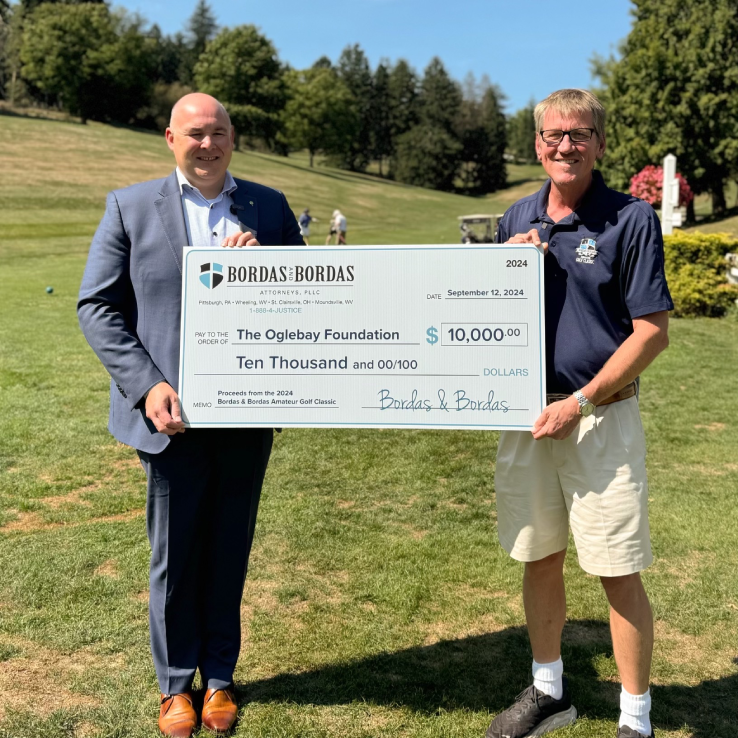
Two men on a golf course holding a $10,000 donation check from Bordas & Bordas to The Oglebay Foundation.

Bordas & Bordas Amateur Golf Classic Proceeds Benefit Oglebay Foundation’s Access to the Parks Program for Seventh Year

Bordas & Bordas’ Scott Blass presented Oglebay Foundation President and CEO Eriks Janelsins with a $10,000 check representing proceeds from the 2024 Bordas & Bordas Amateur Golf Classic. Thank you again to all Bordas & Bordas Amateur Golf Classic sponsors and participants! The $10,000 donation will go towards supporting Access to the Parks scholarships, an Oglebay Foundation program providing low-income Ohio County children and an accompanying adult with free year-round admission to all the activities at Oglebay and Wheeling Park!

Minor’s Brain Injury Claim Dismissed for Lack of Personal Jurisdiction and Forum Non Conveniens

J.F., a minor, was left in a persistent vegetative state due to a defective and unsafe Aisys CS2 anesthesia system (“Anesthesia System”) used during surgery at Shands Jacksonville Medical Center (“Shands”) in Jacksonville, Florida. Datex, a subsidiary of General Electric Company (collectively referred to as “GE Defendants”), manufactured the Anesthesia System, and Crothall Healthcare, Inc. (“Crothall”), an independent entity, serviced the Anesthesia System. Plaintiff sued the Defendants in the Court of Common Pleas of Philadelphia County, Pennsylvania. The GE Defendants filed preliminary objections, asserting that the trial court lacked general and specific personal jurisdiction over them.nnGE was incorporated in New York and headquartered in Massachusetts. Datex was a Delaware corporation with a principal place of business in Wisconsin. The Anesthesia System was designed and manufactured in Wisconsin and sold to Shands by Datex in Florida. However, the invoice that was sent by Datex to Shands indicated that payment for the Anesthesia System was to be sent to the GE Defendants’ bank, located in Pittsburgh, Pennsylvania. The trial court entered an order sustaining the GE Defendants’ preliminary objections and dismissing them from the case.nnCrothall, which was headquartered in Pennsylvania, filed a motion to dismiss for forum non conveniens. The trial court entered an order granting the motion and dismissing the complaint without prejudice to Plaintiff refiling in Florida or another appropriate jurisdiction.nn“A corporate defendant’s activities within the Commonwealth ‘may give rise to either specific or general jurisdiction.’” Merino v. Repak, B.V., 286 A.3d 1249, 1256 (Pa. Super. 2022). General jurisdiction exists in “situations where a corporation’s connections are ‘so continuous and systematic as to render them essentially at home in the forum State,’ allowing for jurisdiction over causes of action unrelated to in-state activities.” Hammons v. Ethicon, Inc., 240 A.3d 537, 555 (Pa. 2020). Specific jurisdiction applies where there are “more limited connections with a state which restrict jurisdiction to causes of action ‘where there is an affiliation between the forum and the underlying controversy.’” Id. nnIn Mallory v. Norfolk Southern Railway Co., 600 U.S. 122 (2023), the Supreme Court of the United States addressed 42 Pa.C.S. § 5301(a)(2)(i), and held by registering in Pennsylvania, the foreign corporation voluntarily consents to suit in the Commonwealth in order to avail itself of the opportunity to do business in Pennsylvania. However, in this case the Superior Court determined that Plaintiff waived any argument on general jurisdiction as it was not raised in the trial court. Trigg v. Children’s Hospital of Pittsburgh of UPMC, 229 A.3d 260, 269 (Pa. 2020).nnPennsylvania courts have relied on the following three-part test to determine whether specific jurisdiction exists in a particular case:n Did the plaintiff’s cause of action arise out of or relate to the out-of-state defendant’s forum-related contacts? Did the defendant purposely direct its activities, particularly as they relate to the plaintiff’s cause of action, toward the forum state or did the defendant purposely avail itself of the privilege of conducting activities therein? Would the exercise of personal jurisdiction over the nonresident defendant in the forum state satisfy the requirement that it be reasonable and fair? Hammons, 240 A.3d at 556.nnHere, the only Pennsylvania related activity or occurrence averred was the existence of a bank lockbox located in Pittsburgh, PA. The Superior Court found no evidence showing that the GE Defendants purposefully sought Pennsylvania as the locale where it would receive payment on the Anesthesia System, and the payments directed to Pennsylvania had no relation to the allegations in Plaintiff’s complaint; therefore, the Court concluded that the trial court did not err or abuse its discretion in granting the GE Defendants’ preliminary objections as to personal jurisdiction.nnFinally, when assessing whether to disturb the plaintiff’s choice of forum, the trial court must consider private factors, including,n the relative ease of access to sources of proof; availability of compulsory process for attendance for unwilling, and the cost of obtaining attendance of willing, witnesses; possibility of view of the premises, if view would be appropriate to the action; and all other practical problems that make trial of a case easy, expeditious and inexpensive. McConnell v. B. Braun Medical Inc., 221 A.3d 221, 227 (Pa. Super. 2019).nnThe court must also consider factors affecting the public interest, including thatn administrative difficulties follow for courts when litigation is piled up in congested centers instead of being handled at its origin. Jury duty is a burden that ought not to be imposed upon the people of a community which has no relation to the litigation. There is an appropriateness, too, in having the trial . . . in a forum that is at home with the state law that must govern the case, rather than having a court in some other forum untangle problems in conflict of laws, and in law foreign to itself. Id. at 227-28.nnUpon review, the Superior Court agreed with the trial court’s decision to dismiss Croththall from the suit on the basis of forum non conveniens because J.F.’s injuries were sustained in Florida, all identified potential witnesses reside outside Pennsylvania, the Anesthesia System remains in Florida along with potentially other relevant evidence, and Florida law likely applies to this dispute. Moreover, the Court determined that Crothall had provided evidence to support the trial court’s conclusion that the key witnesses it would present at trial were based in Florida and would testify, consistent with the company’s defense asserted in its answer that Crothall had insufficient involvement with the Anesthesia System to be found liable for J.F.’s injuries.nnThe Court’s opinion in Kennedy v. Crothall Healthcare, Inc., 2024 PA Super 177 (August 9, 2024) can be accessed here.

Minor’s Brain Injury Claim Dismissed for Lack of Personal Jurisdiction and Forum Non Conveniens

J.F., a minor, was left in a persistent vegetative state due to a defective and unsafe Aisys CS2 anesthesia system (“Anesthesia System”) used during surgery at Shands Jacksonville Medical Center (“Shands”) in Jacksonville, Florida. Datex, a subsidiary of General Electric Company (collectively referred to as “GE Defendants”), manufactured the Anesthesia System, and Crothall Healthcare, Inc. (“Crothall”), an independent entity, serviced the Anesthesia System. Plaintiff sued the Defendants in the Court of Common Pleas of Philadelphia County, Pennsylvania. The GE Defendants filed preliminary objections, asserting that the trial court lacked general and specific personal jurisdiction over them.nnGE was incorporated in New York and headquartered in Massachusetts. Datex was a Delaware corporation with a principal place of business in Wisconsin. The Anesthesia System was designed and manufactured in Wisconsin and sold to Shands by Datex in Florida. However, the invoice that was sent by Datex to Shands indicated that payment for the Anesthesia System was to be sent to the GE Defendants’ bank, located in Pittsburgh, Pennsylvania. The trial court entered an order sustaining the GE Defendants’ preliminary objections and dismissing them from the case.nnCrothall, which was headquartered in Pennsylvania, filed a motion to dismiss for forum non conveniens. The trial court entered an order granting the motion and dismissing the complaint without prejudice to Plaintiff refiling in Florida or another appropriate jurisdiction.nn“A corporate defendant’s activities within the Commonwealth ‘may give rise to either specific or general jurisdiction.’” Merino v. Repak, B.V., 286 A.3d 1249, 1256 (Pa. Super. 2022). General jurisdiction exists in “situations where a corporation’s connections are ‘so continuous and systematic as to render them essentially at home in the forum State,’ allowing for jurisdiction over causes of action unrelated to in-state activities.” Hammons v. Ethicon, Inc., 240 A.3d 537, 555 (Pa. 2020). Specific jurisdiction applies where there are “more limited connections with a state which restrict jurisdiction to causes of action ‘where there is an affiliation between the forum and the underlying controversy.’” Id. nnIn Mallory v. Norfolk Southern Railway Co., 600 U.S. 122 (2023), the Supreme Court of the United States addressed 42 Pa.C.S. § 5301(a)(2)(i), and held by registering in Pennsylvania, the foreign corporation voluntarily consents to suit in the Commonwealth in order to avail itself of the opportunity to do business in Pennsylvania. However, in this case the Superior Court determined that Plaintiff waived any argument on general jurisdiction as it was not raised in the trial court. Trigg v. Children’s Hospital of Pittsburgh of UPMC, 229 A.3d 260, 269 (Pa. 2020).nnPennsylvania courts have relied on the following three-part test to determine whether specific jurisdiction exists in a particular case:n n n Did the plaintiff’s cause of action arise out of or relate to the out-of-state defendant’s forum-related contacts? n n n Did the defendant purposely direct its activities, particularly as they relate to the plaintiff’s cause of action, toward the forum state or did the defendant purposely avail itself of the privilege of conducting activities therein? n n n Would the exercise of personal jurisdiction over the nonresident defendant in the forum state satisfy the requirement that it be reasonable and fair? n n n Hammons, 240 A.3d at 556.nnHere, the only Pennsylvania related activity or occurrence averred was the existence of a bank lockbox located in Pittsburgh, PA. The Superior Court found no evidence showing that the GE Defendants purposefully sought Pennsylvania as the locale where it would receive payment on the Anesthesia System, and the payments directed to Pennsylvania had no relation to the allegations in Plaintiff’s complaint; therefore, the Court concluded that the trial court did not err or abuse its discretion in granting the GE Defendants’ preliminary objections as to personal jurisdiction.nnFinally, when assessing whether to disturb the plaintiff’s choice of forum, the trial court must consider private factors, including,n the relative ease of access to sources of proof; availability of compulsory process for attendance for unwilling, and the cost of obtaining attendance of willing, witnesses; possibility of view of the premises, if view would be appropriate to the action; and all other practical problems that make trial of a case easy, expeditious and inexpensive. n McConnell v. B. Braun Medical Inc., 221 A.3d 221, 227 (Pa. Super. 2019).nnThe court must also consider factors affecting the public interest, including thatn administrative difficulties follow for courts when litigation is piled up in congested centers instead of being handled at its origin. Jury duty is a burden that ought not to be imposed upon the people of a community which has no relation to the litigation. There is an appropriateness, too, in having the trial . . . in a forum that is at home with the state law that must govern the case, rather than having a court in some other forum untangle problems in conflict of laws, and in law foreign to itself. n Id. at 227-28.nnUpon review, the Superior Court agreed with the trial court’s decision to dismiss Croththall from the suit on the basis of forum non conveniens because J.F.’s injuries were sustained in Florida, all identified potential witnesses reside outside Pennsylvania, the Anesthesia System remains in Florida along with potentially other relevant evidence, and Florida law likely applies to this dispute. Moreover, the Court determined that Crothall had provided evidence to support the trial court’s conclusion that the key witnesses it would present at trial were based in Florida and would testify, consistent with the company’s defense asserted in its answer that Crothall had insufficient involvement with the Anesthesia System to be found liable for J.F.’s injuries.nnThe Court’s opinion in Kennedy v. Crothall Healthcare, Inc., 2024 PA Super 177 (August 9, 2024) can be accessed here.

Goodbye August, Hello September

I’m so excited for fall. It brings many of my favorite things with it: football, Thanksgiving, and hockey.nnBut my favorite fall thing is Halloween. I love it, all the decorations, all the spooky stuff like haunted houses, haunted hayrides, pumpkins, and fresh apple cider.nnI have more Halloween decorations than Christmas decorations. I love to set up our yard with skeletons, witches, scarecrows, and lights, along with fall decorations we leave up for Thanksgiving, “our forgotten holiday.”nnLast year, I came home one evening from work. My husband had bought a 12-foot scary clown and had it in our two-story dining room. It scared me half to death, not because it was scary looking, but because it was a clown. I’m not a big fan of clowns and he knows that. (He’s a jokester.)nnI’ve had friends who are clowns, and they don’t bother me dressed because I know who’s behind the make-up. I had an unbelievably bad experience as a child with a clown, though, that I’ve never forgotten.nnI love fall and Halloween so much people have asked if I was born in October. When I say no, that I was born in July, they say you should love summer. I do love summer and all the other seasons, but, sorry folks, fall is my favorite time of year. Fall brings bonfires, sweatshirts, and cooler nights to sleep with the windows open and no more air conditioners running. We can hear all the sounds of the night creatures, big and small, late at night in the woods behind our home.nnThe only fall thing I’m not of fan of is pumpkin-spiced items. Don’t judge me on that; I love the smell, but I don’t like the flavor. Weird, I know, but it is what it is.nnOne young couple’s children ask every year when we are putting up the skeletons! This makes me more excited to know the children like the yard, and I look forward to seeing the skeletons on the old tractor my husband placed in our yard. Living out in the country has its advantages, like a tractor sitting in your yard. (It really is a conversation piece.)nnThe skeleton driver of the tractor changes from Halloween clothes to Thanksgiving/fall clothing, then to Santa Skeleton for Christmas. When the New Year comes, he goes back to his home in our attic.nnSo, in September, when I start putting up Halloween and fall decorations, don’t be judgmental!  Fall is the most wonderful time of the year for me, and I know there are many others out there waiting to decorate.nnHappy fall, y’all.

Bordas_Social_BestLawyers-2024-1

Bordas & Bordas Attorneys Recognized Among The Best Lawyers in America®

Wheeling, WV – Bordas & Bordas is proud to announce that four of its attorneys have been selected for inclusion in The Best Lawyers in America® 2025 edition. This prestigious honor, which highlights the top 5% of practicing lawyers in the United States, recognizes legal professionals based solely on peer review by their colleagues within the same practice areas and geographic regions. “We are incredibly honored to have four of our attorneys recognized by The Best Lawyers in America®,” said Jamie Bordas, Managing Partner at Bordas & Bordas. “This recognition is a testament to our firm’s dedication, expertise, and commitment to providing exceptional legal representation to our clients.” The Bordas & Bordas attorneys included in The Best Lawyers in America® 2025 edition are: Jamie Bordas: Personal Injury Litigation – Plaintiffs Scott Blass: Medical Malpractice Law – Plaintiffs, Personal Injury Litigation – Plaintiffs, Product Liability Litigation – Plaintiffs Geoff Brown: Personal Injury Litigation – Plaintiffs, Product Liability Litigation – Plaintiffs Tom Anderson: Employment Law – Individuals, Litigation – Labor and Employment Jamie Bordas, managing partner of Bordas & Bordas since 2005, has been recognized by The Best Lawyers in America® for the past 10 years. He spearheads Bordas & Bordas’ operations across multiple states and jurisdictions. An extremely accomplished litigator, Bordas has concentrated on the negotiation and resolution of the firm’s most complex and significant cases, including mass tort settlements of $36,500,000 and $18,500,000 and a single plaintiff settlement of over $18,000,000. In 2019, he served as lead counsel for a plaintiff at trial and presented the Oral Argument before the West Virginia Supreme Court in a case that resulted in a $16,922,000 verdict against Walmart. The verdict is believed to be one of the largest, if not the largest, verdicts in the history of Wood County, West Virginia, on behalf of a single plaintiff. He has also obtained a $10 million verdict in an insurance bad faith case in Belmont County, Ohio. Bordas works on cases involving diverse areas of law, including insurance bad faith, toxic torts, personal injury, medical malpractice, oil and gas cases, business litigation and more. He has frequently been invited to speak to groups of attorneys on techniques applicable to trial skills, negotiation, mediation and resolution of cases because of his reputation for getting the best possible results for his clients. He has led the firm’s expansion into Pittsburgh and the rest of Western Pennsylvania and the opening of the firm’s Gateway Center offices in Pittsburgh. Geoff Brown, a partner at Bordas & Bordas, also celebrates his tenth consecutive inclusion to The Best Lawyers in America® list. He concentrates his work on the firm’s complex litigation and medical malpractice cases. He has obtained major jury verdicts not only in medical malpractice, but also in cases of stockbroker negligence, workplace injury, and wrongful death. Brown has earned a reputation for comprehensive preparation and attention to detail in theses demanding areas of law. He has obtained multi-million-dollar verdicts in West Virginia and Ohio. Brown has also been involved in Bordas & Bordas’ business litigation department and has handled multi-jurisdictional contract disputes involving Fortune 500 companies and representation of individuals before the Financial Industry Regulatory Authority (FINRA) arbitration panel. Scott Blass has been on The Best Lawyers in America® for 14 consecutive years. Blass has been litigating complex civil cases for over 30 years. He has obtained seven-figure verdicts on behalf of his clients in diverse areas of the law, including verdicts of over $4 million in a product liability case, $8 million in an auto accident case, $1.4 million in an insurance bad faith case, and $5.7 million in a medical malpractice case. Blass has also represented the families of oil and gas workers killed in fires/explosions and obtained settlements of $19 million and $19.5 million. He has been recognized as one of the foremost insurance bad faith and insurance coverage lawyers in West Virginia. Tom Anderson has been recognized by Best Lawyers in America annually since 2019. Tom focuses his practice on helping individuals who have been injured or discriminated against in violation of state and federal laws, as well as matters of employment law, personal injury, medical malpractice, premises liability, and commercial law including seven-figure verdicts in cases of racial discrimination and retaliation, wrongful discharge and invasion of privacy, along with cases of product and premesis liability. This past April, Tom served as trial counsel in a trial that saw a jury in the United States District Court for the Middle District of Pennsylvania return a verdict of $20,500,000 against American Home Patient/Lincare in a racial discrimination case arising out of its State College, Pennsylvania location. The law firm of Bordas & Bordas has a long history of serving communities in West Virginia, Pennsylvania, and Ohio. The firm’s team of experienced attorneys offers a wide range of legal services, including those recognized by The Best Lawyers in America®. “We remain committed to providing our clients with the highest quality legal representation possible,” said Jamie Bordas “Being recognized by The Best Lawyers in America® is a reflection of our continued commitment to excellence.”

Bordas_Social_AntiBullying_Winners-2024-2

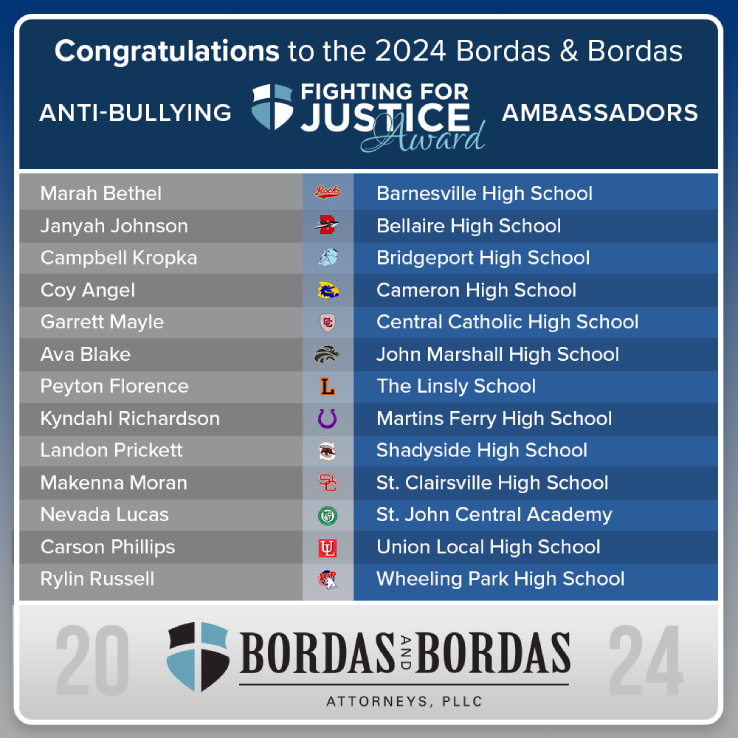
Bordas & Bordas Presents 13 High School Seniors with Anti-Bullying Award

Bordas & Bordas is proud to announce the names of the 13 students from schools in Ohio, Marshall and Belmont counties who are recipients of the Bordas & Bordas Anti-Bullying Fighting for Justice Award. The 2024 award recipients: Marah Bethel, Barnesville High School Janyah Johnson, Bellaire High School Campbell Kropka, Bridgeport High School Coy Angel, Cameron High School Garrett Mayle, Central Catholic High School Ava Blake, John Marshall High School Peyton Florence, The Linsly School Kyndahl Richardson, Martins Ferry High School Landon Prickett, Shadyside High School Makenna Moran, St. Clairsville High School Nevada Lucas, St. John Central Academy Carson Phillips, Union Local High School Rylin Russell, Wheeling Park High School “Congratulations to the senior students who have been named 2024 Bordas & Bordas Anti-Bullying Ambassadors,” said Managing Partner Jamie Bordas. “Teachers, guidance counselors, coaches and community members submit nominations sharing the positive acts of kindness demonstrated by these young adults. We are pleased to continue recognizing those who are modeling how to treat others, and making a difference in their schools and community.” The award was created in 2014 by Bordas & Bordas founder Jim Bordas and honors each Anti-Bullying Ambassador with a $500 cash prize. The criteria for students nominated includes treating everyone equally, respecting differences in others, and standing up for those who are targeted by others or are discriminated against. “We wish the Anti-Bullying Ambassadors and the class of 2024 the best of luck in their future endeavors,” said Bordas. Bordas & Bordas is a plaintiff’s litigation law firm with offices in Pittsburgh, Wheeling, W.Va., St. Clairsville, Ohio, and Moundsville, W.Va. The firm’s attorneys practice throughout the region in diverse areas of law and are licensed in Pennsylvania, West Virginia, Ohio, and Texas.

Bordas_SuperLawyers_CC_TomAnderson

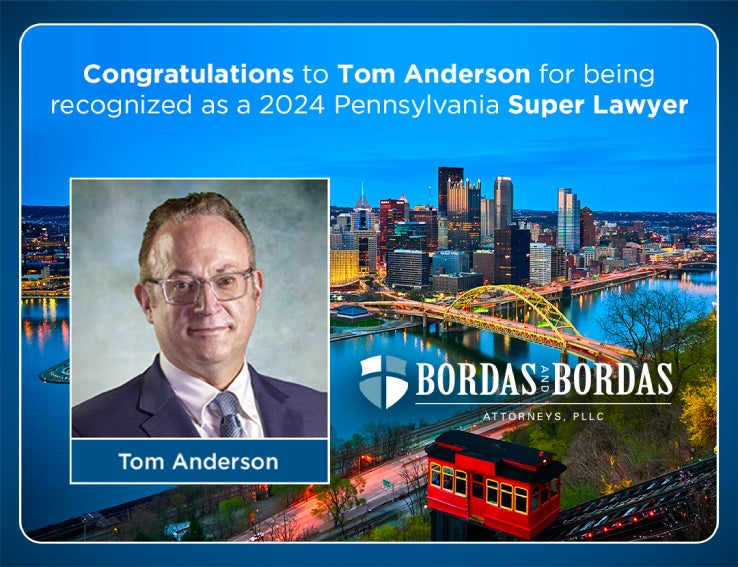
Bordas & Bordas Attorney Tom Anderson named 2024 Pennsylvania Super Lawyer

Bordas & Bordas is proud to announce that attorney Tom Anderson has been selected to the 2024 Pennsylvania Super Lawyers list. Multi-year Pennsylvania Super Lawyer, Tom Anderson, focuses his practice on helping individuals who have been injured or discriminated against in violation of state and federal laws. Anderson focuses his practice on employment law, personal injury, medical malpractice, premises liability, and commercial law. Anderson has tried many jury trials involving very serious personal injury claims, catastrophic damages, and high exposure employment actions in both state and federal courts. He has obtained seven-figure verdicts and numerous significant settlements. Recently, a jury in the United States District Court for the Middle District of Pennsylvania returned a verdict of $20,500,000 against American Home Patient/Lincare in a racial discrimination case arising out of its State College, Pennsylvania location. Anderson served as trial counsel for the plaintiff, Patricia Holmes. The 8-person jury awarded Holmes $500,000 in compensatory damages and $20 Million in punitive damages. It found that American Home Patient/Lincare, by and through its employees, including a manager, intentionally discriminated against Ms. Holmes by creating a hostile or abusive work environment because of her race in violation of federal law (Title 42, United States Code, Section 1981.) Super Lawyers, part of Thomson Reuters, is a rating service of outstanding lawyers from more than 70 practice areas who have attained a high degree of peer recognition and professional achievement. The annual selections are made using a patented multiphase process that includes a statewide survey of lawyers, an independent research evaluation of candidates and peer reviews by practice area. The result is a credible, comprehensive and diverse listing of exceptional attorneys. Bordas & Bordas is a plaintiff’s litigation law firm with offices in Pittsburgh, Wheeling, W.Va., St. Clairsville, Ohio, and Moundsville, W.Va. The firm’s attorneys practice throughout the region in diverse areas of law and are licensed in Pennsylvania, West Virginia, Ohio, and Texas.

Bordas_SuperLawyers_CC_WestVirginia_2024

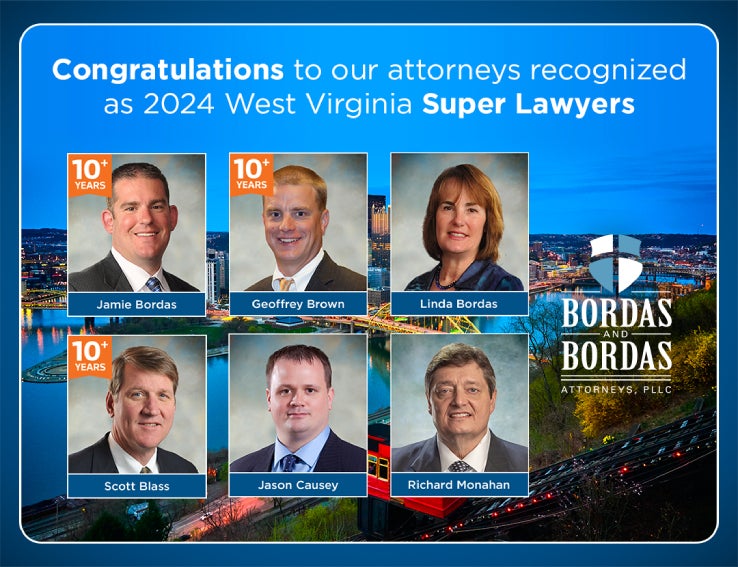
Six Attorneys at Bordas & Bordas named 2024 West Virginia Super Lawyers

Bordas & Bordas is proud to announce that six attorneys have been selected to the 2024 West Virginia Super Lawyers list.  Bordas & Bordas attorneys Jamie Bordas, Linda Bordas, Geoffrey Brown, Scott Blass, Jason Causey and Richard Monahan were selected as 2024 West Virginia Super Lawyers. Jamie Bordas, managing partner of Bordas & Bordas since 2005, has been a West Virginia Super Lawyer for over a decade. Bordas spearheads Bordas & Bordas’ operations across multiple states and jurisdictions. An extremely accomplished litigator, Bordas has concentrated on the negotiation and resolution of the firm’s most complex and significant cases, including mass tort settlements of $36,500,000 and $18,500,000 and a single plaintiff settlement of over $18,000,000. In 2019, he served as lead counsel for a plaintiff at trial and presented the Oral Argument before the West Virginia Supreme Court in a case that resulted in a $16,922,000 verdict against Walmart. The verdict is believed to be one of the largest, if not the largest, verdicts in the history of Wood County, West Virginia, on behalf of a single plaintiff. He has also obtained a $10 million verdict in an insurance bad faith case in Belmont County, Ohio. In 2023, Bordas argued a case, Harris v. Hilderbrand, Slip Opinion No. 2023-Ohio-3005, before the Ohio Supreme Court where the Court unanimously ruled that police officers do not have immunity from negligent acts with K9 officers outside of duty. He also served as appellate counsel in Brown v. City of Oil City in which the Supreme Court of Pennsylvania decided in May 2023 that a contractor who has created a dangerous condition through work performed for a possessor of land may be liable to all persons suffering injuries caused by the dangerous condition. Bordas works on cases involving diverse areas of law, including insurance bad faith, toxic torts, personal injury, medical malpractice, oil and gas cases, business litigation and more. He has frequently been  invited to speak to groups of attorneys on techniques applicable to trial skills, negotiation, mediation  and resolution of cases as a result of his reputation for getting the best possible results for his clients. He has led the firm’s expansion into Pittsburgh and the rest of Western Pennsylvania and the opening of  the firm’s Gateway Center offices in Pittsburgh. Linda Bordas, also a partner, founded Bordas & Bordas with her husband Jim Bordas when she joined his practice upon graduating from law school in 1985. She had previously worked as a hospital pharmacist and immediately applied her background to become one of West Virginia’s most successful medical malpractice attorneys. Linda has obtained numerous major verdicts and settlements in almost every area of medicine and handled appeals that have expanded the rights of patients and especially the families of children who were injured or killed as a result of negligence. She obtained a verdict of $2 Million in Davis vs. Wang, which involved the death of an infant due to medical negligence. That case also significantly affected the law in West Virginia for jury selection and juror bias in medical negligence cases and cases in general. She also obtained a $2,500,000 verdict in Klamut vs. Youssef in a case involving the death of woman as a result of medical negligence involving radiation oncology. In Andrews vs. Reynolds, she obtained a $2,760,000 verdict following the death of an infant, and helped establish law regarding loss of future wages for the survivors in a wrongful death action. In Mackey vs. Irisari, Linda obtained a $1.8 Million verdict following the failure of physicians to recognize signs of septic shock following a surgery. In Nickerson vs. Andreini, she obtained a $1 Million verdict on behalf of a young boy who required a hip replacement as a result of negligence by an orthopedic surgeon. She has also obtained multiple multi-million dollar settlements on behalf of other clients in medical malpractice cases involving various areas of medicine. Geoffrey Brown, a partner at Bordas & Bordas, has been a West Virginia Super Lawyer for 12 years. He concentrates his work on the firm’s complex litigation and medical malpractice cases. He has obtained major jury verdicts not only in medical malpractice, but also in cases of stockbroker negligence, workplace injury, and wrongful death. Brown has earned a reputation for comprehensive preparation and attention to detail in theses demanding areas of law. He has obtained multi-million-dollar verdicts in West Virginia and Ohio. Brown has also been involved in Bordas & Bordas’ business litigation department and has handled multi-jurisdictional contract disputes involving Fortune 500 companies and representation of individuals before the Financial Industry Regulatory Authority (FINRA) arbitration panel. Scott Blass has been a West Virginia Super Lawyer for 14 years. Blass has been litigating complex civil cases for over 30 years. He has obtained seven-figure verdicts on behalf of his clients in diverse areas of the law, including verdicts of over $4 million in a product liability case, $8 million in an auto accident  case, $1.4 million in an insurance bad faith case, and $5.7 million in a medical malpractice case.  Blass has also represented the families of oil and gas workers killed in fires/explosions and obtained settlements of $19 million and $19.5 million. He has been recognized as one of the foremost insurance bad faith and insurance coverage lawyers in West Virginia. Jason Causey has been a West Virginia Super Lawyer for the past seven years. Causey is a leader in consumer law in the State of West Virginia. Through aggressive litigation, he has saved dozens of homes from foreclosure. In 2011, Causey and one of the firm’s founding partners, Jim Bordas, were forced to trial against Quicken Loans in an effort to save the home of two Wheeling, West Virginia, women from foreclosure. In addition to saving the home, they obtained a verdict of nearly $3,000,000 in this predatory lending action. In 2016, Jim Bordas and Causey teamed up again for a $1,700,000 result against a municipality after a broke water-main flooded a local business. In 2017, Causey along with his co-counsel, obtained an $11,000,000 judgment in a consumer class action against Quicken Loans. Richard Monahan has been a West Virginia Super Lawyer since 2020. Monahan has been representing West Virginia citizens and consumers for more than 29 years. Among his successful trials, he has obtained verdicts and judgments of $3.9 million in a wrongful death action arising from a motor vehicle collision and $2.5 million in a retaliatory discharge case.  He has also worked in complex litigation, including substantially contributing to class actions involving natural gas rights, product liability claims involving defective drugs, and other consumer claims resulting in verdicts or settlements in the hundreds of millions of dollars. Monahan is also known for his extensive appellate work.  In addition to his involvement in numerous appeals before the West Virginia Supreme Court of Appeals, he also fully briefed and argued a case before the United States Supreme Court, resulting in a unanimous decision in favor of West Virginia class action plaintiffs in Smith v. Bayer Corp., 564 U.S.299 (2011). He was selected as Appellate Lawyer of the Week for his argument in that case by The National Law Journal. Super Lawyers, part of Thomson Reuters, is a rating service of outstanding lawyers from more than 70 practice areas who have attained a high degree of peer recognition and professional achievement. The  annual selections are made using a patented multiphase process that includes a statewide survey of lawyers, an independent research evaluation of candidates and peer reviews by practice area. The result is a credible, comprehensive and diverse listing of exceptional attorneys. Bordas & Bordas is a plaintiff’s litigation law firm with offices in Pittsburgh, Wheeling, W.Va., St. Clairsville, Ohio, and Moundsville, W.Va. The firm’s attorneys practice throughout the region in diverse areas of law and are licensed in Pennsylvania, West Virginia, Ohio, and Texas.
Tom-Anderson-Bordas-Bordas

Pennsylvania Jury Returns $20.5M Verdict Against American Home Patient/Lincare

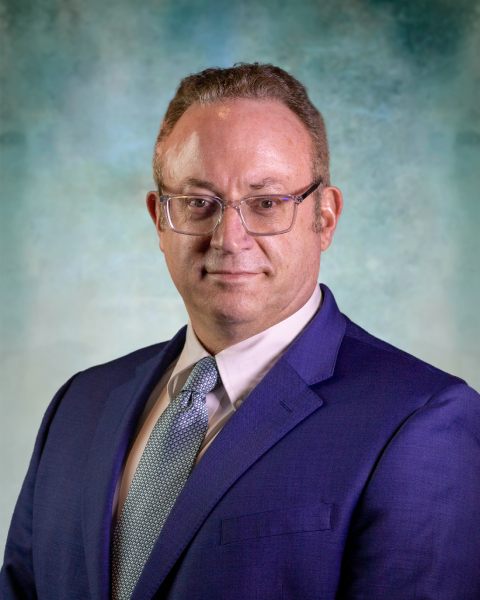
WILLIAMSPORT, Pa. — A jury in the United States District Court for the Middle District of Pennsylvania returned a verdict of $20,500,000 against American Home Patient/Lincare in a racial discrimination case arising out of its State College, Pennsylvania location. The 8 person jury awarded Patricia Holmes $500,000 in compensatory damages and $20 Million in punitive damages. It found that American Home Patient/Lincare, by and through its employees, including a manager, intentionally discriminated against Ms. Holmes by creating a hostile or abusive work environment because of her race in violation of federal law (Title 42, United States Code, Section 1981.) Evidence at trial included testimony that during the approximately 10 months that Ms. Holmes, a black woman, was employed as the only black person in that location, employees in the office, including a manager, engaged in racially discriminatory behavior.  This behavior included the use of the “N” word, references to the Ku Klux Klan, and use of the term “coonie.” Employees of the defendant conceded that they knew that engaging in racially discriminatory conduct was in violation of federal law. Tom Anderson of the Pittsburgh office of Bordas & Bordas who served as trial counsel for Ms. Holmes commented, “From the time that Ms. Holmes first described this conduct to me, my immediate reaction was that it was outrageous.  It is not conduct that is acceptable anywhere, including, and perhaps especially, in the workplace.  It was my privilege to be able to stand up and present this case on behalf of Patricia.  I was confident that once a jury heard the facts that it would do the right thing.” Following the jury’s verdict, Patricia Holmes remarked that “Collectively as Americans we all need to stand together and if we stand by each other’s sides that’s the only way we can make a difference.” Jamie Bordas, Managing Partner of Bordas & Bordas stated, “We are very pleased with the outcome of this case.  Our firm has a long history of fighting for justice for minorities and women dating back to the early 1980s.  Tom did an excellent job of representing Ms. Holmes and it makes us tremendously happy that our attorneys are able to continue to provide this type of excellent advocacy on behalf of our clients in making large companies pay when they mistreat people.” The Defendant was represented by Mishell Kneeland of the Dallas office of Culhane Meadows  and Jo Bennett from its Philadelphia office.  United States District Court Chief Judge Matthew W. Brann presided over the trial. Bordas & Bordas is a plaintiff’s litigation law firm with offices in Pittsburgh, Wheeling, W.Va., St. Clairsville, Ohio, and Moundsville, W.Va. The firm’s attorneys practice throughout the region in diverse areas of law and are licensed in Pennsylvania, West Virginia, Ohio, and Texas.
April Fools' Day: A History of Pranks

April 1 brings with it a day of laughter and lighthearted chaos: April Fools' Day. But where did this tradition of pranks and hoaxes come from? The truth is, the origins of April Fools' Day are a bit murky, lost to the mists of time. Historians have proposed several theories, each offering a glimpse into the possible beginnings of this silly holiday.nnOne theory points to ancient Rome. The festival of Hilaria, held near the beginning of April, involved merriment and merrymaking. Some believe this Roman celebration might be an ancestor of our modern April Fools' Day. Another theory connects the holiday to the shift in calendars. In 1582, France switched from the Julian to the Gregorian calendar. People who continued to celebrate the New Year on April 1, according to the old calendar, became the target of playful mockery, thus birthing the tradition of April Fools' Day.nnThere's also a possibility that April Fools' Day arose more organically. Pranks and fooling around have been a part of human culture for centuries. Perhaps, over time, April 1 simply emerged as a dedicated day for such lighthearted mischief. Whatever its origins, April Fools' Day has become a beloved tradition around the world, a day to spread laughter and remind us not to take things too seriously.

Avoid Taking A Wrong Turn - When Fun Turns To Disaster In An Instant, Just Bail

January and February are times of year I’m not too fond of, but things weren’t always this way. The little girl inside me, for instance, has great memories of sled riding. My parents’ backyard was ideal for sledding. When it snowed, the hill was just a blank slate of white, crystal-like fluff, waiting for us to make our tracks. Who would have the fastest or coolest run?nnFor my siblings and I, sled riding was convenient and a great activity we used to enjoy in the winter months for hours at a time. We had no fancy equipment. I used plastic bread bags to line my rubber boots; a bar of Dial soap to make the sled extra slippery; and layers upon layers of clothes. (Honestly telling this story, I see quite a resemblance to little Randy in A Christmas Story.) Carefully though, I ensured not an inch of skin was exposed because I was serious about this. I was ready to embark upon an adventure for the entire day. By the time we were ready to walk out our door, all you could see were eyeballs.nnWe never thought much about the risks involved. There were just a few faux pas. For example, the time my face got wind burned. Of course, the never-ending issue that could quickly become a disaster was when we had to run inside to use the restroom by dismantling all those wet frozen clothes just in the nick of time. We’d beg our Mom to yank the frozen boots off our feet so we could make a mad dash through the house. We always waited until the very last minute because sledding had to be taken advantage of while it lasted.nnSometimes, my older brother and my neighbor would build snow ramps. They always included me, but their idea of including me was assigning me jobs. And one job was very important. I was the tester. What’s this you ask? The tester is the first one to try something out to let everyone know if it has met safety protocol and was ready for use. Little did I know, I was, in other words, an experiment.nnAnticipation and anxiously eager to just hang with the boys, I didn’t object. I just jumped in and complied. That snow ramp they built – yes, I can attest the landing spot was right onto my parents’ patio – was sometimes without enough snow. I couldn’t say a word because the wind was knocked out of me, but that soon passed. There were the briar bushes – well, yes of course, you should bail because they are able to scratch you through your mittens.nnOh, and the snowball fights (yes, adding water to make ice balls does sting much more when hit).  Then, as they yell bail, I am thinking I am so wrong, They ARE looking out for me, keeping me safe – or, as I soon learned they just wanted to ride alone. That’s okay because they felt bad and to make up for it, they would always let me drag the sleds back up the hill. These were the benefits of being the little sister.nnSounds somewhat comical and probably very similar to many childhood memories, but things didn’t seem so serious back then.  We never really thought about what could go from fun to a disaster in an instant.nnWe had all the wrong approaches and just got lucky nothing too severe ever happened. Yet that’s exactly what it was – luck.nnSeriously, thousands of emergency room visits every year are the result of sled riding accidents. Broken bones, cuts, bruises, and serious head trauma are very real risks.  Some of those accidents are rather serious and can, unfortunately, even be deadly, leaving families shocked from what began with all smiles and innocent fun that suddenly turned into a nightmare.nnSafety tips: Do not stand on a sled. You should single ride a sled unless it’s a smaller child that needs an adult. Keep arms and legs inside the parameter of your sled and certainly don’t follow in my footsteps and jump off ramps and try to maneuver obstacles. Wear a helmet, which is something we never thought about eons ago. They say even a scarf can strangulate someone sled riding if it manages to tangle in just the right spot. I never, ever, thought of those things.nnAlso, use an actual sled, not a garbage can lid. If there aren’t enough sleds, just wait your turn. Yes, we were just really lucky. You better believe I got wiser as I got older and sure have thanked my lucky stars. Beware though, luck may not be on your side.nnTake the safety steps to end the day with stories, smiles and hot cocoa by the fireside instead of sitting in a waiting room for hours wondering if your loved one is going to be okay.nnIf I haven’t scared you straight enough, my next point on this topic is this: premises liability.  Ever think about that?nnYou may need to re-think letting all the kids gather at your house for a fun day in the snow because when accidents happen -- and they always do -- you could potentially open yourself up for legal woes. Depending on certain criteria in your state, personal injury on your property just may land you in court.nnCheck your homeowner coverages and be sure your space is in tip-top shape with no dangerous hazards that could possibly contribute to someone’s personal harm. Premises liability depends on the state where the injury occurred. Some consider not only property condition, but the actions or inaction of the property owner and/or the injured person. Was the person invited? Did they just decide to sled on your land without your consent? It might not matter depending on the laws in your state. You may still be liable.nnDuty of care particularly involving children is always a consideration even if you may not know the child was there to enjoy your land for the day. The uncertainty and worry of where that may place you in a potential lawsuit should be enough to be diligent and take proper care. In the end, concussions, fractures, severed digits or limbs can’t be changed once they happen. So, as you and your family have fun on these upcoming wintery days, be safe and take proper precaution. Don’t take that wrong turn because you don’t want to find out what started as innocent fun turned into a disaster in an instant.

National Courtesy Month

September is National Courtesy Month. With all the negativity in our world today, we could all use a little courtesy and kindness.nnAccording to the Merriam Webster Dictionary, courtesy is “behavior marked by polished manners or respect for others.” My parents taught me at a very young age it was always good to be courteous and kind, even in the face of someone being unkind or discourteous.nnRalph Waldo Emerson spoke about the value of courtesy when he said, “Life is short but there is always time enough for courtesy.” So many of us miss on opportunities to be courteous to others because we are so consumed with our own busy lives and things that really don’t matter.nnAlthough we should be kind and courteous every day, this month serves to remind us kindness and courtesy are both important and rewarding. Here are some small, but impactful ways we can show courtesy to others:n n Greet people with a smile; n Show gratitude; n Remember to say please, thank you, excuse me and you’re welcome; n Practice good manners in person and online; n Send a handwritten note; n Listen to others and don’t interrupt; n Apologize when you do something wrong; n Be patient and wait your turn; n Give sincere compliments to others; n Allow others to go first; n Hold the door open for someone; n Treat others with respect; n Be on time; n Share with others; and n Be charitable. n nThere are many ways to show courtesy to others. So, don’t forget this month and the rest of the year to spread courtesy and kindness. It is sure to brighten everyone’s day.nnHappy National Courtesy Month!

Contact Us

Fill out this form below and we'll contact you shortly
*Required Fields