Blog

All In the Community Know the Law Legal News and Product Recalls Legal Options
Thumbnail image for Bordas_0021.jpg

Have Fun and Stay Safe This Halloween With The Help of Online Resources

Halloween is finally upon us, and trick-or-treaters will soon be knocking at your door. Piles of candy and amazing costumes make October 31 st a night of fun and excitement for so many families. However, as you take your children house to house, it is best to be informed of any potential dangers within your area. The Belmont County Sheriff's Department has gone the extra mile to help with this. For the citizens of this county, Sheriff Dave Lucas has created a sex offender registry website for easy access. This website will allow a user to determine if there are any sex offenders living within their neighborhood. It is important to note that, if you register, this website will also notify you of any future sex offenders that move into your neighborhood. Ohio residents living in other counties can obtain comparable information through the Ohio registry here. With this helpful information, parents can plan a safe trick-or-treating route for their children. If you don't live in Ohio, there are similar options available to you through your own state. For instance, West Virginia State Police has provided a sex offender registry where you can search for information county-by-county. Pennsylvania has also created a statewide registry. At Bordas & Bordas, we love celebrating Halloween! We also love our kids and want to make sure all parents have the right tools to keep their children safe. Although not all the offenders listed on these websites should be considered a risk, it is important to be aware of your surroundings. These suggestions are meant to encourage parents and guardians to be as informed and safe as possible during this holiday season.

Boardas_0255.jpg

Dance the Night Away

So next weekend I'm participating in Dancing With the Ohio Valley Stars. I'd be lying if I said I'd jumped at the opportunity. In fact, my first thought upon being asked involved flying pigs in a frozen Hell. After all, I don't know anything about dancing. I've never watched the ABC show and can't tell a Rumba from a Roomba. Plus, I'm not exactly built for speed when it comes to the dance floor. "Break a leg" is a phrase probably closer to prophecy than favor when it comes to my natural acumen, or lack thereof, as a dancer. But when it was explained that the event is a benefit for the Augusta Levy Learning Center, I quickly reconsidered and agreed to step way out of my comfort zone. After all Augusta Levy is a wonderful organization providing a host of valuable services for needy children. I know several who have benefitted from the organization's offerings, and I really welcomed the chance to participate for such a noble cause. As far as my being asked to participate, I still can't help but think that somebody on the selection committee must have lost a bet. I keep flashing back to Steve Carrel's character in "Dinner With Schmucks". But the flyers are printed, so they're stuck with me now. For the past month, I've spent at least as much time in close physical contact with a girl half my age as I have with my wife. Under different circumstances, this kind of behavior would promptly land me on the street, with only a pile of my burned clothes to call friend. But fortunately for me, my wife, Jessica, has once  again shown supreme patience and support, as she has continuously demonstrated since we first met. She's good like that, particularly when it comes to supporting the important work organizations like Augusta Levy do to change lives every day, and I will always love her for it. Practice itself has exposed me to an entirely new culture I never had the opportunity to really appreciate before. My partner, Devyn Stidd, is a dance instructor at Take a Bow Dance Studio, located in Moundsville, and she and the other instructors have definitely brought me a deep appreciation for dance as art. Devyn, owner Chelsea Loy and instructor Caleb Cooper, have also shown supreme patience and support in getting me as stage ready as possible. It is apparent that they have all invested a tremendous amount of time, effort and discipline in their craft to perform at such a high level and they are all outstanding choreographers who have put together some really engaging and lively routines for all us civilians. I've really enjoyed watching the things the Take a Bow instructors and their students can do. The strength, flexibility and control on display at Take a Bow has been amazing to watch and, in addition to my partner Devyn, I greatly appreciate the support and instruction Caleb and Chelsea have provided me, even though they have their own partners to worry about. It's always tough at first to work closely with strangers, especially on something like dancing. But Devyn and everyone else at Take a Bow  has made me feel right at home and made this a much more enjoyable experience than I could have imagined when I came on board. The other part of practice that has been really great for me is that I've gotten to spend a good deal of time with my fellow contestant, Liz Hofreuter-Landini. I've known "Mrs. H-L" for a several years now through her outstanding work as Head of Wheeling Country Day School and have long admired her philosophies and dedication to education. And let me tell you, Mrs. H-L has brought all of her talents to this competition and she and her dance partner have cooked up a really dynamic routine. So here we are, with only a few days to go before the big night on November 2, 2013 but still a good deal of work to complete. I have to say I'm really looking forward to "performing" at the Capitol Theatre, even if it's not exactly in the way I've always dreamed about. I absolutely love everything about the Capitol, even though my track record there isn't so great. In fact, I think the last time I performed on the Capitol stage was as an 8th grader in the Linsly Extravaganza, when I delivered a badly off-key rendition of Blowin' In the Wind that basically tanked a quartet performance that included country music superstar Brad Paisley (fortunately Brad somewhat recovered). While dancing is certainly not the platform to provide me with any hope of redemption for that performance, my fingers are crossed that it can't be any worse. After all that's the beauty of setting the bar so low, or at least I hope so anyway. But I know everyone involved in putting on this event, from Augusta Levy Director Kathy Shapell to WTRF Promotions Director Jessica Rine to all the dance instructors and civilian participants, has worked very, very hard to deliver a memorable event. So I am hoping for a great turnout on Saturday night, to benefit a great cause and enjoy a fun-filled event. All in all, I have to say it's been an enjoyable experience for me and, while I don't know that I'll be rushing off to ballroom dance classes after this, I am glad I decided to trade my initial reservations for dancing shoes. And lest anyone be concerned, I will not be twerking at any point during the competition (my partner won't let me!). Hope to see you all there.

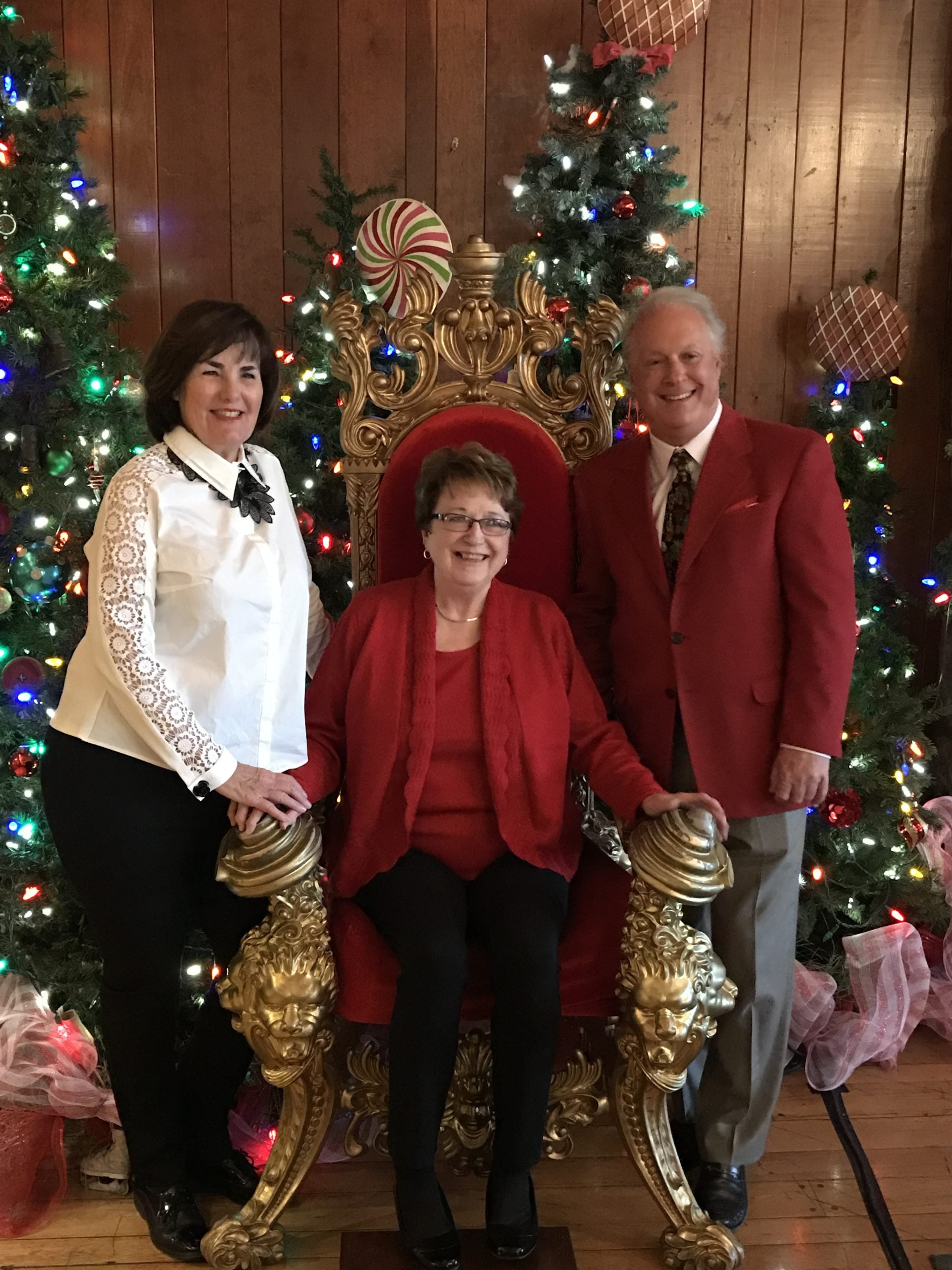
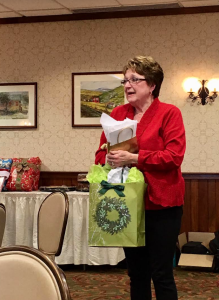
Linda Scaggs holding gifts

Sweet Caroline Finds Her Forever Home: A Rescue Story By Linda Bordas

After the death of my yellow lab, Otis, I couldn't stop feeling like something was missing in my life. I started looking for another lab to help fill the void. My son Ben's chocolate English lab, Stubby, had died a couple of years before Otis died and he was also suffering from "lab loss". You see, once you've had a lab you become addicted and have to have your lab fix. Ben asked if I would consider getting an English chocolate lab like Stubby. And so my quest began. I regularly checked lab rescue sites on the internet and asked my dear friend Barb Scanlon at the Marshall County Animal Rescue League to be on the lookout. Every time I located a rescue dog that was what I was looking for I was too late. You see, every rescue organization has its own application . By the time they call your references, talk to your vet and sometimes do a home study someone else would have been approved and gotten that dog. My disappointment was growing and I started to feel like a bad parent. Maybe this was harder than fostering a child. I then started contacting breeders to see if they had any adult dogs they were retiring or weren't suitable for breeding. My search of the states east of the Mississippi turned up no leads. I finally told my husband that I was giving up the search, that It must not be the right time and that when it was the right time my dog would find me. Fast forward six months. Corey Pietranton and I flew to High Point, North Carolina, to buy furniture and fabrics for the law office the firm is opening in Moundsville. At the end of one of the days there I returned a message from a breeder who I had spoken to last spring. She had an English chocolate lab that she was retiring from her breeding program. She lived in North Carolina less than an hour and a half from High Point. Corey hates to fly so she was all for driving home. I showed up at the breeder's with a collar, leash, 2 bowls, treats and a jug of water, I hadn't met her yet, but I knew my dog had found me. Her name was Caroline. She rode most of the way home with all 68 pounds of her in my lap. I got more kisses than I had gotten on those early dates with my husband. When we stopped at a travel plaza for a quick dinner Corey was in the bathroom with the right side of her face lathered up like she was going to shave. She's not a dog person and every now and then Caroline would lean over and slurp the right side of her face. She refused to let me drive for fear Caroline would be in her lap. The next day my husband came back from a trip to Oglebay Park with Caroline and told me that I had hit the jackpot and found a dog that was sweet, obedient and was fun. That afternoon as I watched her play football and swim with my grandson and his friend I thanked God that I had been patient enough to wait for Caroline. She quickly made everyone at the office feel like she loved them best. She likes to spend a lot of time with Corey. She is determined to turn her into a dog person. Sometimes we pray for things to happen and are disappointed when they don't. God does work in mysterious ways. He has a plan. So keep praying for what you want. After all, my dog found me!

Geoff Brown headshot.jpg

'As Many As 440,000 People Die Each Year From 'Killer' Preventable Medical Errors'

As Forbes magazine recently reported, nearly half a million people die each year from preventable medical errors. The Forbes article relies on a study recently completed by the highly-regarded Journal of Patient Safety. In the words of Forbes, new research techniques have allowed investigators to identify "killer errors in hospitals" and to locate "where the bodies are buried." As Forbes notes, it's bad enough that these inexcusable errors result in the deaths, every year, of the population of Pittsburgh plus the population of Wheeling, but hospitals are actually profiting from these mistakes by collecting revenue driven by the extra treatment these "killer errors" cause. Perhaps most shockingly, there are known steps to reduce the rate of these killer errors, but many hospitals chose not to adopt them and, instead, hide their true error rates. I agree with the author of the article that it is long past time for the public to demand accountability from the healthcare industry, its insurance companies, and their harmful lobbyists. If you, a friend, or a loved one has been harmed by the misconduct of a doctor, a hospital, or a nursing home, we would be honored if you allowed us the opportunity of providing you with a free consultation to discuss your case. While all cases are different and there are no guarantees based on past results, the attorneys at Bordas & Bordas have achieved numerous significant verdicts have obtained numerous favorable settlements on behalf of families victimized by the misconduct of healthcare providers.

Jason Causey small portrait headshot.jpg

Is Your Home Underwater? We May Be Able to Help.

Despite various efforts to turn the housing market around, 10.8 million homeowners remain underwater (meaning they owe more on their mortgages than their homes are worth), which represents 22% of all mortgages in the country. While policy makers continue to butt heads on how to respond to this huge drag on the economy, homeowners continue to suffer. Lower interest rates have not had the desired impact as underwater homeowners are generally unable to refinance at recent low rates. Putting aside for a moment the question of a political remedy, how did millions of American homeowners find themselves underwater? Yes, economic forces and a decrease in housing prices can explain part of it (but even these forces were driven by over-lending, many might say predatory lending, that was so prevalent over the last decade). However, many regions, especially those that were already economically depressed, including locally (at least until very recent times), did not see the large run-up and subsequent collapse of housing prices. Yet, under water mortgages are still prevalent. This is particularly troublesome in West Virginia where lenders are prohibited from making mortgage loans in excess of a home's fair market value. See, W Va. Code § 31-17-8(m)(8); § 46A-4-109(5)(F). Accordingly, if housing prices have not declined and lenders are prohibited from extending loans over fair market value, why are thousands of West Virginians under water? The answer is often found when the homeowner's mortgage loan is closely examined. Our litigation experience has shown that national lenders cultivated relationships with local appraisers through the allure of repeat business. In exchange for making a lenders preferred provider list, appraisers were subject to considerable influence to return appraisals with high enough values to close or even increase loans to homeowners. This influence was often in-artfully accomplished through providing target values to the appraisers directly on the appraisal order form. In Brown v. Quicken Loans, a case tried by Bordas & Bordas, the Ohio County Circuit Court determined that such a practice is contrary to the common law and consumer protection statutes of West Virginia and found "o legitimate purpose is served by providing an appraiser with an estimated value of a property. The only purpose could be to inflate the true value of the property." This finding is hardly surprising and undoubtedly correct. While this practice was common in years past, it was never appropriate. As early as 2005, federal regulators jointly issued an "Interagency Statement" condemning this conduct, "...the information provided should not unduly influence the appraiser or in any way suggest the property's value. Because of widespread non-compliance with the Interagency Statement and litigation by the New York Attorney General, the industry in 2009 implemented the Home Valuation Code of Conduct, which prohibited lenders and their appraisal management companies from "providing to an appraiser an anticipated, estimated, encouraged, or desired value for a subject property or a proposed or target amount to be loaned to the borrower." But after the near collapse of our financial markets, the industry could not be trusted to regulate itself. The United States Congress then stepped in to put a stop to various nefarious lending practices, including influencing appraisers. The culmination of these efforts was the Dodd-Frank Wall Street Reform and Consumer Protection Act signed into law by President Obama on July 21, 2010. Pursuant to 15 U.S.C. § 1639e(b)(3), Congress expressly prohibited financial institutions from "seeking to influence an appraiser or otherwise to encourage a targeted value in order to facilitate the making or pricing of the transaction." See also, 75 Fed. Reg. at 77457. Unfortunately, this federal law only applies prospectively and does nothing to  remedy the past indiscretions of lenders and appraisers. However, West Virginia was a head of the curve and has long prohibited this conduct. In fact, when a state licensed lender willfully makes a mortgage loan in excess of a residential property's fair market value in West Virginia, the price when caught is steep - The court may cancel the loan, meaning it does not need to be repaid and all prior loan payments may need to be returned to the homeowner. Homeowners are further entitled to have their attorney fees paid by the lender. So is your home underwater? Should you explore your legal rights? It is difficult for the average homeowner to accurately value their home, particularly when it was purchased many years ago. Often, the only valuation we come into contact with is from our mortgage lender. However, these appraisals or valuations, especially those obtained prior to 2010, cannot be trusted. Nor can we trust our own preconceived ideas. As homeowners, we tend by nature to believe that our home is worth more than its true economic value. After all, for years we poured our own blood, sweat and tears into improving our home, so it has to be worth way more than we paid for it and besides housing prices tend to rise. This logic often leads to a significant misconception of value. Fortunately for our West Virginia clients, we are able to obtain a retrospective appraisal from credible appraisers to accurately re-value your home at the time of your loan. If this appraisal reveals that your home was significantly underwater at the time of the loan, we may be able to obtain substantial relief and damages for you. Feel free to contact us should you have any questions or would like a free evaluation of your own mortgage situation.

attorney consulting

Why Can We Not Do Better to Preserve Our History?

When I was in school, history was one of my least favorite classes. I always felt it was so boring to have to memorize names and dates of explorers, inventors, wars etc. Why was learning to recite the Gettysburg address in front of the whole class so important? It all seemed so unnecessary. The only thing that did pique my interest was the study of prehistoric times. I became intrigued by the study of Neanderthals and the gigantic dinosaurs that used to roam the Earth so many years ago. And the pyramids of Egypt! Who doesn't enjoy a good mummy story? I remember sitting at my grandmother's kitchen table painstakingly building tiny replicas of the great pyramids of Egypt with some spilt salt declaring that I was going to be an archeologist when I grew up. I envisioned myself in khaki shorts, work boots, long hair in a braided ponytail, driving my jeep around in some hot exotic land to a "dig" to find mummies and treasures. But of course I did not fulfill that dream (cliché that it was) since I've spent most of my adult life behind a desk in a law office. This apathy for history obviously continued into my young adulthood. When I got married I was fortunate enough to join my husband, Jerry, for a year in Aschaffenburg, German where he was serving his tour of duty in the U.S. States Army. Aschaffenburg, Germany is a town that has been around since the Stone Age (no I didn't find any dinosaur bones there) and was home to a beautiful castle, the Schloss Johannisburg. The castle (as we called it) was erected on the same site of a much older medieval castle from the 14 th Century and a "keep" from the earlier Gothic castle was preserved and added as a fifth tower when this structure was built between 1605 and 1614. The castle still stands today even though it was nearly destroyed during the last days of World War II and it took them over 20 years to rebuild and renovate it to its present beauty. However, I didn't know any of this when I was living there and could really see first-hand, explore and appreciate Schloss Johannisburg because when I was a young newlywed I still didn't give a hoot about history. Sigh...opportunity of a lifetime and I was too young and naïve to care! Jerry and I loved to spend time at the castle, either alone or with friends, because we thought it was a really "neat" place and enjoyed the atmosphere of the grounds that overlooked the picturesque Main River. It wasn't until years later, actually within the last 10 years, that I was curious enough to look it up on the internet and read about its history. I'm not sure when I changed but now I cannot get enough of history. The History Channel is one of my absolute "must have" channels. I find myself looking at the old buildings around Wheeling and longing to know what was in them years ago. And I'm fortunate to live in a city that has a deep rich history and organizations that have struggled to protect and preserve the historical structures in Wheeling for years. For the past two years I have been working on a project to collect pictures of old structures and scenes of Wheeling from its early beginnings as a hub of industry. I find it so interesting to see farming landscapes in areas of Wheeling that are now populated with homes and businesses. In the same respect it has been a sad experience for me to compare pictures of the downtown areas in the 1800's and early 1900's filled with buggies and/or vehicles, so busy and productive as opposed to our present day downtown area now so empty, store fronts closed and the buildings so neglected and decayed that they must be torn down. And, sadly a lot of that history has deteriorated and met the wrecking ball anyway. The first time I saw a picture of the majestic City County Building that was built in 1876 and torn down in 1956 and replaced by our present "modern" City County Building it broke my heart. I wondered...why couldn't this building have been preserved? Fortunately, I work for people who do believe in protecting the historical significance of their property and preserving its beauty. Our St. Clairsville office, located at 106 East Main Street, was built in 1895 and still retains its grace and charm from that era and the woodwork in that office is breathtaking. Our Wheeling office, located at 1358 National Road, was built around 1891. The firm has worked hard to restore the building and retrofit it for modern business purposes while still staying true to the charm of the original structure. I'm happy to share that I can really appreciate that fact now as I never did before! I would love to have a picture of the house during the 1800's. I did find a picture of National Road around the general vicinity of the office dated 1888. I know that change is an inevitable product of progress. And I am a great advocate of progress and moving forward into the future. My concern that many of our manmade structures built today are not made to last. As I gaze at the picture of the beautiful Castle Schloss Johannisburg as it still sits today so majestically on the banks of the Main River in Aschaffensburg, Germany and realize that it has literally been there since the 1600s, it provides a stark contrast to our society where buildings are torn down in less than 100 years. We have to question why, with our skills and technology, can we not do just a little better in preserving some of the structures that we build today?

police car

Zero Tolerance Run Amok

Three recent news stories reveal that "zero tolerance" policies in our schools have truly run amok. In Boston, Massachusetts, Erin, a 17-year-old high school honor student, received a call from a friend saying that she had been drinking at a party. The friend asked for a ride home and Erin obliged. Erin arrived at the party at the same time as the police. Even though the responding police officer personally wrote a statement indicating that Erin had no alcohol and had not been drinking, the school found that Erin had violated its banned substances policy. Accordingly, she was suspended for five days and removed as captain of the school's volleyball team. In Anaheim, California, a 16-year-old arrived wore an NRA shirt depicting a deer hunter and a rifle. The shirt was gift from her father. Officials determined that the shirt violated the school's dress code because it promoted or depicted violence. As a result, she was ordered to take off the shirt or face discipline. In Coventry, Rhode Island, a key chain fell out of backpack belonging to a 12-year-old middle schooler. The key chain, which he had won at an arcade, was about the size of a quarter and shaped like a gun. This was found to violate the  school's zero tolerance policy toward guns. As a result of this infraction, the boy was suspended for three days and required to miss a scheduled field trip. Don't get me wrong. I understand the very real dangers that schools are facing in our increasingly violent culture. But these dangers must be balanced against two other, equally important considerations. First, our children "do not shed their constitutional rights...at the schoolhouse gate." Tinker vs. Des Moines Independent Community School District, 393 U.S. 503, 506 (1969). Second, overzealous enforcement of these kinds of policies is counterproductive and, in fact, can end up harming our children. Constitutional rights are just as important in our schools as they are in any other setting. Children still enjoy basic rights of free speech, assembly, and religious expression. No one doubts that schools have an important job to do and that these precious rights are less stringent within the school's four walls. But the fact remains that schools must be conscious of these rights when writing and enforcing their policies. The case involving the NRA shirt is a poignant example. Unfortunately, policies aimed at preventing violence can also be used as a thin veil for engaging in viewpoint-based discrimination. Only six months ago a middle schooler in Logan,  West Virginia was arrested and suspended for wearing an NRA shirt. All charges were later dropped. One is left to wonder if the episode was promoted by a genuine concern for safety or simply by an objection to the NRA. Not only must policies be constitutionally written, they must also be constitutionally enforced. News stories like these also raise a legitimate question: is over-the-top enforcement of anti-drug and anti-violence policies actually counterproductive? Is it actually harming the cause? I don't have any data, but my gut strongly suggests that the answer is yes. What is the takeaway from Erin's story? That helping a friend is wrong? That it would have been better to let her friend drink and drive? Let's be honest: did Erin learn any anti-drug lessons from the actions of the school district? Of course not. If anything, the ordeal probably left Erin deeply hurt and disillusioned. And what about the boy in Coventry, Rhode Island? What's a tweenager supposed to learn from facing a suspension and missing a field trip--all because of a key chain? Not surprisingly, he's upset and he's greatly disappointed that he has to forego a field trip. He's also worried that he'll fall behind in his class work. Is all of this angst teaching the boy anything about school violence? Again, the answer is a resounding no. The reality is that the boy wasn't a threat to begin with. Invoking the school's anti-violence policy under these circumstances did far more harm than good. I'm pleased to report that the school in Anaheim reversed itself a few days ago. It seems that an NRA shirt is not promoting violence. The school even issued an apology. But the other two children are still facing stiff punishments and uncertain futures that compel us to take a long, hard look at this issue. Enough is enough. "Zero tolerance" doesn't mean that school officials should stick their heads in the sand when their policies are misapplied. Anaheim did the right thing by reversing itself. Erin's school in Boston should do the same. Coventry too. The takeaway for me is that schools should apply a common sense approach to enforcing their policies. If applying the policy to a particular situation isn't furthering the goal of the policy, then, for heaven's sake, don't apply it! Unfortunately, if these three news stories are any indication, we've got a long way to go...

Driving

Texting While Driving: It's Not Worth the Risk

"Warning to West Virginia Motorists: If you text or talk on a hand-held cell phone while driving you could be pulled over, convicted and fined" As the above quote notes, West Virginia's ban on texting or talking while driving is now in effect, with 125 convictions in the first 10 months of enforcement. West Virginia Code § 17C-14-15 prevents, among other things, texting or using a cell phone while driving without hands-free use. While it is tempting to think that the penalties for a violation are not all that serious, please think again. On February 20, 2011, 18 year-old Aaron Deveau's car collided with 55 year-old Donald Bowley's truck killing the father of three. Mr. Deveau was subsequently convicted of motor vehicular homicide and sentenced to two years in prison after prosecutors were able to prove that he was distracted because of texting while driving. You should keep in mind that texting while driving could also lead to significant civil liability as well. Also, it's not just texting while driving that could lead to  problems. Even texting to a driver could lead to problems. In fact, one New Jersey appeals court held that a person who knowingly sends a text to a driver can share liability for an accident. The attorneys at Bordas and Bordas are proud to be members of the West Virginia Association for Justice, an organization dedicated to the promotion of safety through access to the civil justice system. Recently WVAJ partnered with End Distracted Driving to provide education programs to high school students about the dangers of distracted driving. On this note, over the summer, my firm had the privilege of hiring Kaylee Miller, a sophomore at Wheeling Park High School. I asked Kaylee for her perspective on this issue. As she wrote: As a teen, I, like almost all of my friends, are counting down the days until we can officially be licensed drivers. I always depend on my cell phone. Whether uploading a picture, downloading music, recording a video, or texting and messaging my friends, my phone is always with me. Unfortunately, as I begin my driving career I realize more and more how the phone could be more hazardous than helpful. Texting and driving is now a criminal offense and the leading cause of death for teens with 2,700 deaths per year. With a schedule filled with homework, sports practices and any other extracurricular activity, a bill from the Sheriff is the last thing I need. According to WV Senate Bill No. 211, operation of technology without a hands-free device results in fines up to $500. Yes, $500 for just one offense. When I think of how many pairs of Uggs or Vera Bradley bags I could buy with $500, why on Earth would I risk my life and license to answer a lousy text?! I, like a large portion of the population, have a smart-phone with an amount of settings just shy of 1.2 million it seems. Some of these settings, which I rarely pay attention to anyway, seem like the perfect solution to protect us from the temptation of answering the text tone. With airplane mode, for example, texts, calls and social media notifications of any kind are blocked for the time being. Not only does this save battery life, but when driving, it wouldn't even allow you to know of incoming messages. There's also a "Do Not Disturb" setting that only allows calls to come through on their second or third attempt. By using conversion factors and my calculator (which of course was on my phone), I calculated that by just reading a text for 5 seconds at a speed of 55 mph is approximately 404 feet of distracted driving. And that's not even replying! Imagine yourself at 70 mph while everyone around you was distracted for 513 feet. On that note, drivers of any age, 16 or 61, need to be aware of the new law. According to the WVDMV, in the first few months of effect, 125 people were convicted. More and more are unfortunately not caught. In reality, in the 10 minutes driving from point A to B, we don't need our phone even with all of its intriguing capabilities. A phone away could save your life today. Let's all remind ourselves, our family members, and our friends that text while driving is a dangerous and unnecessary risk.

Bordas_0051john.jpg

Insurance Company Propaganda: What You Should Know to Inform Yourself

A few weeks back, I wrote an article that discussed how insurance companies and big business are using their vast wealth to pervert the jury system and gain an unfair advantage over folks seeking fair compensation for injuries they have suffered as a result of the misconduct of others. As I was writing that article, I couldn't help but think of the many, many cases I have tried in which evidence which would have had a significant impact on the jury's ultimate decision was kept from them due to the rule of law. I have always felt that the more information we can give to jurors, the more likely they are to reach a fair decision. Unfortunately, the law determines what information members of the jury are allowed to receive and consider, and a good deal of information jurors would like to have is kept from them as a result. I can't count the number of times I have been involved in a trial in which the jury submits a written question to the judge during its deliberations, only to have the judge respond that the requested information is not something the jurors are allowed to consider. It happened to me again just last month. Making the situation even worse is the fact that insurance companies and big business, knowing what information jurors will and will not be allowed to consider at trial, have engaged in campaigns of misinformation which fill the minds of prospective jurors with false and misleading information before they ever set foot in a courtroom. The article referred to above exposed the falsehood of the "independent" medical exam, universally performed by a doctor who earns hundreds of thousands of dollars each year working and testifying for insurance companies. Such doctors are about as far from being "independent" as one can imagine, but that doesn't stop the insurance companies from bellowing otherwise. This article will focus on another bit of insurance company misinformation: the alleged "double recovery." One of the arguments often advanced in support of the supposed need for "tort reform" deals with cases in which the injured party has health insurance available to cover his medical expenses. According to existing laws in West Virginia and most other states, a party who has incurred medical bills is entitled to recover the amount of those bills as part of his damages at trial, regardless of whether or not he is covered by health insurance. Thus, where Joe Smith was injured in an accident and taken to the emergency room for treatment of his injuries, he is entitled to ask the jury to reimburse him the full amount of the emergency room bill, even though it may have been paid by his health insurance carrier. Insurance companies argue that allowing Joe to recover for medical bills already paid by his insurance carrier amounts to Joe essentially being paid twice for the same item of damage, resulting in the "double recovery" mentioned above. That argument is pure, 100% baloney, and the insurance industry knows it is. Nevertheless, the industry continues to belch forth such misinformation, because the end result in more money in their pockets. Allow me to explain. Every health insurance policy I have ever seen or dealt with as a trial attorney contains a provision regarding "subrogation". In fancy legal language, the typical policy provides that in the event the insured incurs medical or related expenses as a result of someone else's negligence, the insurance company is "subrogated" to the rights of the insured against the negligent party. What does that mean in plain English? It means that if Joe Smith runs a red light and smashes into your car causing you to incur medical bills which are paid by your insurance company, YOU HAVE TO PAY THE INSURANCE COMPANY BACK if you collect anything from Smith. It works like this: Smith hits you; you go to the hospital and incur bills; the health insurance policy that you paid for pays your bills; you sue Smith and recover damages; you pay the health insurance company back everything they paid on your behalf. Think about that for a second. Your health insurance policy is something you have paid for, either directly through premiums you pay, or indirectly through lower wages when the coverage is provided by your employer. Nevertheless, if you incur medical bills caused by someone else's negligence, you have to pay your insurance carrier back if you collect damages from the party who caused your injuries. To make matters even worse, you probably had to hire and pay for an attorney to help you collect your damages from the person who caused your injuries. Because of a recent decision from the U.S. Supreme Court, your health insurance carrier doesn't even have to share in the expense you incurred to collect your damages. YOU pay for the insurance coverage; YOU pay a lawyer to help you recover damages from the party at fault; and YOU end up reimbursing your insurance company for every penny they paid out on your behalf. No credit for the premiums you paid; no credit for your attorney fees. They sit back, send you letters every 90 days reminding you of your obligation to pay them back, and in the end, they get their money back. In the case I referred to at the beginning of this article, the jury returned a verdict in favor of my client, but failed to award her all of her medical expenses. After the trial, we had a chance to talk with one of the jurors, and we asked her why they did what they did. Her response: "we figured she had health insurance, so we didn't want her to get paid twice for the same thing." Another victory for insurance company misinformation. Insurance companies make billions upon billions of dollars in profit each year, and each year they try and convince the public that higher premiums and lower benefits are due to those greedy lawyers and their outrageous verdicts. It always amazes me that the people buy into these arguments. The insurance industry and big business has made an art form of convincing the public that it is in their best interest to take money out of their own pocket and hand it over to the insurance companies. We need to wake up to the reality of what is happening. Please take the time to educate yourself regarding the insurance company propaganda. For over 30 years, the lawyers at Bordas & Bordas have fought for the rights of the common man against the insurance industry and big business. It's a fight we are committed to winning, one case at a time. Call us if we can help. The results in a legal case depend on a variety of factors, many of which are unique to each case. Prior results by this firm or any other do not guarantee future results. Case results presented here are illustrations of the type of work done by Bordas & Bordas and not a guarantee that any prospective case will yield any particular amount.

attorney consulting

Protecting the Rights of Predatory Lending Victims: There's More Work Ahead

Consider the following set of facts. Jerry is solicited by a mortgage broker. The broker convinces Jerry that he should refinance his home and hires an unscrupulous appraiser, who gives an inflated value for Jerry's home. Using this inflated appraisal, the broker dupes Jerry into taking a higher loan--so high, in fact, that the loan is more than the home's actual value. With this higher loan, of course, come higher loan payments. The broker knows that Jerry can't really afford the loan, but no matter. The broker simply pockets his fees and moves onto the next victim. Does Jerry have a claim against the broker? Absolutely. But what if the broker goes out of business, or declares bankruptcy, or simply disappears? What then? Our legislature has provided protection for just such an eventuality. Mortgage brokers are required to post a bond for the protection of all West Virginia consumers, including Jerry. Next question: What happens if Jerry gets a judgment against the broker? Does the insurance company that issued the bond have to pay up? You would think the obvious answer would be yes. But insurance companies are not so fast to part with their money. In Hartford Fire Ins. Co. vs. Curtis, 2000 WL 2460723 (W.Va. 4/17/13), Hartford argued that the homeowner, Jerry Rhodes, would have to try his case all over again. Scott Blass of Bordas & Bordas, together with Dan Hedges, represented Jerry and secured a major win for consumers. The West Virginia Supreme Court held that the bond was a judgment bond. Therefore, getting a judgment against the broker was enough to obligate Hartford to pay. But that's not the end of the story. Jerry also sued Hartford for bad faith, alleging that Hartford acted inappropriately by denying Jerry's claim and compelling him to sue to recover money that was clearly due and owing. Incredibly, Hartford has taken the position that Jerry was not a "first party claimant" who had a right to sue for bad faith. But that's simply not true. The bond was written for the purpose of protecting all of the "Jerrys" who might be victimized by predatory lending practices. It was Jerry who had to sue in the first place. It was also Jerry who had to endure years of delay at Hartford's hands until it was finally ordered to pay. Obviously, then, it was Jerry who had the right to sue Hartford for its illegal tactics in delaying payment of the claim. These bad faith issues are presently before the Fourth Circuit Court of Appeals. As always, Bordas & Bordas is committed to protecting consumers and insuring that their legal rights are vindicated. We are confident that the Fourth Circuit will follow the law and reach a result that enables consumers, like Jerry, to fully enforce their rights and keep insurers, like Hartford, from violating them. This means giving Jerry, along with other West Virginians, the right to sue for bad faith when insurance companies engage in delay tactics and otherwise refuse to honor their contractual obligations. The results in a legal case depend on a variety of factors, many of which are unique to each case. Prior results by this firm or any other do not guarantee future results. Case results presented here are illustrations of the type of work done by Bordas & Bordas and not a guarantee that any prospective case will yield any particular amount.

school bus

We Are Called To Serve One Another

I had the privilege of attending the St. Michael's Catholic Grade School children's mass held last Wednesday. The song that is sung at the conclusion of the mass is titled, "We are Called." It goes something like this: Come live in the light Shine with the joy of the love of the Lord We are called to be light for the Kingdom To live in the freedom of the city of God We are called to act with justice We are called to love tenderly We are called to serve one another To walk humbly with God Come open your heart Show your mercy to all those in fear We are called to be hope for the hopeless So all hatred and blindness will be no more Each time this song is sung I think of what the mission of the law firm that my wife and I started in 1985 is all about. The way that I see our mission and hope that others in our firm see the firm's mission is reflected in the song - to give hope to the hopeless, to lend an ear, to act with justice and to love tenderly. I believe that we each are called to serve one another and should walk humbly on this earth with our God. Although I don't always get it right I try to and I'm hopeful that the rest of the members of our firm and our staff do the same thing. It has been my desire since I was privileged to be accepted to law school, graduate and be licensed to assist those in need, to stand up for the bullied, to help the widowed, orphaned and homeless and to seek justice on behalf of our clients. I also recently read an article that was attached to the St. Michael's Catholic Church bulletin with a caption, "What does it mean to be just in our relationships?" The former leader of the Catholic Church, Pope John Paul, II, stated that one should not "forget that true love sets no conditions; it does not calculate or complain, but simply loves." I believe that's who we should be as human beings. Matthew 25:31-46 identifies the corporal works of mercy that have long been a part of the Christian faith tradition. These Beatitudes should remind all of us to feed the hungry, to give drink to the thirsty, to clothe the naked, to shelter the homeless, to take care of the sick, to visit the imprisoned and to bury the dead. Most of us do pretty well with respect to caring for the sick and burying the dead but we oftentimes fail with respect to the other Beatitudes. Certainly the one that I fail most often with is one that most people think would be at the top of a lawyer's list - that is, to visit the imprisoned. I seldom do that but I intend to set the goal of doing that in the future. In considering giving drink to the thirsty, I am reminded of the missions to Africa in which volunteers are drilling wells, thereby providing clean water and saving the countless hours it takes to walk to and from a watering hole. It greatly improves the lives of those fortunate people who will be the beneficiaries of the kindness of those contributing money towards the drilling and those actually doing the digging. While I don't dig the wells sent, I send money to help buy the wells used. It seems I can best meet the requirement of that particular beatitude in that way. In further speaking of the Beatitudes, the corporal works of mercy all involve loving our neighbor. The bulletin that I earlier referred to from St. Michael's listed in "Reflections of Your Faith" three ways to love your neighbor. St. Paul reminds us in Galatians 5:13 that we are to serve one another in love. In living as a Christian, the disciples' responsibilities are to love and care for one another as Jesus taught us. The bulletin advises that we should branch out and "take a risk. Go out and meet your neighbors, especially if you are new to the area. Two: Give from the heart. Outreach does not always involve financial giving. Sharing your time or professional expertise or just offering a listening ear can make a difference to someone who is lonely, sick or struggling. Three: See with the eyes of stewardship. Stewardship is a unique way of living based in the ancient teaching that everything is a gift from God. When we give to our parish, our community, or our neighbor in need, we are sharing resources that have been given to us by grace." These suggestions to branch out, give from the heart, and see from the eyes of faith are taken almost word for word from the "Renew Your Faith" section of the September 22, 2013 bulletin. I have read the bulletin, liked what it read and borrowed the information so that I might share it with those who are reading the blog. Finally, it's this time of year that many of us start thinking about Catholic Charities, Salvation Army and others that help with clothing the less fortunate. I am also reminded of the great work that Catholic Charities and the Greater Wheeling Soup Kitchen do to feed the hundreds of people that are in need of daily meals. These are two of my favorite charities because I feel that they do great good for people who are greatly in need of their assistance. I would encourage you to consider helping these very worthy charities by either contributing money or by volunteering your time. These organizations will appreciate your help and you will feel good about yourself for the help that you provide.

Geoff Brown headshot.jpg

Natural Gas Industry Injuries: Are You Feeling The Impact?

At Bordas & Bordas, we have shared the interest of many in the Ohio Valley about the continuing development of the natural gas industry. We acknowledge and recognize the potential benefits of this drilling to our citizens in terms of jobs and economic growth. We are hopeful that those jobs and the benefits of that growth will stay in our community as much as possible. By the same token, our community has the right to demand of the powerful interests involved that they conduct their operations safely, with an acknowledgement that nothing should be more important than the health of the workers at the job site and the long-term consequences of their activities on our environment. Our children and grandchildren will be breathing the air and drinking the water here in the Ohio Valley long after these companies have gone home. Explosions and other incidents are a serious problem. The U.S. Department of Transportation, Pipeline & Hazardous Materials Safety Administration, PHMSA, has compiled some staggering statistics regarding pipeline incidents in the United States. As PHMSA states, there have been 968 serious pipeline incidents in the United States over the last 10 years resulting in 367 fatalities, 1,462 serious injuries, and over $700 million in property damage. West Virginia is not immune from the dangers of these incidents. Many of us are familiar with the dramatic Sissonville explosion in December of last year. The deaths of two workers in April of this year at the Tyler County Eureka Hunter Pipeline, and the July explosions at a Doddridge County fracking site are also recent examples, but they are far from the only examples. At Bordas & Bordas, we have a significant amount of experience representing individuals harmed through these types of explosions in industrial and residential settings. Like many other types of cases, the early intervention of an experienced attorney is critical. Evidence has to be preserved and analyzed. Often, expert witnesses and investigators need to be obtained immediately. A variety of federal and state agencies may also be involved and gaining access to the investigative reports of these agencies is very important. We have the right expert contacts and are experienced in collecting the relevant information and obtaining answers for our clients. If the facts warrant, we will aggressively fight for justice for the victims of these explosions. The results in a legal case depend on a variety of factors, many of which are unique to each case. Prior results by this firm or any other do not guarantee future results. Case results presented here are illustrations of the type of work done by Bordas & Bordas and not a guarantee that any prospective case will yield any particular amount.

Contact Us

Fill out this form below and we'll contact you shortly
*Required Fields