
It’s become tradition for my family to schedule a long weekend getaway in the fall. These getaways are specific destinations chosen to enhance our Halloween experiences. We love haunted history and actual documented ghost phenomenon. What can I say? We enjoy a good scare and the mysterious circumstances surrounding the stories. It just so happens, one of my daughters has a birthday in the days leading up to Halloween. This year is her 18 th birthday. This specific year was supposed to include our traditional haunted history trip but was tailored a bit more toward her specifically, given her birthday and all. I am the planner and always include some surprises. I try to exceed any expectations during our travels for just a little added bonus. After all, these are our family memories. These are priceless treasured moments; togetherness and time away from the everyday hustle. The location chosen for this fall getaway was Hocking Hills, OH. This would be perfect. Not too far of a drive. We could take our pets, which she cherishes dearly-an added bonus, right? Normally, I wouldn’t permit them on our getaways or vacations. There were going to be a lot of things she would enjoy. There was hiking, boating, haunted walks, houses and areas to explore. Yet, she could relax in the hot tub on the deck in the cool, crisp fall air during the late evening. Plenty of food and unique shopping experiences. Completely unintentional from this trip planner was our first scare. This scare induced a bit of an initial panic. Just what was the inadvertent scare? I booked a cabin in a very remote area. We had no phone connection, no internet, not social media, no texting - nothing. We did not realize until about a half hour before we reached our destination that we were going to be without a connected phone, iPad, or internet for three days. Talk about scaring a teenager to pieces! To my surprise, after the initial seven minute adjustment, everyone adapted quite well without anxiety or meltdowns. The connection loss was forgotten quicker than I imagined. We functioned quite nicely without the interruptions of the outside world. We painted pumpkins and played cards, hiked and fished. We just enjoyed each other with our family pets. Our time was more than plentiful. The lack of sound of the ding of the phone soon was soon forgotten from our minds. I noticed we engaged deeper into our family unit with our one on one conversations and goofing off with each other. Family with no distractions to those phones was a true birthday gift to her. And, we quickly realized that this unexpected ‘scare’ would be one of those added bonuses. We made friends with a lone duck on our lake. Kept an eye out for the black bear and fox. Had a good ol’ fashion swing – ahhh! – the fresh air and not a sound but the echo of nature surrounding us. I do not think any of us would have gone completely without our devices had we simply dared ourselves to do so. The fact that we had no choice made it doable. We went back to basics and that’s just what we did, we embraced it. The only thing concerning to me, which I really tried not to dwell on, or mention to the family at all was, what if something truly happened? Honestly, our cabin was so remote, the navigation couldn’t map our way out in any sort of a rush. After all, how could we call for help if Jason Voorhees, Michael Myers or that crazy clown would have shown up? That was the scariest of all. Guess I would have to rely on my bulldog and shorkie to save us from the scary creatures that roam the woods. Good thing I let them come after all. So, maybe an 18 th birthday spent with your family in an isolated wooded area, wouldn’t be the dream party for many young women, but mine, handled it like a trooper. She made me quite proud. She has not yet succumbed to the superficial reliability of electronics and the necessity to constantly check social media to define her existence. All of this is just one of the many beautiful things about my daughter and makes me quite proud of just how grounded she is and precious to us. She graciously thanked us for the family-oriented weekend and even added she enjoyed living without electronics, at least temporarily. Looking back, other than having a land line or some form of rapid response in the event of an emergency, I’d do it all over again. Get back to who we are without those electronic devices we seem to have we’ve grown do reliant upon. HAPPY HALLOWEEN TO ALL! Image courtesy of Unsplash.
October 25: National Chucky, the Notorious Killer Doll Day
In recognition of my birthday today, I am giving a huge shout out to “CHUCKY, THE NOTORIOUS KILLER DOLL DAY.” Dun, dun, dun! I have to say, as cheesy as they are, I love them all. I guess if I had to pick a favorite, it would be the original, Child’s Play. It came out in 1988. It was definitely the scariest. Who would have thought that Charles Ray’s soul transferring into a doll could be so enjoyable? I know he wanted Andy Barclay’s body, but I’m glad he got the doll’s instead. That’s some kind of imaginary poetic justice being stuck inside of a doll for the rest of eternity. If you haven’t heard, they are doing a Child’s Play reboot. I hope it goes back to horror instead of comedy/horror. I like horror flicks the best. Since I am the queen of “B” movies in my household, I have to represent. I have watched them all, even the ridiculously unimaginative ones that are totally unbelievable. My kids make fun of me, except my oldest son, who enjoys them too. His wife tells me what B movies he has watched lately. I just laugh because I know it’s my influence that made him that way. At least one of my children shows good sense. I have whiled away many hours watching movies someone else considered “Bs,” but to me, most of them were excellent. There’s nothing better on a chilly fall day than curling up on the couch and getting ready for some delightfully scary horror flicks. So in honor of my birthday, and, of course, Chucky, the Notorious Killer Doll Day, pop some popcorn, grab a drink, have a seat on the couch and watch Child’s Play Image courtesy of Unsplash.
The Jury: The Voice of The Community
The Seventh Amendment to the United States Constitution says that, in civil cases, “the right of trial by jury shall be preserved.” West Virginia’s Constitution also protects this important right, guaranteeing that “the right of trial by jury, if required by either party, shall be preserved.” But what makes this right so important? The Founding Fathers believed that the right to a jury was absolutely fundamental. Consider the words of Thomas Jefferson: “I consider trial by jury as the only anchor ever yet imagined by man, by which a government can be held to the principles of its constitution.” Patrick Henry was convinced that jury trials empowered the common man and guarded against oppression: “Why do we love this trial by jury? Because it prevents the hand of oppression from cutting you off ... This gives me comfort—that, as long as I have existence, my neighbors will protect me.” Philosopher Lysander Spooner put it even more bluntly: “If a jury have not the right to judge between the government and those who disobey its laws, the government is absolute, and the people, legally speaking, are slaves.” The Supreme Court has recognized that juries are meant to give the people a common voice: “ purpose of a jury is to . . . make available the common-sense judgment of the community.” It is through the jury system that community men and women of all races, creeds, and backgrounds come together and speak with one voice—demanding that those who do harm must be held accountable. To a derelict doctor, a jury can say: “If your negligence causes injury to one of your patients, you will not walk away. You will compensate that patient!” To a company that puts profits over the safety of its workers, a jury can say: “Enough! You will not treat workers like that in our community!” The voice of the jury can be powerful. The voice of the jury can be a force for change. But there are efforts that are meant to silence the jury’s voice. Next time, we’ll take a closer look at what those are. Image courtesy of Unsplash.

Aerial Lift Injuries Are Preventable With the Right Knowledge
Mobile elevating work platforms, more commonly referred to as aerial lifts, have replaced ladders and scaffolding on many job sites due to their mobility and flexibility. While theses aerial lifts often provide a more safe and efficient way to perform work at heights, unfortunately, these devices are not without their own inherent dangers. One of the known hazards associated with aerial lifts, which can lead to personal injury or death, is contact with ceilings, pipes and other overhead objects which result in trapping and crushing injuries to the operator. Occasionally, operators of these devices have been known to become trapped between the machine and surrounding objects forcing their torso onto the operator controls. As the person’s torso is forced onto the controls, the controls become activated in a manner that further moves the machine and operator towards the obstacle, worsening the operator’s injuries and often resulting in death to the operator. This situation is known in the industry as Sustained Involuntary Operation. Use of a safety system which eliminates Sustained Involuntary Operation gives the operator a vital second chance. In the mid to late 2000s, along with the growth of use of aerial lifts came an increase in the number of serious or fatal accidents, with an increase in reports of operators becoming trapped over the platform controls of the machines. Instead of accepting any blame for these injuries and deaths, or engineering out, or guarding against the known risk of Sustained Involuntary Operation, the manufacturers of these machines often blamed these incidents on operator error, site conditions, and poor operator training. There are two primary ways to eliminate or guard against operator entrapments due to Sustained Involuntary Operation: Physical Guarding and Pressure Sensing Devices. Physical Guarding These are typically steel structures designed to physically protect the operator from colliding with any surrounding structure before a trapping or crushing incident can occur. The idea is, once the operator is alerted to the hazard the steel structure will give the operator protection and allow him/her an opportunity to maneuver the platform back to a position of safety. Pressure Sensing Devices There are several different brands and types of pressure sensing devices, however, in general they all act in a similar manner. A pressure-sensitive edge sits between the operator and the platform control panel. If the operator is pushed against the control during a potential trapping or crushing incident, the pressure sensing device stops the machine from operating, thereby preventing the machine and operator moving towards the obstacle. The technology appears to function in a similar manner to how an elevator door operates while closing. In the elevator door situation, when the pressure sensor comes in contact with an object, the doors automatically reverse and open back up so that the object, usually a person or their limbs doesn’t get trapped and crushed by the closing door. This pressure sensing safety device, for use in Aerial Lifts to prevent Sustained Involuntary Operation, has been available on the market since a company, Nifty, first introduced its SIOPS device in 2009. Although this technology has been available since 2009, many other manufacturers of Aerial Lifts have been slow to adopt and incorporate this safety technology into their products. Moreover, while these pressure sensing safety devices can easily be retro-fitted to many Aerial Lifts already on the market, the manufacturers and equipment rental companies that rent out this type of equipment, have been lackadaisical in their efforts to retro-fit and make safe these existing pieces of equipment. Unfortunately, these manufacturers and equipment rental companies seem content to put profits over safety. Rather than incorporate this lifesaving technology, they continue to conduct business as usually and when a worker gets injured by this industry-wide risk the manufacturers and equipment rental businesses simply blame the worker for inattention or lack of proper training, rather than take responsibility for their failure to utilize this existing safety technology on their equipment. Images courtesy of Niftylift, Genie, & JLG Original Parts. White Paper “Intelligent Secondary Guarding: Advancements in MEWP Safety. Preventing Trapping and Crushing Incidents. Mark Keily, QHSE Director, Nationwide Platforms.
October 16: National Bosses Day
Today, October 16, is National Bosses Day. I’m fortunate to work for Jason Causey, who’s not only one of the very best and brightest in his field (representing consumers like you and me), but he’s also very kind and wants to help people in financial difficulty. Bosses Day gives the staff here at Bordas & Bordas an opportunity to show our appreciation to those we work for and with whom we spend so much of our time. Some years we provide a nice breakfast for them, which proves a little difficult since usually several are out of the office attending trials, depositions and hearings. Not sure what’s in store for them this year?? What makes a good boss? Fairness, honesty, understanding, approachability, a good communicator? Sounds like the traits you would want to have in your attorney, right? Also, good traits to have as a parent, child, student, neighbor or friend. The origin of Bosses Day dates back to 1958. Patricia Bays Haroski, an employee at State Farm Insurance Company in Illinois, registered it with the U.S. Chamber of Commerce. Ms. Haroski chose the date because it was her father's birthday. Who was her boss? ....her father. Hope you take time this month to recognize your boss! Image courtesy of Unsplash
Work Zone Speed Limits Clairified
The question of what a speed limit is in a construction zone can be confusing. There is some conflict as to what the speed limit is an active work zone versus a work zone. A party going over the posted speed limit may attempt to argue that unless the work zone is active, the speed limited is the standard speed limit and not the reduced post speed limit in the construction zone. Don’t let that argument be made although at first blush it may appear such an argument is correct. A closer review of the law shows that the work zone need not be “active” for the lower reduced speed limit to apply. Law “Active work zone” is defined as “The portion of a work zone where construction, maintenance or utility workers are located on the roadway, berm or shoulder.” (emphasis added) 75 Pa. C.S.A. § 102. When passing through an active work zone, a person must not drive a vehicle at a speed greater than the posted limit. 75 Pa. C.S. § 3365(c.1). The section reads: “(c.1) Active work zones. When passing through an active work zone, no person shall drive a vehicle at a speed greater than the posted limit. An official traffic-control device shall indicate the beginning and end of each active work zone to traffic approaching in each direction.” A person driving at a speed greater than the posted limit when passing through an active work zone is guilty of a summary offense which carries with it a fine. 75 Pa. C.S. § 3365(d)(1)(i). From this specific section, it would appear that for the speed limit to apply, the workers must be, in the present tense, located in the construction zone at the time of the incident. However, don’t be fooled into accepting and believing the same. As there is more law on this issue that shows a very technical requirement for the same and that the speed limit may apply even if the workers are not actively working the area. The state of Pennsylvania requires specific signs and lights to designate an active work zone. An official traffic-control device must indicate the beginning and end of each active work zone to traffic approaching in each direction. 75 Pa. C.S. § 3365(c.1). 75 Pa. C.S. § 3326(d)(1) requires proper notice of traffic-control devices by placing these objects to notify motorists that increased penalties apply for moving violations in active work zones. In addition, 75 Pa. C.S. § 3326(d)(1) says that official traffic control devices shall be appropriately placed to notify motorists that increased penalties apply for moving violations in highway safety corridors. 75 Pa. C.S. § 3326(e) states that official traffic-control devices shall be erected at the beginning of an active work zone with a white strobe light or other unique, illuminated light or device. The light or device shall indicate that workers are present in the active work zone. Id. The light or device shall be turned off if no workers are present. Id. An official traffic-control device shall be erected immediately at the end of the active work zone indicating that workers are no longer present. Id. According to 67 Pa. Code § 212.419(d), the “Active Work Zone When Flashing” Sign (W21-19) shall be erected as close as practical to the beginning of the active work zone. In addition, 67 Pa. Code § 212.419(d)(3) states that the W21-19 signs shall be installed on temporary sign posts or on Type III barricades, and a white Type B high-intensity flashing light must be attached to the upper portion of each W21-19 sign. The light shall be activated only when workers are present, and deactivated when workers are not anticipated during the next 60 minutes. Lastly, 67 Pa. Code § 212.419(e) concludes that the “End Active Work Zone Sign” (W21-20) shall be erected immediately at the end of each active work zone, except this sign is not necessary if either the “End Road Work” Sign (G20-2a) or the “End Work Area Sign” (G20-3) is installed at the end of the active work zone. The Pennsylvania Department of Transportation’s website summaries the requirements of an active work zone: “Active work zones must be designated as such to notify motorists when they enter and leave the work zone. A white flashing light attached to the ‘Active Work Zone When Flashing’ sign will indicate an active work zone. The flashing light will only be activated when workers are present and turned off when workers are not present.” Pennsylvania Department of Transportation, Work Zone. This only adds to the appearance that the work zone must be active to require the reduced speed. However, that is not the law. As there are areas termed “work zones” that require the posted reduced speed limits to be followed and there is law that allows Penn DOT to post a reduced speed limit regardless if it is an active work zone or not. The term “ work zone” is defined as “The area of a highway where construction, maintenance or utility work activities are being conducted which is properly signed as a work zone in accordance with regulations of the Department of Transportation.” 75 Pa. C.S.A. § 102. Motorists are required to exercise special caution in driving in construction and maintenance areas, and there are often reduced speed limits that are temporarily in place during such construction. Dale G. Larrimore, 13 West's Pa. Prac., Pennsylvania Rules of the Road § 7:7 (2016–2017 ed.) While driving through work zones, drivers are required to exercise more than ordinary caution in the operation of vehicles. Brenton v. Colbert, 157 A. 619, 620 (Pa. 1931). In an effort to keep both highway workers and the traveling public safe, it is critical to establish sufficient warnings, at the proper distances. Dale G. Larrimore, 13 West's Pa. Prac., Pennsylvania Rules of the Road § 3:10 (2016–2017 ed.). A Pennsylvania court held that classifying a work zone as not active at the time of vehicle stop simply because there were no workers in the posted 40 mph construction zone through which the defendant was speeding was too narrow of an of interpretation. Com. v. Reid, No. CP-36-CR-0003038-2013, 2015 WL 7299802 at *3 (Ct. Com. Pl April 8, 2015). In addition, although there were no workers between the mileposts where the vehicle was pulled over for speeding, there was workers on the road further west of that location. Id. The court in this case held that based upon the facts that the posted reduced speed limit of 40 mph and the proximity to active workers in the construction zone, it was found that the defendant was driving in an active work zone. Id. Something to note about this case is that it is a memorandum decision. According to Pennsylvania Superior Court Internal Operating Procedure (IOP) § 65.37(A): “An unpublished memorandum decision shall not be relied upon or cited by a Court or a party in any other action or proceeding....” 210 Pa. Code § 65.37. Analysis of hypothetical situation: Multiple signs, with and without flashing lights, have designated the speed limit as 45 mph where the accident occurred. In addition, a state trooper observed the reduced speed limit as 45 as well. While there were no workers on that side of the rode while the accident took place, there were workers on the other side of the highway and there were proper signage stating a reduced speed limit and barriers to designate a work zone. Therefore, at the very least the area should be classified as a “work zone” since there is construction, maintenance or utility work activities being conducted and the area is properly signed as a work zone. 75 Pa. C.S.A. § 102. A common-sense argument, not necessarily a legal one, for why there are these signs in a work zone is to not only protect the workers when they are there, but to also alert drivers of traffic patterns and construction equipment. In an effort to keep both highway workers and the traveling public safe, it is critical to establish sufficient warnings, at the proper distances. Dale G. Larrimore, 13 West's Pa. Prac., Pennsylvania Rules of the Road § 3:10 (2016–2017 ed.). By putting these signs before, during, and after a work zone, motorists have time to adjust their driving and anticipate obstacles. Not having workers on that side of the highway does not mean it is not a work zone and it does not diminish the need for drivers to exercise more than ordinary caution in the operation of vehicles. While it is easier to establish there is a work zone from the facts of our case, Com. v. Reid can help us make the argument that there was an active work zone present. Though Reid has no precedential value, it stated that despite there being no workers on the segment of the highway the crime took place, the area was still designated an active work zone since there were workers west of that location. Here, there are workers on the other side of the highway. It can be argued, though maybe a stretch, that this dynamic fits within the definition of an active work zone since the portion of a work zone where construction, maintenance or utility workers are located on the roadway, just going the opposite way on that roadway. It would obviously be more advantageous to have the area deemed an active work zone since there is an ample amount of statutes stating that the speed limit is definitely the rate stated by the construction signs. However, as stated above, there are some good common-sense arguments to why that posted reduced limit would also apply for any work zone, active or inactive. Here are the two statutes that govern speeding in PA. I cite 336. 75 Pa.C.S.A. § 3361 § 3361. Driving vehicle at safe speed No person shall drive a vehicle at a speed greater than is reasonable and prudent under the conditions and having regard to the actual and potential hazards then existing, nor at a speed greater than will permit the driver to bring his vehicle to a stop within the assured clear distance ahead. Consistent with the foregoing, every person shall drive at a safe and appropriate speed when approaching and crossing an intersection or railroad grade crossing, when approaching and going around a curve, when approaching a hill crest, when traveling upon any narrow or winding roadway and when special hazards exist with respect to pedestrians or other traffic or by reason of weather or highway conditions. 75 Pa.C.S.A. § 3362 § 3362. Maximum speed limits (a) General rule.-- Except when a special hazard exists that requires lower speed for compliance with section 3361 (relating to driving vehicle at safe speed), the limits specified in this section or established under this subchapter shall be maximum lawful speeds and no person shall drive a vehicle at a speed in excess of the following maximum limits: (1) 35 miles per hour in any urban district. (1.1) 65 miles per hour or 70 miles per hour for all vehicles on freeways where the department has posted a 65-miles-per-hour or 70-miles-per-hour speed limit. (1.2) 25 miles per hour in a residence district if the highway: (i) is not a numbered traffic route; and (ii) is functionally classified by the department as a local highway. (2) 55 miles per hour in other locations. (3) Any other maximum speed limit established under this subchapter. (b) Posting of speed limit: (1) No maximum speed limit established under subsection (a)(1), (1.2) or (3) shall be effective unless posted on fixed or variable official traffic-control devices erected in accordance with regulations adopted by the department which regulations shall require posting at the beginning and end of each speed zone and at intervals not greater than one-half mile. (2) No maximum speed limit established under subsection (a)(1.1) shall be effective unless posted on fixed or variable official traffic-control devices erected after each interchange on the portion of highway on which the speed limit is in effect and wherever else the department shall determine. (c) Penalty: (1) Any person violating this section is guilty of a summary offense and shall, upon conviction, be sentenced to pay a fine of: (i) $42.50 for violating a maximum speed limit of 65 miles per hour or higher; or (ii) $35 for violating any other maximum speed limit. (2) Any person exceeding the maximum speed limit by more than five miles per hour shall pay an additional fine of $2 per mile for each mile in excess of five miles per hour over the maximum speed limit. § 3363. Alteration of maximum limits. On highways under their respective jurisdictions, local authorities subject to section 6109(e) (relating to specific powers of department and local authorities) or the department, upon the basis of an engineering and traffic investigation, may determine that the maximum speed permitted under this subchapter is greater or less than is reasonable and safe under the conditions found to exist upon any such highway or part thereof and establish a reasonable and safe maximum limit. The maximum speed limit may be made effective at all times or at times indicated and may vary for different weather conditions and other factors bearing on safe speeds. No maximum speed greater than 55 miles per hour shall be established under this section except on highways listed in section 3362(a)(1.1) (relating to maximum speed limits), where the maximum speed for all vehicles shall not be greater than 70 miles per hour. (June 13, 1995, P.L.57, No.9, eff. 30 days; Dec. 21, 1998, P.L.1126, No.151, eff. 60 days; Nov. 25, 2013, P.L.974, No.89, eff. imd.) Section 75 Pa CSA 102 defines "Department." The Department of Transportation of the Commonwealth. 2013 Amendment. See the preamble to Act 89 in the appendix to this title for special provisions relating to legislative findings and declarations. 1995 Amendment. See section 4 of Act 9 in the appendix to this title for special provisions relating to report on effect of increased speed limit. § 3111. Obedience to traffic-control devices (a) General rule: Unless otherwise directed by a uniformed police officer or any appropriately attired person authorized to direct, control or regulate traffic, the driver of any vehicle shall obey the instructions of any applicable official traffic-control device placed or held in accordance with the provisions of this title, subject to the privileges granted the driver of an emergency vehicle in this title. (a.1) Penalty.-- (1) A person who violates this section commits a summary offense and shall, upon conviction, pay a fine of $150. No costs or surcharges imposed under 42 Pa.C.S. § 1725.1 (relating to costs) or section 6506 (relating to surcharge) shall be assessed or imposed upon a conviction under this section. (2) Notwithstanding any other provision of law, including 42 Pa.C.S. § 3733(a) (relating to deposits into account), the fine collected under paragraph (1) shall be deposited as follows: (i) Twenty-five dollars of the fine shall be deposited as provided under 42 Pa.C.S. § 3733(a). (ii) After deposit of the amount under subparagraph (i), the remaining portion of the fine shall be deposited into the Public Transportation Trust Fund. (b) Proper position and legibility of device: No provision of this title for which official traffic-control devices are required shall be enforced against an alleged violator if at the time and place of the alleged violation an official device is not in proper position and sufficiently legible to be seen by an ordinarily observant person. Whenever a particular section does not state that official traffic-control devices are required, the section shall be effective even though no devices are erected or in place. (c) Presumption of authorized placement: Whenever official traffic-control devices are placed or held in position approximately conforming to the requirements of this title, the devices shall be presumed to have been so placed by the official act or direction of lawful authority, unless the contrary shall be established by competent evidence. (d) Presumption of proper devices.--Any official traffic-control device placed or held pursuant to the provisions of this title and purporting to conform to the lawful requirements pertaining to such devices shall be presumed to comply with the requirements of this title, unless the contrary shall be established by competent evidence. Both 75 Pa.C.S.A. § 3111(a) and 75 Pa.C.S.A. § 3111(c) could be relevant to our analysis. Section 3111(a) states the general rule that drivers shall obey any applicable official traffic-control device. According to 75 Pa.C.S.A. § 102 “official traffic-control devices” are defined as “Signs, signals, markings and devices not inconsistent with this title placed or erected by authority of a public body or official having jurisdiction, for the purpose of regulating, warning or guiding traffic.”. In addition, 75 Pa.C.S.A. § 6122 states that “The department on State-designated highways and local authorities on any highway within their boundaries may erect official traffic-control devices…”. Thus, Penn DOT had the authority to erect that sign. And since 75 Pa.C.S.A. § 3111(c) says that the devices shall be presumed to have been placed by the official act or direction of lawful authority, we can presume that Penn DOT placed the sign there and, as stated above, Penn DOT has the proper authority to place the sign. Thus, making that speed limit the valid rate which drivers should obey under the general rule of § 3111(a). 75 Pa.C.S.A. § 3111 was utilized in in Commonwealth v. Gernsheimer, 419, A.2d 528 (Pa. Super. 1980) to establish that a reduced speed limit was valid despite it being lower than what was prescribed by75 Pa.C.S.A. § 3362 without a verifying engineering report. In that case the defendant had been found guilty of operating his automobile at a speed of sixty (60) miles per hour in a speed zone, marked by traffic-control signs, which established the maximum allowable speed at forty-five (45) miles per hour in violation of 75 Pa.C.S.A. § 3362(a)(3). He appealed alleging that a speed zone in which the maximum speed is set at less than fifty-five (55) miles per hour under § 3362(a)(3) is unlawful unless such a speed zone is established on the basis of an engineering and traffic investigation citing 75 Pa.C.S.A. § 3363 for this proposition. 75 Pa.C.S.A. § 3111(c) provides for the presumption that official traffic-control devices, such as a sign establishing a 45 mile per hour speed limit, are validly placed by an official act or direction or lawful authority. It is uncontested that the speed limit signs were official signs and that they were posted so as to have been readily observable by the motoring public. The Commonwealth was, therefore, entitled to the presumption that they were lawfully authorized. In addition, Pa.C.S.A. § 3111(a) gives deference to any applicable official traffic control devices displayed by stating that the general rule is that drivers shall obey the instructions of these devices. Analysis of hypothetical situation Multiple signs, with and without flashing lights, have designated the speed limit as 45 mph where the accident occurred. While there were no workers on that side of the rode while the accident took place, there were workers on the other side of the highway and there were proper signage stating a reduced speed limit and barriers to designate a work zone. Therefore, at the very least the area should be classified as a “work zone” since there is construction, maintenance or utility work activities being conducted and the area is properly signed as a work zone. 75 Pa. C.S.A. § 102. A common-sense argument, not necessarily a legal one, for why there are these signs in a work zone is to not only protect the workers when they are there, but to also alert drivers of traffic patterns and construction equipment. In an effort to keep both highway workers and the traveling public safe, it is critical to establish sufficient warnings, at the proper distances.Dale G. Larrimore, 13 West's Pa. Prac., Pennsylvania Rules of the Road § 3:10 (2016–2017 ed.). By putting these signs before, during, and after a work zone, motorists have time to adjust their driving and anticipate obstacles. Not having workers on that side of the highway does not mean it is not a work zone and it does not diminish the need for drivers to exercise more than ordinary caution in the operation of vehicles. While it is easier to establish there is a work zone from the facts of our case, Com. v. Reid can help us make the argument that there was an active work zone present. Though Reid has no precedential value, it stated that despite there being no workers on the segment of the highway the crime took place, the area was still designated an active work zone since there were workers west of that location. Here, there are workers on the other side of the highway. It can be argued, though maybe a stretch, that this dynamic fits within the definition of an active work zone since the portion of a work zone where construction, maintenance or utility workers are located on the roadway, just going the opposite way on that roadway. It would obviously be more advantageous to have the area deemed an active work zone since there is an ample amount of statutes stating that the speed limit is definitely the rate stated by the construction signs. However, as stated above, there are some good common-sense arguments to why that posted reduced limit would also apply for any work zone, active or inactive. Finally, a review of the identified statues allows us to argue that unless the posted speed limit signs are not covered while in active, it is a work zone for the safety of the traveling public. Regardless if there is active construction going on and Penn DOT has the right an authority to post the speed limit to a speed that it feels is warranted under the demographics of the work zone in question. In short, there is an abundance of support that shows the posted speed limit will apply in a work zone, regardless if it is active work zone at the time of the incident. Image courtesy of Unsplash.
Fighting for Justice: Let's Get Rid of Bullying
The word bullying is a word that we frequently hear and read about in the news. It certainly was present when I was growing up. I remember when I was a 10-year-old, there was a 12-year-old boy who was not particularly well liked by the older kids and who was picked on fairly frequently. As a matter of fact, I was encouraged to play a role in picking on this boy. The moment that I, through peer pressure, decided to join in, still to this day stands out in my mind and is a blemish on who I was at that time. But, I believe that it was also instrumental in who I was to become. I was the oldest of nine children - seven boys and two girls, and I lived in some fairly tough neighborhoods. I was taught by my father to box at an early age. I also was a fairly decent athlete when I was growing up. I could have been identified as a leader if someone cared to do so. At the time, I was not very confident outside of my athletic abilities. It was at age 10 that I was convinced by the older kids to fight the kid that was not so popular. So, I fought the boy, but it was not much of a fight since he did not offer much resistance. I remember the boy was crying, and I was congratulated for beating up this kid that no one seemed to care for. Soon after, I saw the boy, Eddie, and his mother walking across the playground towards my house. I knew that I was really going to be in trouble. Within minutes of Eddie and his mother arriving at my house, my own mother called for me. My mother said, “Jimmy, Eddie and his mother are here, and he has something he wants to say to you.” All I could think about is what I was going to say in defense to Eddie and his mother. I was already thinking of a story that might deflect some of the punishment that I would receive as a result of my actions. In my family, you were never allowed to start a fight, or lose a fight. But, starting a fight was strictly prohibited. Each of us knew that if we started a fight, we would be severely punished. It wasn’t bad enough that Eddie and his mother were at my doorstep getting ready to tell what I had done to Eddie, but I knew that when my dad came home, I would without a doubt be punished. Astonishingly, Eddie’s mother said, “Eddie is so sorry that he has done something that would make you angry enough to want to hit him, and he wants to apologize.” I was absolutely shocked. This was nothing at all what I expected. I immediately burst into tears and ran into my bedroom. I could not believe that this poor innocent kid, whom I picked on, was apologizing to me for something that he felt he had done when he had done absolutely nothing wrong. At age 71, I am starting to forget names. I sometimes even forget faces. But, I will never, for as long as I live, forget the name of Eddie Kuhl or the incredible lesson that his mother taught me. I made a mission after my bad behavior with Eddie to change my life. At age 10, I began thinking for the first time about bullying. I thought, what made the kids that encouraged me to pick on Eddie want to do so, and why did I allow myself to be talked into playing the role of bully! I made up my mind that this would not ever happen again to me and that if I could do something to stand up to bullies, I would do so. As I grew older and approached the eighth grade, I began playing football for the Charleston Catholic High School junior high team. It was at that time in my life that I observed first-hand the seniors bullying the eighth and ninth graders. They would make them run errands for them, and they would push them around and slap them with towels. It seems, looking back, that it was somewhat like a fraternity initiation. I thought to myself that if I was ever strong enough and in the position of a leader that I would change that. When I became a senior, I thought I could assume a leadership role, and in that role, I could encourage my teammates and classmates to look out for the smaller and weaker kids - the underclassmen. It started as just a discussion between my close friends and I that we would not allow the things that we saw as underclassmen happen to the underclassmen now. It would not be tolerated by us as seniors. We also identified the younger and weaker ones on the football team and made a mission to make them feel special and really a member of the team. For example, during away games, we would sing songs on the bus home after we won. We would call out the names of those who were known as the stars of the game. John Shemo, a smaller sophomore who didn’t get much playing time, led us in song every game of my senior year, followed by every classman who did not get to play much. These were the younger kids on the team. We also that year attended daily mass as a unit. Since some of the football players were extremely popular, that encouraged others in school to frequently attend mass. Throughout my life, I continued to have concerns about people being picked on and singled out even as I entered the legal profession. One of the most traumatizing moments I had in my legal career involved a local judge. I had just finished my first criminal case. My client was charged with delivery of LSD, and a policeman had witnessed the transaction and acted as an informant. The only defense we could offer was entrapment. It was the only time that I ever used that defense, and likewise, was the only criminal case that I ever lost. After the verdict, I made a motion for bond to be set for my client so he could remain out of jail while his appeal was being perfected. The hearing was to take place while I was out of town on vacation with my wife. This was the first vacation that I was able to take within the first two years of practicing law, so I arranged for one of my associates to cover for me. This was a routine task for the Court to continue bond until the appeal was finalized. Unfortunately, the associate forgot to attend the hearing. Since the associate did not show up, the Judge called the senior partners at the law firm I was working at and told them that I had missed the hearing and wanted me to call him. I then telephoned the Judge, who I had believed to be my friend. The judge informed me that I had missed the hearing and asked me what had happened. I explained the situation, seemingly to his satisfaction. He then told me to come to Court in the morning and to bring my client with me. When we arrived at the courthouse, I noticed two different television trucks. When we got inside the courtroom, the television crews were setting up and there were a couple of local newspaper reporters. When the Judge entered the room, he glared at me and said, “Mr. Bordas, I am glad that you could make it today. I want you to tell me why you chose to thumb your nose at the Court and ignore your responsibilities to your client this week by failing to attend the bond continuance hearing that had previously been set.” I was stunned. I then said, “Judge, as I told you last night over the telephone …” The Judge interrupted and said, “I don’t want excuses, I want you to tell me what happened.” I then said, “My associate, Greg, was supposed to cover for me. He forgot. Nonetheless, this is my client, and I was the one who was supposed to be there, and I take full responsibility.” The Judge then found me in contempt of Court and ordered me to write a 500-word paper. All of this was being filmed by the television stations and being taken down by the newspaper reporters. I was the subject of the news that day. I later found out that the Judge, whom I thought was my friend, had an ongoing battle with the senior partners of my firm, and they detested each other. He would do anything he could to get at them. In this situation, he got back at them by embarrassing me in front of the county. In fact, this instance was covered locally and nationally. Friends of mine that lived as far away as Florida and Wisconsin called to tease me about what they had seen or read. It was obviously incredibly embarrassing to me and my earliest recognition of bullying by adults. This taught me to be stronger. I have since witnessed first-hand the attempt by others to bully adults throughout my career, and I have found that bullying can occur at any stage or situation in life. Five years ago, my law firm started the anti-bullying program. We recognize children in Ohio, Marshall, and Belmont Counties who most exemplify the ideals of anti-bullying. That person is kind, considerate, courageous, and strong. That person stands out among his or her peers as one who has been able to help prevent bullying that has become so prevalent in our society. A teacher, or anyone for that matter, can identify someone who they think should be recognized. The award is a $500 check, plus tickets to a Pittsburgh Pirates game at our law firm suite, with food and drinks provided by the law firm. This seems to have been a success. The reason we started this is because I wanted to make it popular to be the nice person, the good guy, the one with the courage to stand up to bullying, although it seems to me that the message has to start with the parents and teachers, so it can filter through to kids. In order to get the message to my children, who I hoped would pass it on, my wife and I impressed upon our boys the fact that they needed to be aware of the people who were not blessed with the same opportunities as they were. Hence, if they ever saw someone sitting alone in the cafeteria, they were required to sit by them and talk to them. If they saw someone being bullied or picked on, they were to stick up for them. On the flipside of that, sometimes it is a difficult thing for a parent to ‘walk the walk’ after they were done ‘talking the talk’. I have passed up opportunities to enjoy being with some of my friends to sit with the lonely. This was not necessarily always because it was the right thing to do, but because the message that I have told my kids resonated within me. So, the message I want to relay today through this blog is that in order to try to put a dent in this bullying curse that we have in society, first we need to make it a popular thing to be against bullying. I especially think we need to make it popular to prevent bullying. I think that once we get the kids to buy into this idea, we can begin to bring the bullying curse to an end. It’s going to take a lot of work, courage, and preaching, but I think that with the right attitude, we can greatly reduce the incidents of bullying. Finally, I recently had the fortunate opportunity to watch the movie, Wonder. This is a movie that our law firm took all the Ohio County fifth graders to. I was not able to attend with the fifth graders, but my wife and I were able to watch the movie in Naples, Florida, with practically all of the moviegoers being over the age of 50. My wife and I both cried at times during the movie. Although no producers, actors, or so forth were present in this showing, when the movie was over, there was a round of applause. I have been told this has happened in many of the theaters across the country. It seems that the anti-bullying message is truly one that sells under certain circumstances. We all need to work to find the right buttons to push – then push them. Image courtesy of Unsplash.
A Missed Opportunity
In a long string of cases, the West Virginia Supreme Court has consistently enforced arbitration agreements in the face of legal challenges. The Court continued this trend in Hampton Coal, LLC v. Varney. Unfortunately, the Court in Varney refused to provide protection against forced arbitration in two important areas—in employment cases generally and in cases involving statutory claims. The plaintiff, Michael Varney, worked at a coal company for nearly 15 years. When the company was bought out, the new company required all employees to sign an agreement stating that all future employment disputes would be resolved through binding arbitration. Thereafter, Mr. Varney sued the company for “deliberate intent,” alleging that he was entitled to compensation for a workplace injury caused by the company’s intentional conduct. Mr. Varney also alleged that the company violated the human rights act, W.Va. Code 55-11-1, by demoting him after an illness. Citing the arbitration agreement Mr. Varney was forced to sign, the company moved to compel arbitration. The trial court found the agreement to be unenforceable. The Supreme Court, however, reversed the trial court’s ruling and found the agreement to be enforceable in its entirety. First, the Court rejected the argument that more stringent rules should be applied in the employment context. Employers often require employees to sign an arbitration agreement as a condition of employment. Because the arbitration agreement is offered on a take-it-or-leave-it basis, Mr. Varney argued that it was unsupported by consideration and, therefore, unenforceable. The Court disagreed, finding that the agreement was valid simply because it contained mutual promises to arbitrate. Second, Mr. Varney argued that statutory claims should not be arbitrated. Claims arising under the human rights act are meant to implement our state’s public policy favoring equal treatment. Those claims should be heard by law-trained judges and decided by juries chosen from a cross section of our communities--not by arbitrators. There are, after all, critically important rights at stake. Nevertheless, the Supreme Court held that even statutory claims are subject to arbitration, depriving Mr. Varney of his right to a jury trial. Unfortunately, this case is part of a steady erosion of the right to a jury trial—a right guaranteed by the Seventh Amendment. Compelling arbitration in employment cases deprives working West Virginians of a valuable right. Hopefully, the Supreme Court will correct its course in the future so the right to a jury trial will be fully protected. Image courtesy of Unsplash

September 25 is National Voter Registration Day
National Voter Registration Day: September 25, 2018 The fourth Tuesday of September is known as National Voter Registration Day. Voting is one privilege in this Nation that many people fail to exercise. Considering the political climate in our country today, and the upcoming midterm elections, it is more important than ever that folks get out and exercise this right. I found some interesting facts on the internet. If you’re not registered to vote, now is the time to do it! Make sure to check out your polling place and deadlines before it’s too late. Here are some fun historical facts about voting: 1. No idiots, please Ohio's constitution bans "idiots" from voting according to Article V, Section 6 of the state constitution. 2. George Washington campaigned with booze During his first legislative run, George Washington spent his campaign budget of 50 pounds on a round of election day drinks for his constituents. 3. Voting, Texas-style As part of the Texas voter ID process, you can't vote with a student ID but if you show a gun license, you're good to go. 4. Those persevering Utah women Utah women voters were granted the right in 1870 — but it was revoked by Congress in 1887 — and re-instituted by the state in 1895. 5. You had to pay a tax to vote Poll taxes, started in the 1890s, legally kept southern African-Americans from voting by making them pay for the right. 3 important facts you should know about voting & what you can do to spread the word: 1. Time to celebrate our democratic heritage National Voter Registration Day has volunteers out en masse with voter registration activities at school, in the workplace, and in your neighborhoods. For one whole day, volunteers and various organizations collaborate by setting up registration tables, knocking on doors or producing social and mass media awareness campaigns over the importance of registering to vote. National Voter Registration Day makes an all-out effort to register the tens of thousands of Americans who can make a difference at the ballot box. 2. Don't hate—celebrate National Voter Registration Day discourages political voter rage in favor of voter celebration. Imagine over 10,000 volunteers working together one full day to educate Americans on one of our most precious rights — the right to vote. In 2016, 750,00 voters registered on National Voter Registration Day. With so many world citizens denied this basic right, promoting our core democratic values, voting, should give all Americans something to cheer about on National Voter Registration Day. 3. It educates Americans on voting rights National Voter Registration Day reminds and educates American on the voter requirements. You must be at least 18 years old, a U.S. citizen, and a current resident of your state. When you see a National Voter Registration Day table or volunteer, you can do more than just register. You can confirm your polling place, update your registration details, or just get information if it all seems a little over your head. Voting — it's all good! Image courtesy of Unsplash.

The Mountain State: Almost Heaven, Bad Roads
I love living in a rural area. I have a 45 minute commute each day and I wouldn’t change it for the world, however, in the past few years my commute has become more and more of a daily challenge. I can take a few different routes, on back roads or main roads, to get to work each morning. Lately, I have found there are several questions I ask myself each morning to determine what the best route would be. Some things I take into consideration in trying to map out my morning commute are whether there’s a “super load” coming through, and which road it is on. What condition is the road in? For instance, how many potholes, slips, etc., will I encounter? I also consider where the pipelines are going through or where a well is being drilled, because usually that means a LOT more traffic on that roadway—everything from workers going to the job site, to tractor trailers hauling heavy equipment. It’s sad when you wake up and it’s raining and you’re happy because you know you won’t have to deal with the traffic because the workers are rained out. There is no doubt that the oil and gas boom of the past several years has boosted our economy and put people back to work and I am all for that, but there’s a price to pay for all of this progress and unfortunately all of the traffic, hauling of heavy equipment, etc., has taken a toll on our local roads. They simply weren’t constructed to handle the heavy loads and major traffic that they see now. There are three major slips on a seven mile stretch of my ridge alone. These are severe slips that have taken what once was a narrow, two-lane road, and turned it into a narrow, one-lane road. In some places it is barely wide enough for a school bus to get through which, in my opinion, is a safety concern. Most of the roads in Marshall County and neighboring counties are in very bad shape, especially the rural ones, with multiple slips, pot holes, etc. The “solution” seems to be to put out a few orange barrels or signs and have people try to navigate around the problem area, rather than fix it. I have seen a couple of really good repairs on some of the ridges but was told that the oil and gas companies are the ones who actually repaired them. We constantly hear that the state has no money to fix the roads—why is that? I’m not really sure who should be responsible for the repairs, but wouldn’t it be nice if someone would step up to the plate and get the roads fixed for the safety of everyone?
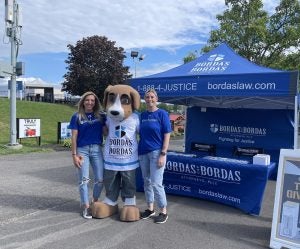
Recap: United Way Day of Caring 2018
The United Way of the Upper Ohio Valley held their yearly Sandy O’Haver Day of Caring on Wednesday, September 12, 2018. This event is to bring awareness to the monetary needs of our many non-profit organizations and to provide assistance with any odd jobs that need completed at their facilities. A very large group of 350 volunteers assisted in this endeavor. Bordas and Bordas was the Campaign Kick-Off Sponsor and also generously asked for volunteers from the law firm to join in and lend a helping hand to the agencies we were assigned. The Laughlin Memorial Chapel on 18 th Street in Wheeling was visited by half of our volunteers where we organized a very large storage room of paper, crafts, art supplies, books, toys, games, and a myriad of school supplies, helped to move and clear items to be otherwise utilized and/or discarded from the basement and sorted through books in the library. The other half of our volunteers went to Wheeling Health Right on 29 th Street in Wheeling where they painted two offices. We were provided with lunch and met some wonderful, giving people. Both of these non-profit organizations (as well as all those the United Way assists) are very important and this day provided an insight into what they do for members of our community. The group I was with visited the Laughlin Memorial Chapel where they are on a mission to provide a safe haven after school for many of our community’s children. Some of the programs/activities provided for children in grades K-8 range from assistance with homework, art and music activities, teen G.A.P. (Get Ahead Program) among many others, along with providing a healthy snack and sitting down to a “family style” dinner and available transportation to and from the facility. Having a broad spectrum of ages and children from several different area schools proves quite challenging but is absolutely rewarding knowing they are providing children with a good, sound place to go after school. The children know they are cared for and that they matter to God. The Chapel’s mission statement: “Continue in what you have learned…” 2 Timothy 3:14. Supporting the United Way of the Upper Ohio Valley allows them to promote good health, quality education and sound financial stability by assisting many organizations in our community which in turn provides for a brighter future for everyone. * Photos courtesy of the United Way of the Upper Ohio Valley* "Supporting the United Way of the Upper Ohio Valley allows them to promote good health, quality education and sound financial stability by assisting many organizations in our community which in turn provides for a brighter future for everyone."

The Art of Hygge
Hygge (prounounced Hue-guh) is a Danish word used to acknowledge a special feeling or moment. It can be alone or with friends, at home or out, ordinary or extraordinary, but it is always cozy, charming and special. Recently, I have read that Denmark is one of the top three countries in the world that is considered the happiest. You see, the Danes have created a method called “hygge” which is an art of creating intimacy and coziness in their homes. With so many cold, dark days the simple act of a glowing candle while sipping on a cup of coffee in the morning or a home cooked meal with friends by candlelight can make a huge difference to a person. Hygge is an art of taking in a deep breath of life. It’s making a meal at home and taking in the tastes and smells. It’s making your home a sanctuary where people feel as though they live there as well. It’s surrounding yourself in warm blankets, fuzzy socks and hot tea. In short, it’s getting in touch with your senses and being at peace. Hygge is the ability of being present and appreciating the minimalist outlook. It’s simple. Just be happy…and they are! *Image courtesy of Unsplash
Contact Us
The information you obtain at this site is not, nor is it intended to be, legal advice. You should consult an attorney for advice regarding your individual situation. We invite you to contact us and welcome your calls, letters and electronic mail. Contacting us does not create an attorney-client relationship. Please do not send any confidential information to us until such time as an attorney-client relationship has been established.
The results in a legal case depend on a variety of factors, many of which are unique to each case. Prior results by this firm or any other do not guarantee future results. Case results presented here are illustrations of the type of work done by Bordas & Bordas and not a guarantee that any prospective case will yield any particular amount.
Request Consultation
Call 304-242-8410 or fill out the form below.