Blog / Legal News and Product Recalls

Shock for Republicans, and a Strike for the Schools, as Teachers Refuse to Sell Out Students

There’s nothing worse for a corrupt politician than meeting someone who can’t be bought. It’s like watching a cat fall in a bathtub: you see first shock, and then anger, as though the world itself has betrayed him. A sellout simply assumes that everyone else is also selling and he bristles at a world where money is not the only currency. The Republicans designed Senate Bill 451 as straightforwardly as any protection racket. A five-percent raise for West Virginia’s educators, inextricably linked to a series of proposals to weaken her public schools. The text of the bill explicitly stated that if any part of its “omnibus” provisions were found unconstitutional or illegal, the raise would be taken away. “That’s a nice paycheck you’re getting, teach. Be a shame if something happened to it. . . .” It must have seemed like a sure thing for Senate President Mitch Carmichael and the GOP. “We’ll make them an offer they can’t refuse.” But it turns out that West Virginia’s teachers and school service personnel weren’t selling. On Tuesday, February 19th, they went on strike for the second time in as many years. They had every reason to do so. Republicans filled the omnibus bill with poison pills. It contained provisions weakening the right of teachers to unionize and negotiate in the future. It diverted public money into private hands in the form of so-called charter schools that have allowed private businesses to walk away with hundreds of millions in tax dollars leaving students and communities with nothing. It sought to deprive veteran teachers of benefits they had earned over years of service. It’s not hard to figure out what this is all about. The three largest pots of money in state government are the roads, the schools, and Medicaid. That’s why your typical Republican idea involves taking money from one of these three pots out of the public’s hands and transferring it to some private businessman. Charters and other privatization schemes are the chief method for doing this in the education arena. Privatization of public schools yields predictable results. Wealthy families take full advantage, and concentrate their kids in schools with vast resources. Middle class families have to go into debt just to get a whiff of the middle-of-the-road schools. What little public money is left is what the poor kids get: the worst facilities, locations, lowest-paid staff, and then they are concentrated away from the lucky winners. And charters have ways of weeding out the kinds considered “undesirable” by the architects of these cash grabs. The Republicans thought they could buy all this hardship for West Virginia’s kids with a raise for the state’s educators, but the teachers and school service personnel declared on Monday evening that the kids and their schools were not for sale. The out-of-state organizations, like ALEC, that run these bills on a river of special interest money must be stunned to find a group of people they can’t pay off to get what they want. It’s pretty clear that part of Carmichael’s motivation to push this without the governor has to do with payback from last year’s strike. That’s why his version of the bill included the anti-union and anti-strike provisions. Republicans proposed those changes as a way of saying “we’ll negotiate in good faith as soon as you lay down your arms.” Agreeing to terms like that would be an unconditional surrender – accepting not only the plundering of the education budget this year, but in every year to come. Now that the strike has begun, West Virginians need to come together and understand the stakes. Killing the bad bill is not enough. The Legislature needs to reform education the right way, with students put first instead of private business. West Virginia’s teachers remain some of the lowest paid in the country and that needs to change. The raise must go through without the poison pills. Moreover, the PEIA system needs to fixed once and for all to guarantee its future solvency with adequate revenue. Even if the oil and gas drillers have to pay another point or two on their millions and billions, West Virginia’s kids deserve that money to fund their educations. The opioid epidemic and the poverty in West Virginia have made social workers and psychologists out of educators. New funds need to be appropriated to add counselors and trained professionals to help kids with drug issues in their homes cope at school so they can learn when they’re in class. The current ratio of students to counselors should be cut in half by adding enough new personnel so that every child can get the special help they require. Funding must also be increased for students with disabilities. It is a persistent injustice that children with physical, mental, or emotional disabilities are often left behind because politicians will not adequately fund the equipment needed to integrate those kids into regular classrooms. Research shows they can succeed if accommodations are made. Every student is a precious resource and our political leadership needs to treat each child as equally deserving and worthy of education. Before anyone says “well, how are we going to pay for all that,” remember that hundreds of millions of dollars in tax cuts for wealthy businesses are always at the top of the Republican agenda. They say we have the millions and millions to do that, so it stands to reason we have the money to do what’s right for West Virginia’s children. The kids have waited long enough for their priorities to be the top priorities. The educators and their strike represent the overwhelming majority of West Virginians’ interests. If teachers can’t strike to do what’s right for the schools and the children, how can any working people hope to stand up for better wages, decent hours, or affordable medical care? Everyone who works benefits when a strike succeeds. Let everyone in this state who earns a wage come together to support this strike for as long as it takes to secure the reforms we need. Some school days will be missed. But solidarity in the face of injustice and unity in support of what is right will be the best lesson West Virginia’s children ever learn. Christopher J. Regan is the former Vice Chair of the West Virginia Democratic Party and an attorney with Bordas & Bordas, PLLC in Wheeling.    

Posted in:

Related Posts

Hospital sign pointing to the Emergency Room and Main Entrance outside a medical building

$3.77 Million in Medical Malpractice Case Against Wheeling Doctor and PA

WHEELING, WV / PITTSBURGH, PA — An Ohio County, West Virginia jury has returned a $3.77 Million verdict in a medical malpractice case against a doctor and a physician’s assistant at WVU Medicine Wheeling Hospital. Following a four-day trial, the jury found both Dr. Barry Mitchell and Physician’s Assistant Michelle Porembka negligent in their medical care of 64 year old Julie Daley when she presented with abdominal complaints at the Wheeling Hospital emergency room in June 2022. As a result of the medical care providers’ failure to timely and properly treat her condition, Daley ultimately sustained a perforated colon along with necrosis which ultimately lead to her needing to have a permanent colostomy. The jury found that the conduct of both Mitchell and Poermbka fell below the standard of care for medical care providers in their field and that their negligence proximately caused injuries and damages to Mrs. Daley.  Daley was represented at trial by Geoff Brown and Tyler Smith of the Wheeling law firm of Bordas & Bordas. Following the verdict, Smith commented, “We are pleased that the jury recognized that this should not have happened to Julie Daley and that they compensated her for the life-long effects that she will have as a result of the negligence of the medical providers.” Mark Robinson and David Givens of Flaherty, Sensabaugh, and Bonasso represented the medical providers at trial.  Circuit Court Judge Jason Cuomo presided over the case. Brown stated “Our practice is based upon fighting for justice for people who have been injured or wronged by others.  Helping others is at the root of everything that we do and we are glad that we were able to help Julie and her family obtain a measure of justice through this case and this result.” About Bordas & Bordas Founded in 1985, Bordas & Bordas Attorneys PLLC has earned a reputation as one of the region’s premier personal injury and plaintiff litigation law firms. With offices in Wheeling and Moundsville, West Virginia; Pittsburgh, Pennsylvania; and St. Clairsville, Ohio, the firm represents clients in cases involving automobile and trucking accidents, medical malpractice, workplace injuries, nursing home negligence, product liability, wrongful death, insurance bad faith, and more. The firm operates on a contingency fee basis (clients pay only if there is a recovery) and offers free initial consultations. Rooted in its core values of experience, family, community, and results, Bordas & Bordas continues to stand as a trusted advocate for individuals and families across the Ohio Valley and beyond. Visit www.bordaslaw.com for more information.

The Pennsylvania Superior Court Analyzes the Federal Public Readiness and Emergency Preparedness Act in Denying Defendants’ Motion for Judgment on the Pleadings

The Pennsylvania Superior Court Analyzes the Federal Public Readiness and Emergency Preparedness Act in Denying Defendants’ Motion for Judgment on the Pleadings

The Pennsylvania Superior Court Analyzes the Federal Public Readiness and Emergency Preparedness Act in Denying Defendants’ Motion for Judgment on the Pleadings In Boyle v. Meyer, 2025 PA Super 198 (September 9, 2025), the Pennsylvania Superior Court denied a physical therapy company’s motion for judgment on the pleadings based on the immunity provisions contained in the federal Public Readiness and Emergency Preparedness Act (PREP Act). Background of the Case Plaintiff Boyle required physical therapy following open-heart surgery. To minimize the risk of contracting COVID-19, he arranged for OSPTA Home Care to provide in-home services. On November 8, 2020, physical therapist Meyer arrived without gloves, a face shield, or a proper mask — only wearing a thin, disposable surgical mask. Meyer also shook Boyle’s hand without gloves, did not wash her hands before treatment, and performed therapy as usual. Days later, OSPTA informed Boyle that Meyer had tested positive for COVID-19. Boyle soon developed symptoms, was hospitalized for ten days, and continued to suffer complications five months later. Boyle sued OSPTA and Meyer, alleging: Meyer was negligent in failing to wear proper personal protective equipment (PPE). Meyer exposed him to unreasonable risk and performed therapy despite known exposure. OSPTA failed to properly train and supervise Meyer and implement safeguards to prevent the virus’s spread. Defendants’ Motion and PREP Act Defense In response, Defendants admitted Meyer was not wearing gloves or a face shield but stated she wore a surgical mask and used hand sanitizer earlier in the day. They argued they were immune from liability under the Public Readiness and Emergency Preparedness Act, 42 U.S.C. §§ 247d-6d, 247d-6e. Defendants asserted that they met all four requirements for immunity: Public health emergency – The COVID-19 pandemic triggered PREP Act protections. Covered persons – They qualified as both “program planners” and “qualified persons” under the Act. Covered countermeasure – Meyer’s “thin, disposable surgical mask” was a device authorized for emergency use by the FDA. Causal relationship – Meyer’s use of the mask had a causal connection to Boyle’s COVID-19 claim. The trial court denied their motion for judgment on the pleadings. Superior Court’s Analysis On appeal, the Superior Court found several factual disputes that prevented judgment for the Defendants. Specifically: It was unclear whether Meyer’s surgical mask qualified as a “covered countermeasure.” The pleadings did not conclusively establish that the Defendants were “covered persons.” Even if both were true, PREP Act immunity applies only to the use or administration of a covered countermeasure — not to its non-use. Citing Hampton v. California, 83 F.4th 754 (9th Cir. 2023), the Court noted that the PREP Act shields defendants from claims related to administering a covered measure, but not from claims alleging failure to administer one. Because Boyle’s complaint focused on the failure to use proper PPE, inadequate screening, and lack of training, his claims fell outside the scope of federal immunity. Conclusion The Superior Court concluded that the PREP Act did not preempt Boyle’s state-law negligence claims, affirming the trial court’s denial of the motion for judgment on the pleadings. The full opinion in Boyle v. Meyer, 2025 PA Super 198 (September 9, 2025), is available on the Pennsylvania Judiciary website. To learn more about legal issues surrounding immunity and negligence in Pennsylvania courts, visit our post on how the PA Superior Court reviews evidentiary challenges in medical cases.

Lead Risk Prompts Nationwide Recall of Ground Cinnamon

Lead Risk Prompts Nationwide Recall of Ground Cinnamon

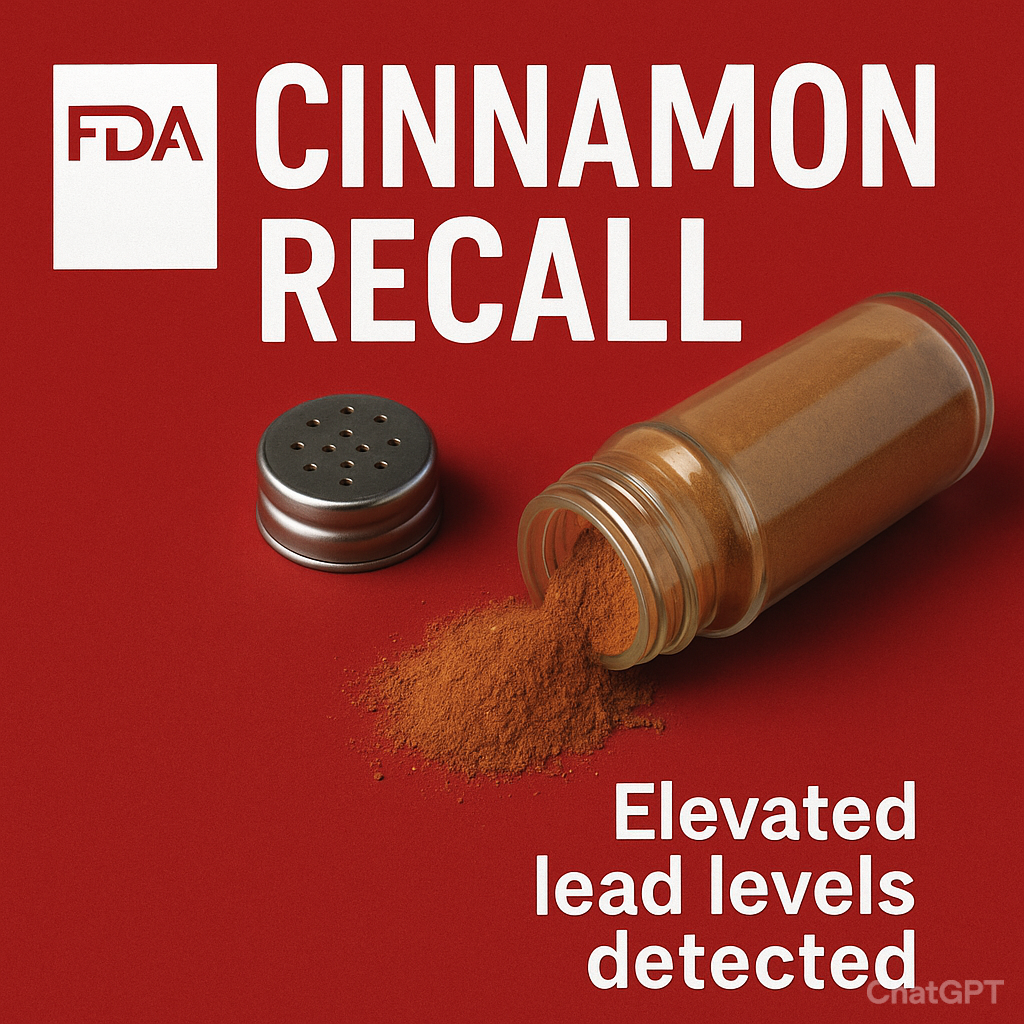
Lead Risk Prompts Nationwide Recall of Ground Cinnamon The U.S. Food and Drug Administration (FDA) has issued a nationwide recall of 12 ground cinnamon brands after testing revealed elevated levels of lead. Roughly 21,690 units were sold through retailers like Dollar Tree and Save-A-Lot before being pulled from shelves. Consumers are urged to immediately throw away any affected products and avoid purchasing them until further notice. See the official FDA recall notice. Why This Recall Matters Although no injuries have been reported yet, the FDA warns that prolonged consumption of contaminated cinnamon can cause lead accumulation in the body. Children are especially at risk, since lead exposure can impact neurological development. Cinnamon is often used in foods like cereals, baked goods, and snack mixes — staples in many households with kids. This makes the recall a major public health concern for families nationwide, including those in West Virginia, Ohio, and Pennsylvania. FDA’s Broader Effort This recall is part of a larger FDA initiative to monitor imported spices more closely. Several cinnamon brands have been flagged in prior alerts, and surveillance is ongoing. For example: The FDA recently added Asli brand ground cinnamon to the list of affected products after new testing revealed unsafe lead levels. Additional products may be named as investigations continue. See the expanded FDA alert. What You Should Do If you purchased ground cinnamon recently: Check your spice cabinet against the recall list. Dispose of any recalled products immediately. Do not repurchase affected brands until the FDA clears them. If you suspect your child or another family member has been exposed, consult a healthcare provider for guidance. For ongoing updates, visit the FDA’s cinnamon recall page. Protecting Consumers This recall is a reminder that product safety issues extend beyond toys, appliances, and vehicles — even everyday food staples can carry risks. Families in WV, OH, and PA should stay informed about recalls and understand their rights if a defective or dangerous product causes harm. At Bordas & Bordas, our attorneys help consumers hold corporations accountable when safety takes a backseat to profit.