Blog / In the Community

Critical Thinking About Mine Safety in West Virginia

Boardas_0216.jpg
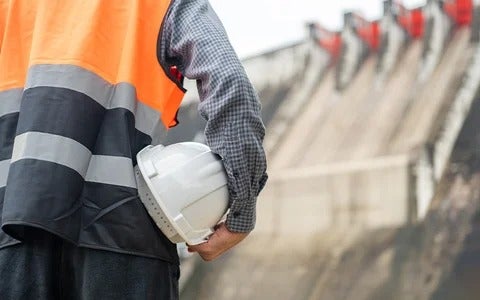
As a recent transplant to West Virginia, I have had little personal experience with the coal mining industry that is such an essential part of this state's economy. Of course, I had general ideas as to what coal mining involved; holes and tunnels dug deep into the ground, miners working to remove the coal from dark caves, and special machinery used to dig and transport the coal. I know that the process poses a variety of significant safety risks to miners, but I always assumed that for an industry that is both essential to the economy and potentially very dangerous, every possible precaution would be taken to help ensure miners' safety and reduce the risk of accidents. As I become more familiar with West Virginia, and the issues important to our state, I have come to learn that my assumption about mining safety is not entirely accurate, and that miners and their families are forced to work hard to try to prevent tragedies, especially where the legislature and regulatory boards refuse to do so. Recently, the West Virginia Gazette reported the story of a young woman named Caitlin O'Dell who appeared at a monthly meeting of the West Virginia Board of Coal Mine Health and Safety. Following a tragic accident where her husband was crushed to death by a scooping machine in an underground coal mine, Mrs. O'Dell was determined to convey a message that the board has heard time and again: that rules requiring "proximity detection" devices in mines are a necessity to protect miners. Despite the fact that this issue has been raised repeatedly over the past several years, and despite the fact that accidents similar to the one that killed Mrs. O'Dell's husband continue to claim the lives of miners, the board has chosen to sit on the proposed safety requirements. No rules or regulations have been passed that require proximity detection systems. This meeting was no different, and the proposal to require proximity detection devices failed, with a 3-3 vote. Government and regulatory inaction in regards to the health and safety of miners coalminer.jpg has been even more troubling in light of the recent government shut-down. In response to the shut-down, the Mining Safety and Health Administration has been conducting fewer inspections, and has focused inspection resources on those mines deemed to be "high hazard" locations. On each day of this past weekend, where inspections may be even less likely to occur due to lack of employees available to conduct them, a miner has lost his life in an on-the-job accident. One of these deaths occurred in Moundsville, West Virginia. Another involved an accident in which an underground cart rolled over a worker, presumably the type of accident the proximity detection devices are designed to help prevent. While these recent deaths cannot be conclusively attributed to the government furlough, the situation highlights the need for prevention, rather than relying solely on inspections and measures taken in response to accidents. Rules requiring mines to instill and operate safety measures at all times could help ensure that miners' safety is not compromised by a lack of government employees to conduct inspections and supervisory measures. To be sure, inspections are an essential part of maintaining safety in the mines, but the message that is becoming increasingly clear is that prevention must be the next step taken, and it must be taken at once. By appearing in person to urge the board to take action on these long-stagnant proposals, Mrs. O'Dell hoped to press the issue and effect change. She represented a man who may very well still be alive if proximity detection devices were required and used in every mine. As she herself asserted, her goal was to prevent another accident for another family, and she hoped this would be the goal of the board as well. While recognizing that the damage to her family had been done, Mrs. O'Dell sought to make the most out of her loss, and speak as an advocate for improvement in the future. While it is unfortunate that her words did not prompt the immediate response of the board at that particular meeting, her efforts certainly cannot be said to have been a waste. Mrs. O'Dell's story serves as a reminder that individuals will continue to hold responsible parties accountable, Coal.jpgeven in situations where, as here, elected and appointed officials have failed to adequately protect those they serve. Attending a meeting, writing letters or making telephone calls to elected officials or regulatory bodies, signing petitions, and sharing news stories are just some of the ways that people can voice their support for proposed regulations or demand a change. Another way to hold responsible parties accountable and voice the need for better precautionary methods is through litigation. Lawsuits serve to help the injured person and their family recover from a tragedy, but also serve the broader purpose of shining light upon the failure of current health or safety mechanisms, and demanding the enactment of new and improved precautionary measures. Law firms that are especially familiar with workplace injuries and the mining industry can be powerful advocates for those who have been injured or killed as the result of inadequate safety precautions. As a West Virginia firm with a long history of success in these types of cases, Bordas & Bordas is such an advocate for preventative health and safety measures in the workplace. It is unfortunate and wrong that the legislature and the West Virginia Board of Coal Mine Health and Safety have repeatedly declined to enact regulations that could likely save miners' lives, but people like Mrs. O'Dell will make sure that the issue is not forgotten. Until the appropriate changes have been made and the best available safety precautions have been enacted to protect those who work in West Virginia coal mines, the West Virginia legislature and the West Virginia Board of Coal Mine Health and Safety can expect to hear from citizens who demand that these governmental and regulatory bodies do what is right to prevent tragedies. Now that I am also a citizen of West Virginia, and an attorney at Bordas & Bordas, I am glad to have the opportunity to voice my support of mining safety and preventative measures that could help save lives. The results in a legal case depend on a variety of factors, many of which are unique to each case. Prior results by this firm or any other do not guarantee future results. Case results presented here are illustrations of the type of work done by Bordas & Bordas and not a guarantee that any prospective case will yield any particular amount.    

Posted in:

Related Posts

What to Do After a Truck Accident in West Virginia, Ohio and Pennsylvania

What to Do After a Truck Accident in West Virginia, Ohio and Pennsylvania A recent trucking accident on I-70 near Wheeling caused serious injuries and brought traffic to a standstill. These kinds of accidents are all too common in West Virginia, Ohio, and Pennsylvania, especially on major highways like I-70 and I-79. If you’re involved in a crash with a commercial truck, knowing what to do next is critical for your health and your legal rights. Protecting Yourself Legally and Medically If you’re involved in a truck accident: Call 911 immediately. Document the scene (photos, notes, witness names). Seek medical attention—even if injuries seem minor. Commercial trucking accidents are far more complicated than regular car crashes. The trucking company, driver, and even cargo loaders may all play a role in what happened. That’s why it’s so important to protect yourself early. Truck crashes often involve federal trucking regulations in addition to local laws. The Federal Motor Carrier Safety Administration (FMCSA) requires drivers to operate with “extreme caution” in hazardous conditions, a regulation often cited in legal cases. Don’t Navigate This Alone Trucking companies have their lawyers working to limit what they pay. Victims need someone in their corner who understands both state and federal laws across the tri-state region. An experienced attorney can help preserve evidence, negotiate with insurers, and ensure you’re treated fairly.  At Bordas & Bordas, we fight to protect victims and ensure they’re not taken advantage of during this complex process. Learn more about truck accident claims

Bordas and Bordas Attorneys celebrating 40 years of justice from 1985 to 2025 with the message "Fighting for Justice for 40 Years.

Fighting for Justice for 40 Years

Fighting for Justice for 40 Years In 2025, Bordas & Bordas is proudly celebrating 40 years, a testament to our unwavering commitment to serving our community and fighting for justice. Since our founding in 1985 by Jim and Linda Bordas, we’ve grown from a small practice into one of the region’s premier personal injury law firms with offices in Pittsburgh, Pennsylvania, Wheeling and Moundsville, West Virginia, and St. Clairsville, Ohio. The story of Bordas & Bordas Attorneys PLLC began with a unique partnership. Linda, a former hospital pharmacist turned lawyer, and Jim, who has been described by many as a giant in the legal profession, combined their expertise and passion for justice to open the doors of Bordas & Bordas upon Linda’s graduation from law school in 1985. Their remarkable record, including never losing a trial together, fueled the firm’s early success. Linda’s medical background proved invaluable, particularly in medical malpractice cases, where she became a leading force, securing landmark verdicts and expanding patient rights. Jim spent his career fighting battles for his clients that others couldn’t or wouldn’t fight. For over four decades, he built a reputation of success through landmark jury verdicts and settlements. In 2000, the Bordas legacy continued with the addition of Jim and Linda’s oldest son, Jamie, who became the firm’s managing partner in 2005. Jim cherished working alongside Jamie, creating a strong bond, and ensuring the firm’s values would endure. Linda remains a partner at Bordas & Bordas and continues to provide guidance and advice as we continue to fight for justice. Our Core Values: The Shield of Bordas & Bordas Our logo, a shield with four quadrants and a central cross, symbolizes what we hold dear: Experience: Four decades of dedicated legal service. Family: A firm built on strong family values and lasting relationships. Community: A commitment to serving and giving back to our community. Results: A proven track record of securing substantial recoveries for our clients. Christian Values: The Cross in the center represents the moral compass that guides our work. Our Commitment to You A lot has changed in 40 years, but one thing remains the same: Our reputation for taking on any opponent in the courtroom. This is backed by years of success and record-breaking results, including numerous multi-million-dollar verdicts and settlements across a wide range of personal injury practice areas. We understand the challenges clients face, which is why our cases are handled on a contingency fee basis. This means clients pay no fee unless we secure a recovery for them. We offer: Free initial consultations. No retainer required. We advance all case expenses. Our work has garnered national attention, with features on programs like 60 Minutes, Inside Edition, and CNN, showcasing our dedication to seeking justice for our clients. Learn more about our results by clicking here. As we celebrate 40 years, we reaffirm our commitment to providing exceptional legal representation and upholding the values that have guided us since 1985. We are grateful for the trust our clients have placed in us and look forward to serving our community for many years to come.

Bordas & Bordas Presents 16 High School Seniors with Anti-Bullying Award

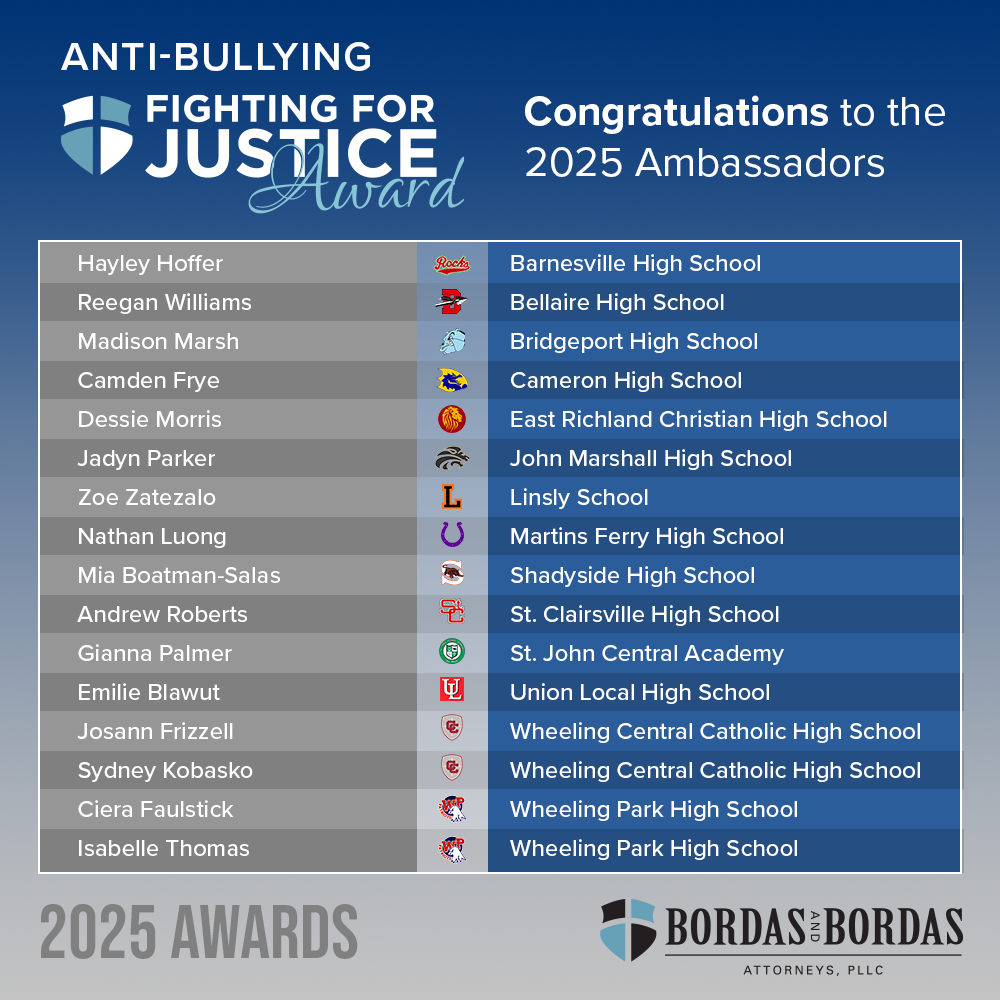
Bordas & Bordas is proud to announce the names of the 16 students from schools in Ohio, Marshall and Belmont counties who are recipients of the Bordas & Bordas Anti-Bullying Fighting for Justice Award. The 2025 award recipients: Hayley Hoffer, Barnesville High School Reegan Williams, Bellaire High School Madison Marsh, Bridgeport High School Camden Frye, Cameron High School Dessie Morris, East Richland Christian High School Jadyn Parker, John Marshall High School Zoe Zatezalo, The Linsly School Nathan Luong, Martins Ferry High School Mia Boatman-Salas, Shadyside High School Andrew Roberts, St. Clairsville High School Gianna Parker, St. John Central Academy Emilie Blawut, Union Local High School Josann Frizzell, Wheeling Central Catholic High School Sydney Kobasko, Wheeling Central Catholic High School Ciera Faulstick, Wheeling Park High School Isabelle Thomas, Wheeling Park High School “Congratulations to the senior students who have been named 2025 Bordas & Bordas Anti-Bullying Ambassadors,” said Managing Partner Jamie Bordas. “Nominations from educators and community members highlighted the significant contributions these young adults have made through their actions and attitudes in both their schools and communities.” The award was created in 2014 by Bordas & Bordas founder Jim Bordas and honors each Anti-Bullying Ambassador with a $500 cash prize. The criteria for students nominated includes treating everyone equally, respecting differences in others, and standing up for those who are targeted by others or are discriminated against. “We are proud to recognize these individuals who serve as positive examples for their peers. We wish the Anti-Bullying Ambassadors and the class of 2025 the best of luck in their future endeavors,” said Bordas. Bordas & Bordas is a plaintiff’s litigation law firm with offices in Pittsburgh, Wheeling, W.Va., St. Clairsville, Ohio, and Moundsville, W.Va. The firm’s attorneys practice throughout the region in diverse areas of law and are licensed in Pennsylvania, West Virginia, Ohio, and Texas.